


Updated Rules checked 2026-10-16
The “40%” or “55%” fee discount in a referral code headline is usually not a single rate from the exchange. Broken down, it’s mostly several amounts added or multiplied together: the exchange’s automatic fee rebate, which the exchange refunds straight to your account, capped by the exchange’s own limit (Binance and OKX both give invitees at most 20%); the rebate site’s extra rebate, which the rebate site pays out of the referral commission it receives and settles afterwards; and some headlines also count a platform-token discount such as BNB.
Take Binance spot: a 25% BNB discount plus a 20% rebate cuts the fee you actually pay by exactly 40%; the BNB discount plus a 40% rebate cuts it by exactly 55%. Both numbers come from multiplying, not from adding 25% and 20%. On futures the BNB discount is only 10%, so the same math gives just 28%.
I put the invitee rebate caps that 13 exchanges state officially, and how rebate sites pay their extra rebate, into tables. I also worked through 10,000 USDT of futures volume to show who pays each amount and when it arrives, and at the end I explain how to work out from your account records the percentage you actually get.
Key points: the high percentage in a referral code headline is often “the exchange’s automatic fee rebate” plus “the rebate site’s extra rebate”, sometimes with a platform-token discount multiplied in. On Binance spot, paying fees with BNB saves 25%; add a 20% rebate and you pay 0.75 × 0.8 = 60% of the original fee, which is 40% less. With a 40% rebate it’s 0.75 × 0.6 = 45%, which is 55% less. The rebate an exchange itself gives invitees is capped: Binance spot and futures at 20%, OKX 0% to 20%, Bitget, MEXC and Gate at 20%, and BingX no more than 45% for newly created referral codes. Bybit officially gives invitees no fee rebate. A rebate site’s extra rebate comes from the referral commission it receives, is settled to your account on the rebate site, has to be withdrawn separately, and its rate may change.
The information below was checked against official pages on 2026-10-16 (fact-check date) and is provided for reference.
How do 40% and 55% add up?
Common headlines read “permanent 40% fee discount”, “55% off trading fees” or “double the rebate”. These numbers can be made of three things, each with its own source, cap and payout method:
- The exchange’s automatic fee rebate: after you sign up with a referral code, the exchange refunds a percentage of the fees you pay, straight into your exchange account. The referrer sets the percentage within the exchange’s cap; Binance invitees, for example, get at most 20%.
- The rebate site’s extra rebate: the referrer (the rebate site) receives referral commission from the exchange and passes part of it on to you. This money isn’t paid by the exchange. It’s usually settled to your account on the rebate site first, and you then request a withdrawal.
- Platform-token discount: paying fees with BNB saves up to 25% on Binance spot and margin, and 10% on USDⓈ-M futures (Binance BNB fee discount, Binance futures fees). The exchange gives this discount to every user, with or without a referral code.
The examples below use Binance’s regular-user spot rate of 0.1% (Binance spot trading fees) and a 10,000 USDT trade, so the original fee is 10 USDT. The same “40%” can be put together in several ways:
| Headline percentage | Possible makeup | Math | Actual payment on a 10 USDT fee |
|---|---|---|---|
| 40% | 20% automatic fee rebate from the exchange + 20% extra from the rebate site | 20% + 20%, both based on the same fee | 10 − 2 − 2 = 6 USDT |
| 40% | 25% BNB discount, then a 20% rebate | 1 − (1 − 25%) × (1 − 20%) = 40% | 10 × 0.75 = 7.5, 7.5 × 0.8 = 6 USDT |
| 40% | A 20% rebate, “doubled” | 20% × 2 | 6 USDT |
| 55% | 25% BNB discount, then a 40% rebate (20% + 20%) | 1 − 0.75 × 0.6 = 55% | 7.5 × 0.6 = 4.5 USDT |
| Not 45% | 25% BNB discount and a 20% rebate simply added together | The discount makes the fee smaller, so the base for the rebate shrinks too | You pay 6 USDT, not 5.5 USDT |
Each layer of discount multiplies: share you actually pay = (1 − platform-token discount) × (1 − total rebate rate), and 1 minus that is “how much less you pay in total”. The rebate is calculated on the fee you actually pay. Once BNB cuts what you pay, the base for the rebate shrinks with it, which is why 25% and 20% stack to 40%, not 45%.
Apply the same math to futures and the result changes. The BNB discount on Binance USDⓈ-M futures is only 10%: with a 20% rebate that’s 1 − 0.9 × 0.8 = 28%, and with a 40% rebate it’s 1 − 0.9 × 0.6 = 46%. So a “40%” or “55%” built on the BNB discount only holds on spot, and anyone with heavy futures volume should redo the math. The basics of futures fees are in how futures fees are calculated.
Are a “fee discount” and a “rebate” the same thing?
For the fee you end up paying, the effect is the same, but the money moves differently. Most exchanges charge the full fee first and refund a percentage afterwards, which is why it’s called a rebate. Headlines that say “fee discount” or “fee reduction” are usually talking about this after-the-fact refund too. Binance, for example, converts the rebate into USDC every hour and pays it to your Spot Account within 6 hours (Binance Referral Pro FAQ). This site calls the exchange’s share the “automatic fee rebate (fee discount)” throughout, and uses the same term for Pionex.
Also note that the rebate is based on the “net fee”, not the list-price fee you see. Binance calculates it on the net fee after maker rebates; OKX states that fees covered by rebate cards, futures trial funds or deduction vouchers don’t count (OKX affiliate program rules); HTX’s net fee excludes spot rebate vouchers, futures trial funds, and the 0-rate and negative-rate portions. The rebate rate is multiplied by this smaller number. How fee vouchers relate to rebates is covered in fee vouchers vs referral code rebates.
With the same 10,000 USDT of futures volume, who pays each amount, and when does it arrive?
Take the breakdown Fee Otter publishes on its rebate page as an example: Fee Otter’s 40% for Binance is “20% automatic from the exchange + 20% extra from Fee Otter”, while its 40% for Bybit is entirely Fee Otter’s extra rebate, because Bybit has no automatic fee rebate from the exchange (Fee Otter’s explanation of rebate settlement). Fees use the regular-user taker rate: 0.05% on Binance USDⓈ-M futures (Binance futures fee structure) and 0.055% on Bybit perpetual contracts (Bybit trading fee structure).
| Item | Binance (20% + 20%) | Bybit (Fee Otter 40%) | Who pays, where, and when |
|---|---|---|---|
| Volume (taker) | 10,000 USDT | 10,000 USDT | — |
| Fee | 10,000 × 0.05% = 5 USDT | 10,000 × 0.055% = 5.5 USDT | Charged at full price by the exchange when the trade fills |
| Automatic fee rebate from the exchange | 5 × 20% = 1 USDT | 0 (Bybit has no fee rebate for invitees) | Paid by Binance, converted to USDC every hour, in your Spot Account within 6 hours |
| Rebate site’s extra rebate | 5 × 20% = 1 USDT | 5.5 × 40% = 2.2 USDT | Paid by Fee Otter, settled daily to your Fee Otter dashboard, and only reaches your account after you request a withdrawal |
| Fee actually paid | 3 USDT (equal to a 0.03% rate) | 3.3 USDT (equal to a 0.033% rate) | — |
The two 1 USDT amounts in the table are the same size but different in nature. The exchange’s 1 USDT lands in your Binance Spot Account within a few hours; the rebate site’s 1 USDT is first recorded in the rebate site’s dashboard and waits for you to request a withdrawal. So of the “40%”, only half is paid by the exchange.
If you use only this site’s Binance referral code and take only the exchange’s automatic fee rebate, the current rate is 20% (updated 2026-10-24), refunded directly by Binance. Here is the same calculation with the 0.05% futures taker rate; the rate syncs with the exchange daily:
| Monthly volume | Fees (0.05%) | Auto rebate (20%) | Net fees |
|---|---|---|---|
| 10,000 USDT | 5 USDT | 1 USDT | 4 USDT |
| 100,000 USDT | 50 USDT | 10 USDT | 40 USDT |
| 1,000,000 USDT | 500 USDT | 100 USDT | 400 USDT |
Example at a futures fee rate of 0.05% and the current 20% automatic rebate (rate updated 2026-10-24). Your exchange statement prevails.
Futures use leverage, and if the market moves against you, your position may be liquidated. For each exchange’s actual fees after rebates, see actual fees after rebates.
Is there a cap on the exchange’s automatic fee rebate?
Yes, and each exchange words it differently. Some state outright the maximum percentage a referrer can share with invitees; others only cap the referrer’s own commission, and the invitee’s share comes out of that. The table below lists the invitee rebate caps stated on the official pages of 13 exchanges. The rightmost column is the current automatic fee rebate on this site’s referral codes, synced with the exchanges daily.
| Exchange | Official invitee rebate cap | Who sets the rate | Official source | This site’s current rate |
|---|---|---|---|---|
| Binance | Spot (including margin) up to 20%; futures up to 20% from 2025-10-25, and it can’t be changed once set | Referrer, within the cap | Affiliate program basics, Referral Pro update announcement | 20% |
| OKX | 0% to 20% | Affiliate | OKX affiliate FAQ | 20% |
| Bybit | No invitee fee rebate stated officially; invitees get welcome rewards and task rewards | — | Bybit referral program FAQ | No exchange rebate |
| Bitget | Direct-client rebate up to 20% | Affiliate, shared from their own rebate rate | Bitget affiliate portal guide | 20% |
| MEXC | Up to 20%, set separately for spot and futures | Affiliate | MEXC commission-sharing announcement | 20% |
| Gate | Up to 20% (from 2023-06-12) | Affiliate | Gate rebate rate adjustment announcement | 20% |
| BingX | Newly created referral codes: rebate rate no more than 45% | Referrer, when creating the code | BingX rebate rate announcement | 45% |
| KuCoin | No more than the referrer’s current commission rate; standard referral commission up to 35%, affiliates up to 60% | Referrer | KuCoin referral program upgrade announcement, KuCoin affiliate program 2025 guide | 60% |
| HTX | No separate invitee cap stated officially; the friend reward share comes out of the inviter’s 30% (regular inviter) or up to 60% (global partner) | Inviter sets the friend reward share | HTX referral trading reward rules, HTX custom invite code announcement | 30% |
| XT | No separate invitee cap stated officially; regular-user referral commission up to 20%, affiliates up to 50% | Referrer | XT referral guide, XT affiliate program guide | Futures 60%, Spot 35% |
| WEEX | No cap published officially | Upline partner or direct inviter | WEEX partner FAQ | Futures 60%, Spot 35% |
| Pionex | No separate invitee cap stated officially; regular inviter commission is 20% on spot and 15% on futures, part of which can be shared with friends | Inviter | Pionex affiliate program v3 | 15% |
| Ourbit | No cap stated officially; spot currently has 0 fees, so there’s no rebate, and futures are Maker 0.02%, Taker 0.04% | Referrer | Ourbit fee announcement | 50% |
The table shows two things. First, at Binance, OKX, Bitget, MEXC and Gate, the exchange’s automatic fee rebate tops out at 20%. However high the headline goes, anything above 20% isn’t paid by the exchange. Second, at exchanges where the invitee’s share “comes out of the referrer’s commission”, such as KuCoin, HTX, XT and Pionex, how much an invitee can get depends on the referrer’s own commission tier at the exchange, so different referral codes at the same exchange may differ a lot. The difference between referral commission and invitee rebates is explained in referral commission vs rebate.
Time limits and VIP levels also cut the rate
- Binance futures: the referrer earns futures commission for only 12 months from when the invitee opens a futures account, unless the referrer passes the 30% commission assessment; once the referrer’s 12 months end, the invitee stops receiving the futures rebate as well. On spot, the calculation stops once the invitee reaches VIP 3 or above (Binance Referral Pro FAQ). When a headline says “permanent”, check first which kind of referral code it is.
- OKX: commission stops once a trader at VIP 5 or VIP 6 reaches the monthly commission cap of 100,000, and VIP 7 and above don’t qualify (OKX affiliate program rules).
- HTX: no trading rewards are paid once an invited user reaches Prime 9 or above, and since 2024-05-15 invited users can only rise as high as Prime 8 (HTX referral trading reward rules).
- Examples without a time limit: for BingX referral codes created after 2023-03-01, invitees get the rebate indefinitely (BingX rebate duration announcement); KuCoin invitees who signed up after 2022-09-22 have a lifetime commission period (KuCoin affiliate program announcement).
When the exchange stops calculating commission, the rebate site has no commission left to share, so the extra rebate usually stops too. If your volume is high enough to move you up VIP levels, read VIP levels and referral code rebates first.
Who pays a rebate site’s extra rebate, and when does it arrive?
The extra rebate is paid by the rebate site, not the exchange. The rebate site has you sign up with its own referral code, the exchange pays the referral commission to the rebate site, and the rebate site then settles part of it to you at the rate it publishes. So how much extra rebate you get, when it’s paid and how you withdraw it all depend on the rebate site’s own rules.
Take Fee Otter as an example; everything below comes from its own pages. The Fee Otter rebate page lists fee rebates of up to 75%, settled daily, with Binance at 40% (including a 20% automatic fee rebate as soon as you sign up) and Bybit at 40%, and explains that Bybit has no automatic fee rebate mechanism from the exchange. This extra rebate is paid by Fee Otter, not the exchange, and not Kevin Wu; the rate shown on Fee Otter’s page prevails.
Rules in the Fee Otter terms of service that affect when money arrives:
- The extra rebate is settled daily to the rebate data site, and you then request a withdrawal under the withdrawal rules. It’s sent preferably by internal exchange transfer to your own linked account, or by on-chain USDT transfer when that isn’t possible. The minimum amount, fees, monthly limit on withdrawals and processing time are whatever the member dashboard shows at the time.
- Settled rebates are based on the referral share the exchange actually pays Fee Otter; if an exchange delays, reduces, claws back or ends its referral program, Fee Otter may delay, adjust, suspend or claw back accordingly.
- Fee Otter may adjust rebate rates and calculation methods; changes apply from the time they’re announced and don’t apply retroactively to rebates already settled.
- The withdrawable balance shown in the dashboard is an amount the platform owes you (denominated in USDT); the terms state that it isn’t a virtual asset you’ve deposited with the platform.
Below is a screenshot of my own Fee Otter dashboard, showing Bybit rebates actually credited:
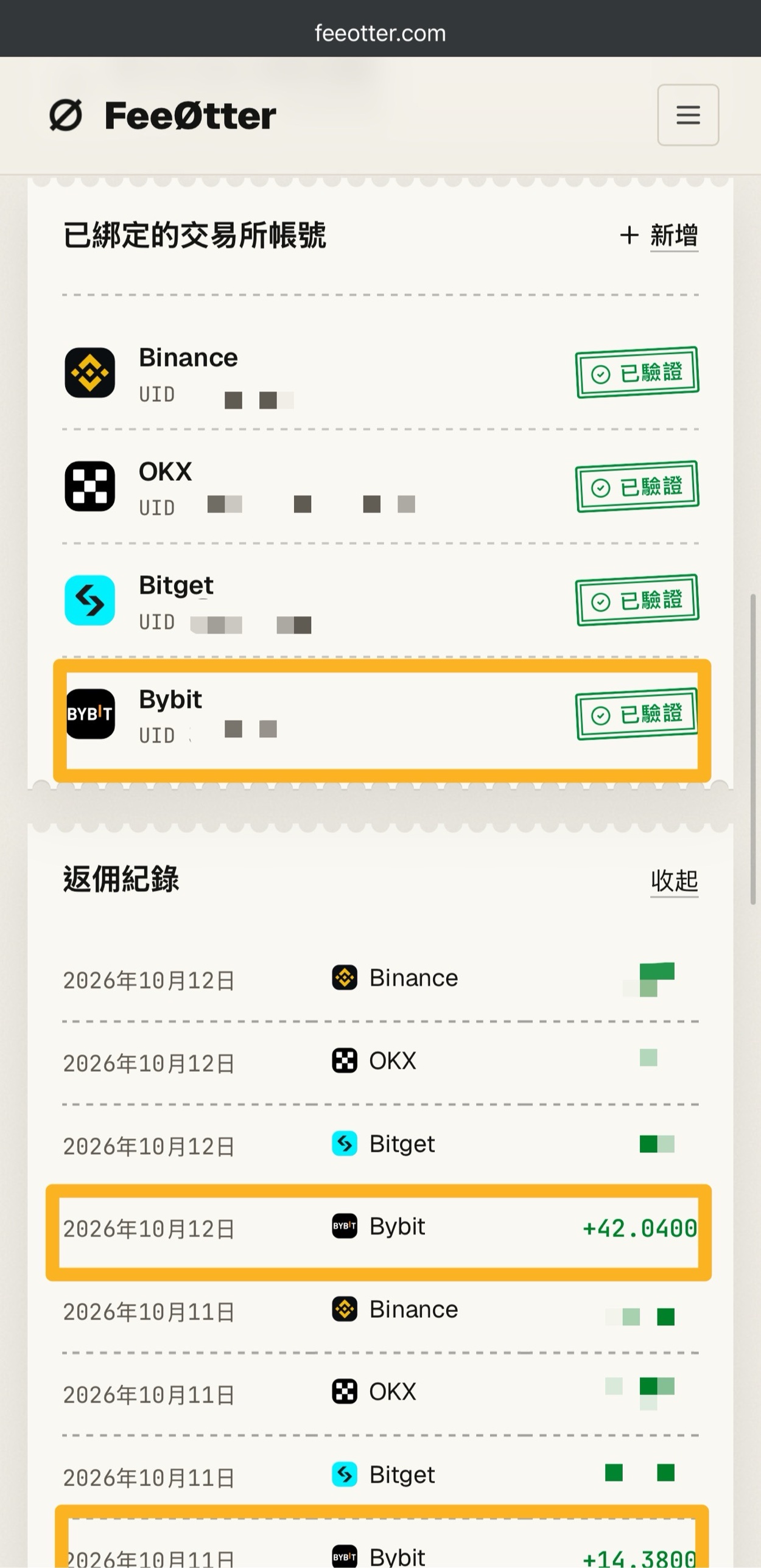
The full Bybit process (sign-up, linking your UID, withdrawal) is in Bybit fee rebate: Fee Otter.
How can you check what percentage you actually get?
The most reliable method is to divide the “rebate credited” by the “fee actually paid” over the same period. Say you paid 5 USDT in fees one day and the exchange refunded 1 USDT: the exchange’s automatic fee rebate is 20%. If the rebate site’s dashboard recorded 1 USDT for the same day, the extra rebate is 20%. Only by calculating the two separately can you tell how much of the headline number the exchange pays.
- First confirm who you’re linked to: if the referral relationship isn’t in place, there’s nothing to calculate. How to check on each exchange is in how to check whether your referral code is linked.
- Find the exchange’s rebate records: on Binance, the USDC credits in your Spot Account; on OKX, “My rewards” in the app’s user center; on XT, Spot account → Funding records → “Distribution” (XT referral guide); on Pionex, the “Invitee Cashback” records in the app; on Ourbit, the “self-rebate records” on the referral page.
- Add up the fees from your trade history: use the fees you actually paid, minus anything covered by vouchers or trial funds; for fees paid in a platform token, convert using the token amount.
- Match the timing: Binance credits within 6 hours, MEXC pays the invitee’s share before 01:00 (UTC) (MEXC commission-sharing announcement), and XT credits the day after the trade (T+1). Some of today’s trades won’t show up until tomorrow.
- Check the rebate site separately: look at the same day’s details in the rebate site’s dashboard and divide the amount by that day’s fees.
If your result is lower than the headline, rule out the common causes first: you traded a pair with 0 fees, vouchers covered the fee, your level has passed the exchange’s VIP threshold, or the headline already counted a platform-token discount. If it still doesn’t add up after that, go through what to do if you haven’t received your rebate item by item.
Is a higher percentage always better? Where are the risks?
Looking only at the fee you pay, a higher percentage obviously saves more. But the part the exchange refunds and the part the rebate site pays carry different risks, and I look at them separately:
- Where the money comes from: the extra rebate comes from the referral commission the rebate site receives. The commission caps exchanges publish are a useful reference: Binance affiliates up to 50%, Bitget up to 50%, XT affiliates up to 50%, KuCoin affiliates up to 60%, HTX global partners up to 60%. Individual partnership terms may be higher, and exchanges don’t publish them. The closer a headline percentage gets to these numbers, the more it’s worth asking where the money comes from.
- Where the money sits: the exchange’s automatic fee rebate goes straight into your exchange account; until you withdraw it, the extra rebate is a balance on the rebate site’s books, and whether you can withdraw it and how long that takes depend on the rebate site’s rules.
- Rates change: exchanges have changed their own caps, for example Gate lowered its direct-client rebate cap to 20% in 2023, and in 2022 BingX limited newly created referral codes to no more than 45%. A rebate site’s rates may change as well.
- Clawbacks: for self-referral, multiple accounts or wash trading, exchanges cancel or claw back rebates, and rebate sites claw them back too. Each exchange’s rules are in when rebates get cancelled.
If anyone asks you to pay upfront, transfer money to a personal account, or guarantees profits, stop first; the common warning signs are collected in rebate scam warning signs. For what to look at when comparing rebate sites, see rebate site comparison.
FAQ
Is a 40% fee discount on a Binance referral code real?
The exchange itself can’t give 40%: Binance’s invitee rebate on spot and futures is capped at 20% for both. A headline saying 40% usually means a 20% rebate plus a 20% extra from a rebate site, or a 25% BNB discount multiplied with a 20% rebate (0.75 × 0.8 = 0.6, so you pay 40% less). To tell which it is, look at how much of that 40% Binance refunds directly to your Spot Account.
How is a 55% fee discount calculated?
The most common math is a 25% BNB discount with a 40% rebate: 0.75 × 0.6 = 0.45, so you pay 45% of the original, which is 55% less. This only holds on Binance spot. The BNB discount on futures is only 10%, so the same 40% rebate saves just 46%.
Can you get the exchange’s automatic fee rebate and a rebate site’s extra rebate at the same time?
Yes, provided you sign up with the rebate site’s referral code and that code itself is set to give an automatic fee rebate from the exchange. The exchange’s share is refunded straight to your exchange account and the rebate site’s share is settled to the rebate site’s dashboard, so they arrive separately. Bybit has no automatic fee rebate from the exchange, only the rebate site’s extra rebate.
Is the rebate based on trade volume or on fees?
On fees, not trade volume. For a 10,000 USDT trade with a 5 USDT fee, a 20% rebate is 1 USDT, not 2,000 USDT. And most exchanges use the net fee, so anything covered by vouchers or trial funds doesn’t count.
Does “permanent rebate” always mean permanent?
Not necessarily; it depends on the exchange’s rules and the type of referral code. With a regular Binance referral code, the futures rebate lasts only 12 months unless the referrer’s commission reaches 30% or more, and spot stops at VIP 3 or above. For BingX referral codes created after 2023-03-01 and KuCoin invitees who signed up after 2022-09-22, the official wording is no time limit or lifetime.
What is OKX’s maximum rebate?
OKX officially states an invitee rebate range of 0% to 20%. You can see your rate in the app menu → user center → “My rewards”; if that section doesn’t appear, no rebate rate has been set for you.
Do you get a fee rebate when you sign up for Bybit with a referral code?
Not from the exchange itself. Bybit’s referral program gives invitees welcome rewards and task rewards, and doesn’t officially state that invitees get a share of fee commission. To get fees back, you need to go through a rebate site. For example, Fee Otter’s rebate page lists Bybit at 40%, paid by Fee Otter; the rate shown on Fee Otter’s page prevails.
Why is the rebate rate I calculated lower than the headline?
The most common reason is that the headline counted a platform-token discount or a rebate site’s extra rebate, while you only looked at the exchange’s share. The next most common is that the rebate base is smaller than you thought: pairs with 0 fees, fees covered by vouchers and trades above the VIP threshold don’t earn a rebate.
For what a referral code is and how it works, start with what is a referral code; for how KOL referral codes differ from regular ones, see KOL vs regular referral codes. Each exchange’s referral code and automatic fee rebate are listed in the exchange referral code overview, monthly rate changes are in the monthly rebate rate report, and how the data is synced is in rebate data methodology; for terms like net fee and self-rebate, see the rebate glossary.