

Updated Rules checked 2026-10-21
There are roughly three ways to get exchange airdrops. The first is to hold the platform token and let the exchange hand out new tokens based on past snapshots, as with Binance HODLer Airdrops and the HODLer airdrops on Gate and KuCoin. The second is to subscribe specified coins into an Earn product or staking pool and share the new token pro rata, as with OKX Flash Earn. The third is to complete tasks such as deposits or trading volume, as with Bybit Token Splash, Bitget CandyBomb, Gate CandyDrop, MEXC Airdrop+ and the Alpha Points that Binance Alpha airdrops require.
All three require identity verification first, and most also exclude some countries and regions, sub-accounts or institutional accounts. The real difference is cost: holding-based airdrops charge no trading fees, while task airdrops make you actually place orders, and the fees, slippage and price moves are all on you. Also, Binance HODLer Airdrops are calculated retroactively. By the time the announcement is out, the snapshot has long ended, so subscribing BNB after you see the announcement won’t get you that round.
This article sets out the airdrop rules that 7 exchanges currently publish in their official announcements, with examples from the latest rounds. I also worked out how many days pass between a Binance snapshot and its announcement, and how much trading volume Alpha Points take. For staking-based mining (Launchpool) only, see the Launchpool token mining guide.
Key points: Binance HODLer Airdrops count BNB in Simple Earn Flexible, Locked and On-Chain Yields, taking several snapshots an hour and averaging them. The announcements for three rounds in May and June 2026 all came 5 to 15 days after the snapshot ended. Binance’s recent announcements say rewards reach the spot account within 5 hours of the announcement, and a single user is counted at no more than 4% of total holdings. Binance Alpha Points add 1 volume point each time your buy amount doubles, so 15 points takes 32,768 USD of buying, and points last only 15 days. Gate’s HODLer Airdrop requires you to tap “Join Now” and hold at least 1 GT; KuCoin’s HODLer Airdrops require at least 20 KCS plus trading activity within the last 90 days.
The information below was checked against official pages on 2026-10-21 (the rules check date) and is provided for reference.
What types of exchange airdrops are there, and how do they differ from Launchpool and Launchpad?
Sorted by what you have to put in:
- Holding snapshot airdrops: hold the platform token (BNB, GT, KCS) during the snapshot period and get new tokens in proportion to your share of the total. No trading needed.
- Earn/staking airdrops: subscribe specified coins into the campaign pool and rewards accrue by the hour. The principal can usually be redeemed at any time, as with OKX Flash Earn and the various Launchpools.
- Task/trading airdrops: complete deposit, buy or trading-volume tasks and share the prize pool by candies, points or volume. You have to actually place orders, which costs fees.
- Paid subscriptions (Launchpad type): you pay to buy the new token. This isn’t an airdrop, and if the price falls below the subscription price, the loss comes out of your principal.
Sign-up gifts and trial funds for new users are a different kind of campaign, covered in exchange new-user bonuses compared.
How do the exchanges’ airdrop programs compare?
The table lists only rules the exchanges state officially. Prize pools, thresholds and regions change from round to round, so the announcement for each round is what counts.
| Exchange | Program | Type | What you need | Sign-up required? | Account and region limits | Reward distribution | Official source |
|---|---|---|---|---|---|---|---|
| Binance | HODLer Airdrops | Holding snapshot (retroactive) | BNB in Simple Earn Flexible/Locked or On-Chain Yields; at least 0.01 BNB at each snapshot | No, counted automatically | Identity verification required; excludes the US, UK, Hong Kong, Japan, Canada, Australia and others, and Binance states the list is not exhaustive; BNB used as loan collateral does not count | Recent announcements: to the spot account within 5 hours of the announcement | OPG announcement, program announcement |
| Binance | Alpha airdrops | Points threshold (task) | Alpha Points = balance points + buy-volume points over the past 15 days | Yes, confirm the claim on the Alpha Events page; points are deducted | Only the main account earns points; sub-account balances are merged into the main account | To your Binance Wallet address within 1–2 days of taking part (official FAQ) | Alpha Points FAQ |
| OKX | Flash Earn (Lite) | Earn-to-airdrop | Specified coins, such as BTC, OKB or the project token, subscribed into Simple Earn | Yes, subscribe | Identity verification required; main accounts only, sub-accounts and institutions cannot join; some regions cannot join | Accrues hourly, usually paid in the next hour and claimable at any time; credited to the funding account within 4 hours after the end | 2Z campaign announcement |
| Bybit | Token Splash | Task (deposit, trading) | Depends on the campaign: a deposit, a deposit plus a buy, or a trading-volume target | Yes, tap Register Now | Standard identity verification; institutions and market makers cannot join; users in the European Economic Area are prohibited; main accounts only | Per each round’s announcement; the STABLE round, for example, says “distributed in batches before the campaign ends” | Token Splash FAQ |
| Bitget | CandyBomb | Task (trading volume for candies) | Spot or futures trading volume in the specified pairs | Yes, tap Join; volume only counts after you join | Identity verification required; sub-accounts, institutions, PRO accounts and market makers cannot join | Automatically within 1–3 business days after the campaign ends | CandyBomb x CP announcement |
| Gate | HODLer Airdrop | Holding snapshot (after sign-up) | At least 1 GT; several random snapshots an hour, averaged | Yes, tap Join Now | Identity verification required; institutions and sub-accounts cannot join; VIP 0–4 have a cap on counted GT | Calculated and distributed within 1 hour after the project ends | HODLer Airdrop FAQ |
| Gate | CandyDrop | Task (trading volume for candies) | Spot or futures trading volume in the specified coin | Yes, tap Join now | Identity verification required; sub-accounts, market makers, enterprises and institutions cannot join | Taking the 2025 MILK round as an example: within 14 business days after the end | CandyDrop x MilkyWay announcement |
| MEXC | Airdrop+ | Task (net deposit, trading) | Net deposit = total deposits − total withdrawals; spot and futures trading volume | Yes, tap Register Now | New-user rewards require advanced identity verification and can be claimed only once per person; restricted accounts cannot join | Within 10 calendar days after the campaign ends | Airdrop+ FAQ |
| KuCoin | HODLer Airdrops | Holding snapshot (retroactive) | 20–10,000 KCS (taking the ALIGN round as an example), plus trading within the last 90 days | The announcement does not mention signing up | Identity verification required; excludes the US, mainland China, Hong Kong, Singapore, Canada, Malaysia, France, the Netherlands and others | At the time stated in the announcement, 100% to the funding account | ALIGN announcement |
| KuCoin | GemSlot | Task (trading) | Spot trading volume in the specified coin | Per the campaign page | Full identity verification required; sub-accounts, market makers and institutions cannot join; multiple accounts under the same identity count as one person | The WBAI round’s announcement does not state a distribution time | WBAI GemSlot announcement |
Sources and check date: the official announcements and FAQs linked in each row, checked on 2026-10-21. For BingX, HTX, XT, WEEX, Pionex and Ourbit, I found no airdrop program with a fixed name and published rules this time, so they are not listed.
The column people overlook most is “Sign-up required?”. Binance HODLer Airdrops need no sign-up, but Gate’s HODLer Airdrop, Bitget CandyBomb and Bybit Token Splash all need you to tap the join button first, and Bitget states that trading volume only starts counting after you join. Meet every condition but skip the sign-up, and you get nothing.
How do you get Binance HODLer Airdrops? Snapshot rules and the last three rounds
Binance HODLer Airdrops work like this: subscribe BNB to Simple Earn (Flexible or Locked) or On-Chain Yields, and from then on you are included automatically, with no separate sign-up. The 2026 announcements set out these rules (OPG HODLer Airdrops announcement):
- How snapshots work: several snapshots are taken at random times each hour and averaged per hour. After the announcement, Binance picks a random past period to calculate from. Binance’s own example is an airdrop on 2024-06-11 that may use snapshots from 2024-06-01 to 06-07.
- Minimum holding: at each snapshot, any eligible asset must be above 0.01 BNB to be counted. slisBNB and slisBNBx in Binance Wallet (Keyless) also count.
- Cap: your average BNB is counted as at most 4% of the total average; anything above that still counts as 4%. The 2024 program announcement used a cap on the amount of BNB (HODLer Airdrops program announcement); each round’s announcement now applies.
- What doesn’t count: BNB used as collateral for Binance Loans (Flexible Rate) is not counted.
- Regions: you must complete identity verification and live in an eligible region. The OPG round lists Australia, Canada, Cuba, Crimea, Cyprus, Hong Kong, Iran, Japan, New Zealand, the Netherlands, North Korea, Russia, the UK, the US and its territories, and the non-government-controlled areas of Ukraine as excluded, and Binance states that the list is not exhaustive and may change.
- Distribution: the 2026 announcements say rewards reach the spot account within 5 hours of the announcement; the 2024 program announcement said within 24 hours, and before spot listing.
How many days before the announcement did the last three snapshots end?
Snapshot periods and announcement times for the three most recent rounds of 2026:
| Project | Announcement date (UTC) | Snapshot period (UTC) | Snapshot end to announcement | Total airdrop | Share of total supply |
|---|---|---|---|---|---|
| Gensyn (AIGENSYN) | 2026-05-21 11:00 | 05-04 00:00 to 05-06 23:59 | About 14.5 days | 100,000,000 AIGENSYN | 1% (total supply 10 billion) |
| Genius Terminal (GENIUS) | 2026-05-29 08:00 | 05-11 00:00 to 05-13 23:59 | About 15 days | 10,000,000 GENIUS | 1% (total supply 1 billion) |
| OpenGradient (OPG) | 2026-06-30 05:00 | 06-22 00:00 to 06-24 23:59 | About 5 days | 6,400,000 OPG | 0.64% (total supply 1 billion) |
Sources and check date: Binance’s official announcements for the three rounds, checked on 2026-10-21. “Snapshot end to announcement” is my own calculation: the announcement time minus the snapshot end time.
All three snapshots lasted 3 days, and each announcement came out 5 to 15 days after the snapshot ended. In other words, moving BNB into Simple Earn after you see the announcement does nothing for that round; the people who get a share are the ones who happened to keep it there for those 3 snapshot days. Binance also doesn’t announce the next snapshot dates in advance.
Be realistic about frequency, too. I went back through the “New Cryptocurrency Listing” category of Binance’s announcements: in 2026, up to October 21, there were 7 HODLer Airdrops in total. The latest was OPG on June 30 (the 66th project), and there were no new HODLer Airdrops announcements between July and October 21 (Binance new listing announcements). In September 2025 alone, that category had 12 rounds, so the pace has clearly slowed.
How much would 10 BNB get you?
Your share in each round is: your average BNB ÷ total average BNB × total airdrop (with the ratio capped at 4%). Binance doesn’t publish the total average holdings, though, so you can’t work out an exact figure in advance. The round numbers below only illustrate the proportions and don’t represent actual total holdings:
- Assume the total average is 20 million BNB and you hold 10 BNB: 10 ÷ 20,000,000 × 6,400,000 = 3.2 OPG.
- Assume the total average is 10 million BNB: the same 10 BNB gets 6.4 OPG.
The larger the total holdings, the less each BNB receives. The reward is a newly listed token whose value depends on its market price after listing, and BNB’s own price moves are also yours to bear. For Earn rates, see USDT savings rates compared and exchange staking rates compared.
How do Binance Alpha airdrops and Alpha Points work?
Alpha airdrops and HODLer Airdrops are two different things. Alpha airdrops look at your “Alpha Points”: anyone who reaches the threshold has to go to the Alpha Events page and confirm the claim themselves, and confirming deducts points. The points rules are in the Binance Alpha Points FAQ:
- Daily points = balance points + volume points, with a snapshot every day at 23:59:59 UTC. Your total is the sum of your daily points over the past 15 days, and each point expires automatically 15 days after its snapshot date.
- Balance points: coins listed on spot in your Binance account and coins in your Alpha account, plus eligible assets in Binance Wallet. 100–1,000 USD earns 1 point a day, 1,000–10,000 USD 2 points, 10,000–100,000 USD 3 points, and over 100,000 USD 4 points.
- Volume points: the amount of Alpha tokens you buy on the Binance exchange or in Binance Wallet (Keyless). 2 USD earns 1 point, 4 USD earns 2 points, and each doubling adds 1 point. Selling doesn’t deduct points, but only purchases paid with coins already listed on Binance spot count.
- Balance threshold: since 2025-10-22, if your balance points for the day are 0, neither volume points nor task points count. Your balance has to reach at least 100 USD equivalent.
- Two-phase distribution: since 2025-06-19, phase 1 is open only to users whose points reach threshold X; in phase 2 the threshold drops to Y, first come, first served, until the rewards run out. Eligibility is based on your points at the moment the campaign starts.
- Accounts: only the main account earns points. Sub-account balances are merged into the main account, so you can’t split accounts to farm points.
Take GAIB in 2025-11: the announcement said eligible users had to claim the airdrop with Alpha Points on the Alpha Events page between 2025-11-19 10:00 and 11-20 10:00 (UTC) (GAIB listing announcement). The points threshold for each round is announced separately; the “100 points, 60 points” in the FAQ are only an illustration.
How much do you have to buy for Alpha Points? Costing out the doubling rule
Volume points grow logarithmically: each extra point doubles the amount you have to buy. The table below applies the official “each doubling adds 1 point” rule to show how much you need to buy per day and the cumulative purchases over 15 straight days. The last column shows the cost “per 0.1% round-trip cost”, meaning what 15 days costs when fees, slippage and gas together come to 0.1% of the amount bought. Multiply it by your own cost to get the real figure:
| Daily volume points | Daily purchase (USD) | Cumulative purchases over 15 days (USD) | Per 0.1% round-trip cost, about, over 15 days (USD) |
|---|---|---|---|
| 10 points | 1,024 | 15,360 | 15.36 |
| 12 points | 4,096 | 61,440 | 61.44 |
| 14 points | 16,384 | 245,760 | 245.76 |
| 15 points | 32,768 | 491,520 | 491.52 |
| 16 points | 65,536 | 983,040 | 983.04 |
Sources and check date: points rules per the Binance Alpha Points FAQ (official page last updated 2026-07-09), checked on 2026-10-21; the amounts are my own calculations from those rules.
Going from 15 to 16 points means buying an extra 32,768 USD a day for just 1 more point, so the marginal cost of farming volume keeps climbing. Balance points top out at 4 a day, points expire after 15 days, and claiming an airdrop deducts points, so work out whether it’s worth it with your own real costs. The official FAQ mentions that volume in some tokens is counted at 2x or 4x, but explains this only with screenshots; the campaign page for each round is what counts.
As for the cost of trading Alpha tokens, the official Alpha Points FAQ does not state a fee rate, so check the estimated fee shown on the order screen before you trade. On referral rebates, Binance’s referral explanation states that commission comes from the trading fees the referee pays on spot, margin and futures, that zero-fee trades generate no commission, and it says nothing about Alpha trades (Binance Referral Pro FAQ). Whether Alpha trades count toward rebates is not stated officially.
Binance also states that Alpha assets cannot be withdrawn from the Binance exchange and can only be used in the Alpha account. There are also Alpha trading competitions, such as the DNA competition on 2026-10-20, which ranked users by buy volume and split 510,000 DNA among the top 2,000 (DNA trading competition announcement). These are separate from the points airdrops.
How do you join the holding or Earn airdrops on OKX, Gate and KuCoin?
OKX Flash Earn: subscribe to Earn and share the airdrop by the hour
The airdrop campaign seen most often on OKX’s global site lately is Flash Earn Lite: subscribe BTC, OKB or the project token into Simple Earn, and during the campaign you accrue an hourly airdrop on top of the Earn interest. The common rules are that you must complete identity verification, only main accounts qualify, and sub-accounts and institutions cannot join. You can redeem at any time, but if you redeem during a given hour, you get no interest or airdrop for that hour (OKX 2Z campaign announcement).
| Campaign | Announced | Campaign period (UTC) | Total airdrop | Eligible coins (reward per pool) |
|---|---|---|---|---|
| Flash Earn Lite (CP) | 2026-09-15 | 09-21 07:00 to 09-26 07:00 | 30,000,000 CP | BTC 18,000,000, ETH 5,700,000, SOL 1,800,000, OKB 3,000,000, CP 1,500,000 |
| Flash Earn Lite (2Z) | 2026-09-25 | 10-02 07:00 to 10-08 07:00 | 5,500,000 2Z | BTC 3,850,000, SOL 550,000, OKB 825,000, 2Z 275,000 |
| Flash Earn Lite (XDP) | 2026-10-08 | 10-09 07:00 to 10-14 07:00 | 15,000,000 XDP | BTC 9,000,000, XRP 3,750,000, OKB 1,500,000, XDP 750,000 |
Sources and check date: OKX’s official announcements for the three rounds, checked on 2026-10-21.
All three rounds gave more than half of the prize pool to the BTC pool, and the subscription minimums are low; the 2Z round, for example, required at least 0.001 BTC or 1 OKB. The XDP round also set 4 tiers of subscription caps based on your assets or trading volume over the past 30 days. The announcements don’t list the excluded regions; they point to section 3 of OKX’s risk and compliance disclosure.
OKX also has X Drops “Hold to Earn”, but the general terms I found limit it to users residing in the US (confirmed through advanced identity verification), with at least 10,000 USD in crypto at each daily snapshot, and stablecoins such as USDT and USDC don’t count (X Drops general terms). If you come across a tutorial about X Drops, first check whether your region can take part.
Gate HODLer Airdrop: hold GT and tap Join Now first
Gate’s rules: complete identity verification, hold at least 1 GT, and tap “Join Now” to sign up; only then does the system start tracking your GT, taking several random snapshots an hour and averaging them. Your share = your hourly average holding ÷ everyone’s hourly average holding × total airdrop. It is calculated and distributed within 1 hour after the project ends, and recorded under “Earn” → “HODLer Airdrop” → “History”. Institutions and sub-accounts cannot join (Gate HODLer Airdrop FAQ).
- IDOS (round 336): announced 2026-03-02 10:49 (UTC), ended 03-03 13:00, 500,000 IDOS, with VIP 0–4 counted at no more than 5,000 GT per person (IDOS announcement).
- KYO (round 325): announced 2025-12-06, ended 12-10 07:00, 60,000 KYO, with VIP 0–4 counted at no more than 2,000 GT per person (KYO announcement).
The biggest difference between Gate and Binance is that they run in opposite directions: Binance looks back at past snapshots, while Gate only starts counting after the announcement. The IDOS round ran only about 26 hours from announcement to end, so signing up on the day you saw the announcement was still in time. Gate’s Q2 2026 quarterly report says HODLer Airdrop ran 3 rounds that quarter (Gate Q2 2026 report).
KuCoin HODLer Airdrops: hold KCS and have recent trading activity
KuCoin’s ALIGN airdrop, announced on 2026-08-20, totaled 3,000,000 ALIGN. The snapshot period was 2026-07-22 16:00 to 07-29 15:59 (UTC), calculated on average hourly holdings, with a minimum of 20 KCS and anything above 10,000 KCS not counted. KCS in the funding, trading, margin, futures, trading bot and Earn accounts all counted. You also needed spot, margin, futures or bot trading within the past 90 days, and rewards were credited 100% to the funding account at 2026-08-20 15:00 (UTC) (KuCoin ALIGN announcement).
Like Binance, this round was calculated retroactively: the snapshot ended on July 29 and the announcement came on August 20, 22 days later. The announcement also listed boosts: 5%–20% for KCS membership levels, 10%–50% for VIP, up to 50% for new users, and another 5%–20% for 600–360,000 USDT of futures volume during the snapshot period.
How much do trading-task airdrops cost in fees?
Task airdrops make you actually deposit and trade, so the cost is certain, while the reward depends on how many people share it. Here are the rules from each exchange’s latest rounds:
- Bybit Token Splash: in the STABLE round of 2026-10-20, running from 10-20 10:00 to 10-27 11:00 (UTC), you trade at least 500 USDT of STABLE on spot to share a 565,000 STABLE prize pool. The more you trade, the bigger your share, up to 15,000 STABLE per person (STABLE Token Splash announcement). The USDT round of 2026-08-21 required at least 500 USDT of trading to share 100,000 USDT, capped at 1,000 USDT per person; for cumulative volume, API orders didn’t count, while trades from sub-accounts and trading bots did (USDT Token Splash announcement).
- Bitget CandyBomb: the CP round of 2026-09-02 shared 2,500,000 CP, with 1,944,000 CP going to the CP/USDT spot pool for all users and 556,000 CP to the futures new-user pool; earlier trades were weighted more heavily (CandyBomb x CP announcement). Carnival round 5 on 2026-09-14 shared 70,000 USDT across the BTC, XRP, BGB and ZEC USDT spot pairs and all futures (CandyBomb Carnival round 5 announcement). Both rounds state that zero-fee spot trades don’t count.
- Gate CandyDrop: in the MILK round of 2025-04-30, futures volume (buys plus sells) of 1,000 to 5,000 USDT earned 1 candy, 5,000 to 10,000 USDT earned 2, and 10,000 USDT or more earned 3. Your share = your candies ÷ all candies × prize pool, with the futures pool capped at 700 MILK per person (CandyDrop x MilkyWay announcement). Gate’s Q2 2026 quarterly report says CandyDrop ran 20 rounds that quarter and brought in nearly USD 38 billion of futures volume (Gate Q2 2026 report).
- MEXC Airdrop+: the CHOMP round announced on 2026-10-13 ran from 10-14 08:00 to 10-21 08:00 (UTC) with a 60,000 USDT prize pool (CHOMP listing announcement). The official FAQ states that net deposit = total deposits − total withdrawals, that futures volume only counts trades with a non-zero fee, and that rewards are distributed within 10 calendar days after the campaign ends (MEXC Airdrop+ FAQ).
- KuCoin GemSlot: the WBAI round from 2026-09-15 to 09-22 shared 16,000 USDT, of which the trading pool was 12,000 USDT. You first had to reach 600 USD of WBAI/USDT spot volume, then shared in proportion to your adjusted volume against the total, capped at 500 USDT per person (WBAI GemSlot announcement).
Worked example: how much in fees to hit the threshold?
Bybit’s spot fee for regular users (VIP 0) is 0.1% for both maker and taker (Bybit trading fee structure). To meet the minimum threshold of the STABLE round, buying 500 USDT of STABLE costs 500 × 0.1% = 0.5 USDT; selling it later costs about another 0.5 USDT, so about 1 USDT round trip, plus the bid-ask spread and price moves.
Gate’s USDT perpetual futures fee at VIP 0 is 0.02% maker and 0.05% taker (checked on 2026-10-17; see the Gate futures trading guide). To get 3 candies in the MILK round’s futures pool, you need 10,000 USDT of volume (buys plus sells). Doing it all with taker orders costs 10,000 × 0.05% = 5 USDT; if every fill is a maker order, it’s 10,000 × 0.02% = 2 USDT. For the difference between maker and taker orders, see maker vs taker fees. Futures use leverage: if the market moves against you, your position may be forcibly liquidated and you lose your margin. Don’t open futures positions just to reach a campaign threshold.
These are all ordinary spot or futures trades that pay fees, so referral rebates are calculated as usual. What Bitget and MEXC exclude is “zero-fee” trades. A referral rebate returns part of the fee after the trade is filled, and the trade itself is still charged a fee; whether the rebate affects the campaign calculation is not stated officially.
Sign up with this site’s Gate referral code and the exchange’s automatic fee rebate is currently 20% (updated 2026-10-23), refunded by Gate directly to your account. Using the 0.05% taker futures rate, here is the rebate at different trading volumes. The rate syncs with the exchange every day:
| Monthly volume | Fees (0.05%) | Auto rebate (20%) | Net fees |
|---|---|---|---|
| 10,000 USDT | 5 USDT | 1 USDT | 4 USDT |
| 100,000 USDT | 50 USDT | 10 USDT | 40 USDT |
| 1,000,000 USDT | 500 USDT | 100 USDT | 400 USDT |
Example at a futures fee rate of 0.05% and the current 20% automatic rebate (rate updated 2026-10-23). Your exchange statement prevails.
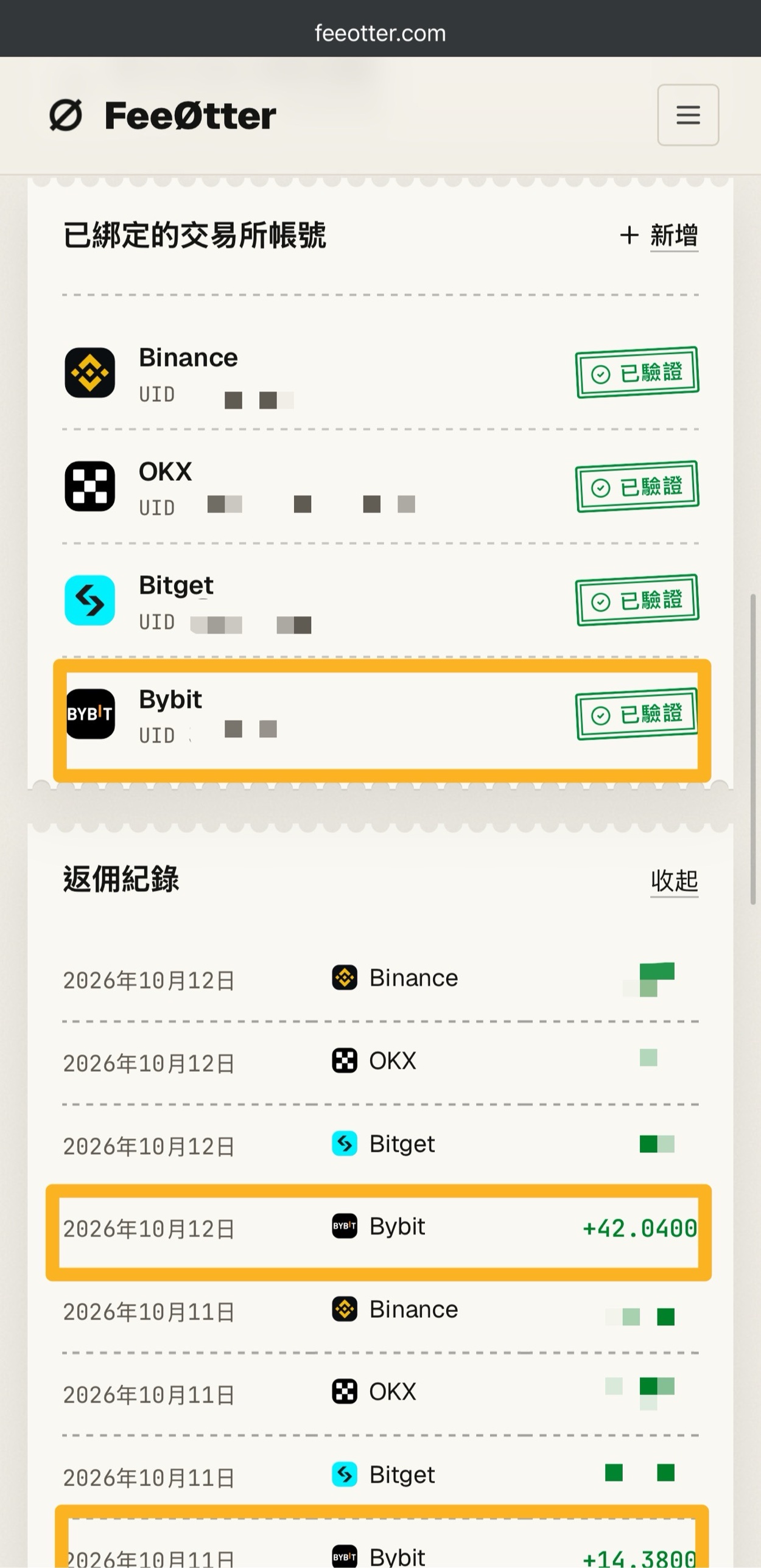
Bybit has no automatic fee rebate from the exchange for invitees, so when you trade for Token Splash on Bybit, the exchange won’t refund any fees. To get part of your fees back, you have to go through a rebate site such as Fee Otter. The extra rebate is paid by Fee Otter, not by the exchange and not by Kevin Wu, and the rate is whatever Fee Otter’s page shows. For details, see Bybit fee rebate (Fee Otter).
Planning to do task airdrops? Bind your referral code before you deposit
Almost every task airdrop needs a deposit first, and BingX doesn’t let you add a referral code after you deposit, while OKX only accepts one at sign-up. So the order is: sign up with a referral code, confirm the binding, then deposit and join the campaign. Whether each exchange lets you add a code later is covered in can you add a referral code after signing up, and how to check is in how to check whether your referral code is bound.
What are the risks of exchange airdrops?
- Airdropped tokens have no guaranteed value: rewards are mostly newly listed tokens that may fall sharply after listing. Binance states that Alpha assets are highly volatile and you may lose all or part of the amount you put in (Binance Alpha Points FAQ).
- The platform token you hold still moves in price: if you hold BNB, GT or KCS for HODLer airdrops, you bear the price changes yourself, and the airdrops usually don’t make up for a fall in the platform token.
- Task costs are certain, rewards are not: you will definitely pay fees, slippage and gas, but the prize pool is shared among all participants, and Bybit Token Splash, Gate CandyDrop and KuCoin GemSlot also set per-person caps.
- You may be disqualified: for multiple accounts, bulk registrations, wash trading or false identity information, most exchanges state that they can disqualify you and claw back rewards.
- Regional exclusions: both Binance and KuCoin list excluded regions in their announcements, and the lists change; the OKX X Drops terms I found are limited to US residents. For each exchange’s overall service restrictions, see exchange restricted countries.
Is that “claim your airdrop” link real? How to spot fake airdrops
Exchange airdrops are joined on the official website and app, and rewards go straight to your exchange account. You never need to click a link in a private message, connect a wallet and sign, enter your seed phrase, or first send a “fee”. The following are almost certainly scams:
- A private message or social post gives you a “claim your airdrop” URL whose domain is one or two characters off the official site.
- You are asked to connect a wallet and “sign an approval” to claim. Once a wallet drainer gets that approval, it can move the coins out of your wallet.
- You are asked to first send some USDT as an “unlock fee” or “tax” before the airdrop is released.
- Someone claiming to be customer support contacts you and asks for verification codes, passwords or your seed phrase.
Binance has an official verification tool for checking whether a URL, email, phone number or Telegram account is official, and it states that Binance will never ask you for funds or tokens through private messages (Binance Verify). Binance’s HODLer Airdrops announcements also open with a reminder to do your own checks before trading these tokens outside Binance, to avoid scams. For common tactics, see common crypto exchange scams and fake exchange withdrawal scams; for account security settings, see exchange account security settings. If you run into something suspicious in Taiwan, you can call the 165 anti-fraud hotline (165 反詐騙諮詢專線).
FAQ
How do you join Binance HODLer Airdrops?
Subscribe BNB to Simple Earn Flexible, Locked or On-Chain Yields, complete identity verification and live in an eligible region, and you are included automatically with no sign-up. After the announcement, Binance picks a random past period and calculates from its snapshots. The 2026 announcements say rewards reach the spot account within 5 hours of the announcement; BNB used as loan collateral does not count.
Is it too late to buy BNB after a HODLer Airdrops announcement?
Yes, it’s too late. Binance HODLer Airdrops use snapshots taken before the announcement; in the three rounds of May and June 2026, the snapshots all ended 5 to 15 days before the announcement. The only way to take part is to keep BNB in Simple Earn as a matter of routine.
How many points do Binance Alpha airdrops require?
Binance announces the points threshold separately for each round; there is no fixed number. Points are your daily balance points plus volume points over the past 15 days. A balance of 100–1,000 USD earns 1 point a day, up to a maximum of 4 a day; volume points add 1 for each doubling of your buy amount, so buying 1,024 USD a day, for example, gives 10 points. Claiming an airdrop deducts points.
Do exchange airdrops require identity verification?
Yes. The official rules for Binance HODLer Airdrops, OKX Flash Earn, Bybit Token Splash, Bitget CandyBomb, Gate HODLer Airdrop and KuCoin HODLer Airdrops all require identity verification, and MEXC Airdrop+ new-user rewards require advanced identity verification. For the verification steps, see the Binance identity verification guide.
Can sub-accounts join exchange airdrops?
Mostly not. OKX Flash Earn, Gate HODLer Airdrop, Bitget CandyBomb and KuCoin GemSlot all state that sub-accounts cannot join. Bybit Token Splash is limited to main accounts, but sub-account trading volume counts toward the main account. Binance Alpha Points merge sub-account balances into the main account.
Do you pay fees on airdropped tokens?
Claiming an airdrop itself carries no trading fee. If you later sell the tokens on spot, the normal spot fee applies, for example 0.1% for regular Binance users (Binance spot fee explanation), and that trade earns referral rebates as usual.
What’s the difference between exchange airdrops and Launchpool?
Launchpool has you lock coins in a pool to earn new tokens by the hour, and you can redeem at any time. HODLer-type airdrops need no separate lock: the exchange calculates from snapshots of the platform token you hold. Task airdrops require a deposit or trading. The Launchpool rules are covered in the Launchpool token mining guide.
For how referral codes work, see what a referral code is. Every exchange’s referral code and automatic fee rebate are listed in the crypto exchange referral codes roundup; for Binance, see the Binance referral code and Binance fees. Before doing task airdrops, you may want to read actual fees after rebates and spot vs futures.