


Updated Rules checked 2026-10-17
Launchpool, Megadrop and HODLer Airdrops are all ways exchanges hand out tokens around a new listing. The most common is Launchpool (new-token mining): you lock a designated coin such as BNB, BGB, MX or USDT in a pool, and every hour the exchange distributes the new token according to your share of the whole pool. Most pools let you redeem at any time. HODLer Airdrops need no separate lock: the exchange looks back at how much of its platform token you held and airdrops in proportion. Launchpad and Jumpstart On Sale are different from both: you pay to subscribe to the new token.
Almost all of these programmes require identity verification, and they exclude some countries and regions, sub-accounts or institutional accounts. Staking and holding are not trades, so they generate no fees and therefore no referral rebate. When you later sell the airdropped tokens on spot, that is an ordinary spot trade: fees apply as usual, and the rebate is calculated as usual.
I went through the rules on the official pages of Binance, OKX, Bybit, Bitget, Gate, MEXC, KuCoin and BingX: what you need to lock, how rewards are calculated, who can’t take part, and which account the rewards land in. I also worked through an example of how snapshot averaging affects the amount you receive.
Key points: Binance Launchpool has a minimum lock of 0.01 coins, lets you redeem at any time, takes several snapshots an hour and calculates on your average hourly balance; rewards can be claimed to your Spot account at any time. Binance HODLer Airdrops automatically count BNB held in Simple Earn or On-Chain Yields, using historical snapshots chosen at random; each snapshot needs more than 0.01 BNB, each user’s share is capped at 4% of the total, and rewards go to your Spot account (for OPG on 2026-06-30, within about 5 hours of the announcement). Bybit Launchpool requires individual identity verification Lv.1, excludes sub-accounts, institutional and corporate accounts, and pays rewards to your Funding account a few hours after UTC 00:00 each day. Binance referral commission comes only from trading fees on spot, margin and futures; OKX lists spot, futures, options and CeDeFi trades; Bitget lists spot and futures fees. Staking itself generates no rebate. BingX states that once you have deposited (including buying crypto), you can no longer add a referral code, so new users who want to join these programmes should sign up with a referral code first and deposit afterwards.
The information below was checked against official pages on 2026-10-17 (the rules check date) and is provided for reference.
Launchpool vs Megadrop vs HODLer Airdrops: what’s the difference?
There are many names, but sorted by what you have to put in, they fall into roughly four groups:
- Staking pools (Launchpool type): you lock a designated coin for a period and receive the new token in proportion to your share of the pool; your principal can be redeemed at any time. Binance Launchpool, Bybit Launchpool, Bitget Launchpool and PoolX, Gate Launchpool, MEXC Launchpool, KuCoin GemPool, BingX Launchpool and OKX Jumpstart mining all belong here.
- Holding-snapshot airdrops (HODLer type): no extra action needed; the exchange calculates from how much of its platform token you held during a past period. Binance HODLer Airdrops look at BNB in Simple Earn, Gate HODLer Airdrop looks at GT, and MEXC Kickstarter looks at MX in your Spot account. Binance Megadrop sits between the two: a score from locking BNB in Locked Products, multiplied by a Web3 quest multiplier.
- Paid subscriptions (Launchpad type): you use USDT or the platform token to buy the new token; if it is oversubscribed, allocations are pro rata and unused funds are returned. Gate Launchpad, MEXC Launchpad and OKX Jumpstart On Sale belong here. This is spending money to buy a token: if the new token falls below the subscription price after listing, what you lose is your principal.
- Trading-task airdrops: you complete tasks such as deposits or trading volume and share the reward pool in proportion to your share of all participants. Bybit Token Splash, Bitget CandyBomb and MEXC Airdrop+ belong here. These require you to actually place trades, which generates fees, unlike the first three groups.
For the first two groups the cost is opportunity cost: the locked coins can’t be used for anything else, and price moves still affect you. Binance Launchpool automatically counts BNB in Simple Earn Flexible and Locked products (except BNB used as loan collateral), so anyone who already keeps BNB in Flexible savings is included without doing anything (Binance Launchpool guide). For a comparison of flexible savings rates across exchanges, see USDT savings rates compared.
How do the exchanges’ token mining and airdrop programmes compare?
The table lists only rules written on official pages. Reward pool size, personal caps and eligible staking coins vary from round to round, so the current event page is what counts. “Announced per round” means the official page states that each round’s announcement decides it.
| Exchange | Programme | What to stake / hold | Minimums and caps | Lock-up and redemption | Reward payout | Official source |
|---|---|---|---|---|---|---|
| Binance | Launchpool | BNB and other coins listed on the page; BNB in Simple Earn Flexible, Locked and On-Chain Yield is counted automatically | Minimum 0.01 coins; reward pool announced per round | Redeem at any time | Accrues hourly, can be claimed to your Spot account at any time; transferred automatically within 90 minutes after the end | Launchpool guide |
| Binance | Megadrop | BNB Locked Products, plus Binance Web3 Wallet quests | Lock-up duration multipliers announced per round | Standard redemption takes 48–72 hours; no fast redemption | Payout time not stated in the official FAQ | Megadrop FAQ |
| Binance | HODLer Airdrops | BNB in Simple Earn Flexible or Locked products or On-Chain Yields, counted automatically | More than 0.01 BNB at each snapshot; each user’s share capped at 4% of the total | No separate lock; historical snapshots are used | To your Spot account, before listing; for OPG (2026-06-30), within about 5 hours of the announcement | HODLer Airdrops announcement |
| OKX | Jumpstart (mining / On Sale) | Mining: the coin designated each round, held in your Funding account; On Sale: paid subscription | Announced per round | You can unstake during the mining period (based on the ANIME round in January 2025) | To your Funding account | Jumpstart guide |
| Bybit | Launchpool | Depends on the project; may be MNT, USDT, USDC or the project token | VIPs may have higher caps; announced per round | Redeem at any time; the event page says you must stake for at least 24 hours to share in that day’s pool | To your Funding account a few hours after UTC 00:00 each day | Launchpool FAQ, event page |
| Bitget | Launchpool | BGB or designated tokens | Minimum and maximum lock amounts announced per round; caps differ by VIP level | Unlock at any time | Calculated hourly, can be claimed to your Spot account at any time; transferred automatically after the end | Launchpool terms of use, event page |
| Bitget | PoolX | Designated each round, e.g. USDT, BGB | Announced per round | The event page says you can unlock at any time, but there are also fixed-term pools you can’t exit early; returned to your Spot account after the end | Paid hourly starting from the second hour after confirmation | PoolX introduction |
| Gate | Launchpool | GT, BTC, ETH, USDT, GUSD and others, designated each round | Hourly reward cap per user; for some projects the staking cap depends on 60-day trading volume | Redeem at any time, but early redemption may forfeit rewards already accrued | Hourly to your Spot account | Launchpool FAQ |
| Gate | HODLer Airdrop | GT | Average of at least 1 GT; cap announced per round | Not stated officially | Within 1 hour after the project ends | HODLer Airdrop FAQ |
| MEXC | Launchpool | MX, USDT, project tokens | Minimum and maximum amounts announced per round; rewards under 0.01 USDT are not paid | Redeem to your Spot account at any time | Hourly, daily or in one payment after the end, depending on the event page | Launchpool FAQ |
| MEXC | Kickstarter | MX in your Spot account | Commit 5–100,000 MX; at least 1 completed futures trade | Committed MX is not frozen | To your Spot account | Kickstarter FAQ |
| KuCoin | GemPool | KCS, USDT and other designated tokens | Personal cap announced per round | Flexible and fixed-term options; funds arrive 1–2 hours after redemption | Claimable after the daily distribution time | GemPool guide |
| BingX | Launchpool | Designated each round | Two modes: “reward limit” and “personal staking limit” | Redeem at any time; returned to your Funding account after the end | Staked at T, paid at T+1; only full hours count | Launchpool FAQ |
The detail people most often miss in this table is which account the rewards go to. Binance, Bitget, Gate and MEXC pay to your Spot account; OKX and Bybit pay to your Funding account; BingX returns the staked coins to your Funding account after the end. To sell a new token on spot, coins in the Funding account first have to be transferred to your trading account. KuCoin’s general guide says rewards go to your Trading account, while individual event announcements say they are transferred to your Funding account after the end; follow the current announcement.
How are rewards calculated? Snapshots and average balances
Most exchanges don’t look at a single point in time. They take several snapshots an hour and use the average, so moving in a large amount just before a snapshot has limited effect. Binance Launchpool spells out its formula most completely:
Hourly reward = (your locked amount ÷ total locked in the pool) × (that day’s reward pool ÷ 24)
An example with hypothetical numbers: a pool distributes 2,400,000 new tokens that day, the pool holds 1,000,000 BNB in total, and you lock 10 BNB. Each hour you receive 10 ÷ 1,000,000 × 2,400,000 ÷ 24 = 1 token, or 24 a day. The formula shows that your share depends on how much everyone else locks, and the pool total changes all the time; the reward is also a new token whose value isn’t known until it lists. Binance also states that if your hourly reward is below 0.01 tokens, you may not receive it (Binance Launchpool guide).
How much does joining late lower your average?
Binance’s Megadrop FAQ gives an example: the snapshot period is 4/26–4/28, and you only lock 10 BNB at UTC 12:00 on 4/26. On the first day you were locked for just 12 hours, so that day’s average is 10 × 12 ÷ 24 = 5 BNB; the next two days are 10 BNB each. The three days add up to 25, and divided by 3 days, the amount counted is about 8.333 BNB, not 10 BNB (Megadrop FAQ). That is why Binance recommends locking before the snapshot period starts.
How do the calculation details differ by exchange?
- Bybit: takes a snapshot at a random minute each hour and uses these snapshots to calculate your average daily stake; each day’s snapshot minutes are published after UTC 00:00. The event page says you must stake for at least 24 hours to share in that day’s pool (Bybit Launchpool event page), but the Bybit Lite tutorial says less than a full day also counts (Bybit Lite Launchpool tutorial). The two official sources disagree, so go by the current event page.
- MEXC: daily reward = your average daily stake ÷ everyone’s average daily stake × the daily reward pool; staking for less than 1 hour earns nothing (MEXC Launchpool FAQ). Kickstarter takes 3 random snapshots a day and uses the lowest.
- Gate: takes several snapshots an hour and averages them into an “effective staking amount”; each hour’s pool is shared according to the effective staking amount over the most recent 1 hour (Gate Launchpool FAQ).
- Bitget PoolX: if you lock in hour H, rewards are calculated and paid from the following hour; hourly reward = your locked amount ÷ the locked amount of all eligible users × that hour’s pool (Bitget PoolX introduction).
- Binance HODLer Airdrops: calculated from snapshots of a historical period chosen at random after the announcement, with a cap per user. The 2024 launch announcement’s example: with a cap of 200 BNB, holding 203 BNB still counts as only 200 BNB (HODLer Airdrops announcement); the OPG announcement of 2026-06-30 instead caps each user at 4% of the total and requires more than 0.01 BNB at each snapshot.
When several projects run at the same time, Binance splits your Simple Earn BNB evenly across the active Launchpool projects, and you can adjust the split yourself under “BNB Allocation” on the Launchpool home page. When a Launchpool and a Megadrop run at the same time, you get both; when two Launchpools run at the same time, each gets half.
Who can’t take part? Identity verification and regional restrictions
| Programme | Identity verification | Excluded accounts or regions (as officially stated) | Official source |
|---|---|---|---|
| Binance Launchpool | Required, and you must reside in an eligible region | Canada, Cuba, Crimea, Iran, Japan, the Netherlands, North Korea, the United States, non-government-controlled areas of Ukraine; Binance states the list is not exhaustive and may change. Sub-accounts and corporate accounts can take part | Launchpool guide |
| Binance HODLer Airdrops | Required | Depends on region of residence; BNB used as collateral for Binance Loans (Flexible Rate) does not count | HODLer Airdrops announcement |
| OKX Jumpstart | Required | Varies by round; the ANIME round in January 2025 excluded Hong Kong and South Korea, and sub-accounts could not take part | ANIME event announcement |
| Bybit Launchpool | Individual identity verification Lv.1 | Corporate accounts, institutions, sub-accounts, restricted countries and regions; users in the European Economic Area are strictly prohibited from taking part | Launchpool FAQ |
| Bitget Launchpool | Required | Singapore, the United States, Cuba, Iran, Syria, Sudan, Crimea, Donetsk, Luhansk, North Korea | Launchpool event page |
| Gate HODLer Airdrop | Required | Institutional accounts, sub-accounts | HODLer Airdrop FAQ |
| MEXC Launchpool | Required | Market makers, institutional accounts, restricted countries and regions | Launchpool FAQ |
| KuCoin GemPool | Required, and you must reside in an eligible region | Listed in each round’s announcement | GemPool guide |
| BingX Launchpool | Advanced identity verification | Restricted regions; multiple accounts on the same IP or linked devices | Launchpool FAQ |
Taiwan does not appear on the exclusion lists published by Binance and Bitget, but Binance states that its list is not exhaustive, and individual project announcements may exclude further regions, so check the current announcement every time before you join. For each exchange’s overall restricted regions, see exchange restricted countries; for how to complete identity verification, see the Binance identity verification guide and the Bybit identity verification guide.
How to join: steps on Binance, OKX, Bybit and Bitget
These are the paths given on the official help pages, checked on 2026-10-17. Names may differ after an interface update.
- Binance Launchpool: on the website, log in and click “More” → “Launchpool”, choose a project and pool, then press “Lock” under “My Funds” to lock and “Unlock” to redeem; claim rewards under “My Airdrops” with “Collect Airdrops”. In the app, tap the adjustment icon on the Launchpool home page to set your BNB allocation.
- OKX Jumpstart: in the app, “Explore” → “Jumpstart” → view details → “Stake” → confirm, and press “Withdraw” after the end to collect; on the website, “Grow” → “Jumpstart”. Staking records are under “Assets” → “Funding” → “History” (OKX Jumpstart guide). The ANIME round’s announcement gave the app path as “Grow” → “Jumpstart”, so you may see either.
- Bybit Launchpool: on the website, “Trade” → “Spot X” → “Launchpool” → choose a project and press “Stake Now” → enter the amount, agree to the terms → confirm; records are under “Staking History” (Bybit Launchpool introduction). In the app’s Lite mode, tap your avatar in the top-left corner → “All Services” → “Launchpool” → “Stake Now” (Bybit Lite Launchpool tutorial).
- Bitget: on the website, the top menu “Launchhub” → “Launchpool” or “PoolX”; in the app, tap your avatar in the top-left corner → “Rewards” → “Launchpool”, and PoolX is under the avatar → “Popular” → “PoolX”. Launchpool reward records are under “Assets” → “Earn account” → “Transaction history” → “Launchpool” (Bitget Launchpool guide, Bitget PoolX guide).
- Others: on Gate’s website it is “Earn” → “Launch” → “Launchpool”; KuCoin Spotlight is “Earn” → “Spotlight” → choose a project → “Register”; on MEXC, check rewards under “Reward History” on the Launchpool page.
Does joining a Launchpool affect your referral rebate or referral binding?
Staking itself produces no rebate. A rebate returns part of the trading fees you pay, and staking, holding and claiming airdrops carry no trading fees, so there is nothing to return. Binance states that referral commission comes from the trading fees referees pay on spot, margin and futures, and zero-fee trades generate no commission (Binance Referral Pro FAQ); OKX lists spot, futures, options and CeDeFi trades, excluding fee-free coins (OKX affiliate program rules); Bitget pays on referees’ net spot and futures fees, with zero-fee trades excluded (Bitget affiliate program policy). None of the Launchpool, Launchpad or HODLer rules I checked says staking earns a fee rebate.
Receiving a new token from an airdrop and selling it on spot is an ordinary spot trade: fees are charged at the spot rate, and the rebate is calculated as usual. Binance’s standard spot fee for regular users is 0.1% (Binance spot fee guide), so selling new tokens worth 500 USDT costs 500 × 0.1% = 0.5 USDT in fees.
If you sign up with this site’s Binance referral code, the exchange’s automatic fee rebate is currently 20% (updated 2026-10-23), paid back to your account by Binance directly. Here is the rebate on selling new tokens at the 0.1% spot fee; the rate is synced with the exchange daily:
| Monthly volume | Fees (0.1%) | Auto rebate (20%) | Net fees |
|---|---|---|---|
| 500 USDT | 0.5 USDT | 0.1 USDT | 0.4 USDT |
| 5,000 USDT | 5 USDT | 1 USDT | 4 USDT |
| 50,000 USDT | 50 USDT | 10 USDT | 40 USDT |
Example at a spot fee rate of 0.1% and the current 20% automatic rebate (rate updated 2026-10-23). Your exchange statement prevails.
Some programmes require trading volume themselves, and those trades carry fees and earn rebates as usual. For some Gate Launchpool projects, how much you can stake depends on your 60-day trading volume (spot volume plus 40% of futures volume); MEXC Kickstarter requires at least 1 completed futures trade, and Airdrop+ futures volume tasks count only trades with non-zero fees; Bitget CandyBomb also excludes zero-fee spot trades (Bitget CandyBomb guide). Futures use leverage: if the market moves against you, your position may be liquidated and you lose your margin. Don’t open futures positions just to meet an event threshold.
Depositing first to join an event may stop you from adding a referral code later
This is the easiest trap to fall into. Joining a Launchpool usually means moving coins to the exchange first, and some exchanges’ rules for adding a referral code after sign-up depend on exactly that: not having deposited, or not having traded:
- BingX: once you have deposited (including transfers from other platforms and purchases through “Buy Crypto”) or have already invited friends, you can no longer add a referral code (BingX registration FAQ).
- Pionex: you can add one within 14 days of sign-up; if you have placed a trade order since signing up, the window shrinks to 3 days after sign-up (Pionex guide to adding a referral code).
- OKX: once the account is created, you can’t add or change a referral code; it can only be entered at sign-up.
So the order matters: sign up with a referral code first, confirm the binding worked, then deposit and join the event. Which exchanges let you add a code later, and how long you have, is covered in Can you add a referral code after signing up?; to check whose code you’re bound to, see how to check your referral code binding. If your referral code is already bound, there’s nothing to worry about: the official rules don’t say that joining these programmes affects an existing referral relationship.
An event’s “invite friends” bonus is separate from your rebate
Some programmes have their own invitation rewards, calculated separately from the referral code’s fee rebate. In Bybit Launchpool you can press “Share” on the event page to generate an invitation code; invited friends must sign up and take part during the event, and the rewards are airdropped to the Rewards Hub for you to claim after the event ends (Bybit Launchpool FAQ). In MEXC Kickstarter, the number of valid invitees raises your commitment multiplier; for example, inviting 1 person gives 1.5x. A valid invitation means the friend signs up through your link, deposits at least 100 USDT within 7 days and completes one futures trade (open and close) (MEXC Kickstarter FAQ). These bonuses are paid by the exchange under each round’s rules and have nothing to do with whose referral code you signed up with or how much fee rebate you get.
Do you get a rebate when you sell new tokens on Bybit?
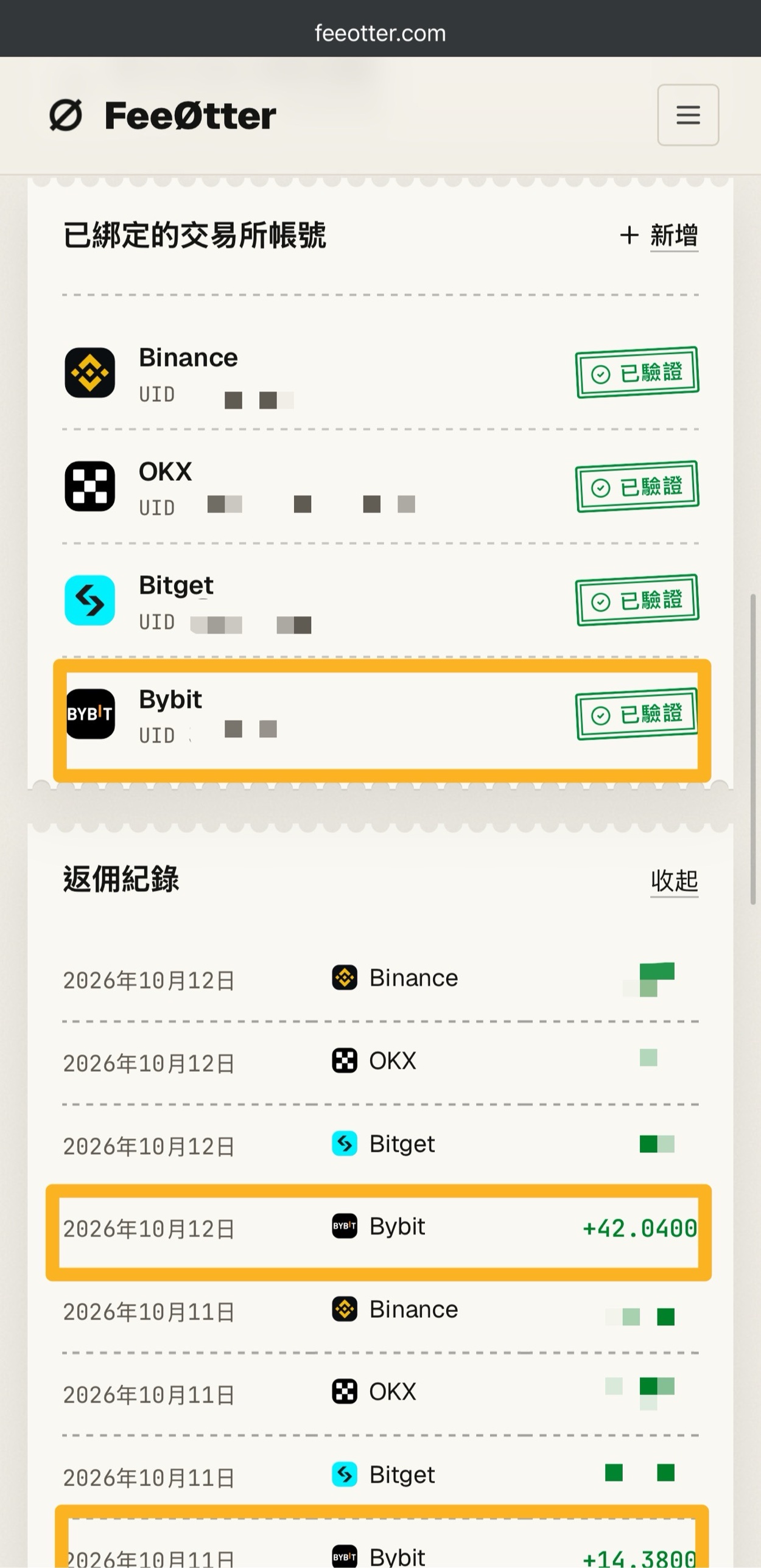
Bybit has no automatic exchange rebate for invitees, so when you sell tokens from a Launchpool on Bybit spot, the exchange won’t return any fees. To get part of your fees back, you need a rebate site, such as Fee Otter. This extra rebate is paid by Fee Otter, not by the exchange and not by Kevin Wu, and the rate is whatever Fee Otter’s page shows. For details, see Bybit fee rebate (Fee Otter).
What are the risks of token mining?
- New-token price swings: rewards are freshly listed tokens, their price after listing is not guaranteed, and it may fall sharply. The platform tokens you lock, such as BNB, BGB and MX, also go up and down, and you bear the price risk during the staking period yourself. OKX’s event terms state that the value of prizes fluctuates with the market and OKX is not responsible (OKX ANIME event announcement).
- Paid subscriptions can lose principal: Launchpad and On Sale mean paying to buy a new token. If it falls below the subscription price, that is a loss, and there is no principal protection.
- Disqualification or cancelled rewards: beyond restrictions on regions, sub-accounts and institutional accounts, the exchange can disqualify you and confiscate rewards for multiple accounts, false identity information or wash trading. OKX, Bitget and BingX all have similar clauses.
- Redemption and unlocking aren’t always instant: the BNB Locked Products used for Binance Megadrop take 48–72 hours for standard redemption; Bitget’s terms state that unlocking may be delayed during extreme market volatility or when many users unlock at once (Bitget Launchpool terms of use); on Gate, early redemption may forfeit rewards already accrued.
- Small amounts may not be paid: Binance doesn’t pay hourly rewards under 0.01 tokens, MEXC doesn’t pay rewards under 0.01 USDT, and on MEXC staking for less than 1 hour earns nothing.
- Fake airdrop links: scammers often use the names “Launchpool” or “claim your airdrop” in private messages or fake URLs, asking you to connect a wallet, enter your seed phrase or send coins first. Exchange events are joined only on the official website and app. Binance has an official verification tool that checks whether a URL, email, phone number or Telegram account is official, and states that Binance will never ask you for funds or tokens by private message (Binance Verify). For common tactics, see common crypto exchange scams.
FAQ
What is Launchpool?
Launchpool is an exchange’s new-token mining programme: you lock a designated coin and receive newly listed tokens in proportion to your share of the pool, and most pools let you redeem at any time. Binance, Bybit, Bitget, Gate, MEXC and BingX all use the name Launchpool; KuCoin calls it GemPool, and OKX calls it Jumpstart mining.
How do you join Binance HODLer Airdrops?
Subscribe your BNB to Simple Earn Flexible or Locked products (or On-Chain Yields), complete identity verification and reside in an eligible region; no separate lock is needed. Binance calculates from snapshots of a historical period chosen at random after the announcement; each snapshot needs more than 0.01 BNB, each user’s share is capped at 4% of the total, and rewards go to your Spot account (for OPG on 2026-06-30, within about 5 hours of the announcement). BNB used as loan collateral does not count.
Can you redeem Launchpool coins at any time?
Binance, Bybit, Bitget, MEXC and BingX all state that their Launchpools allow redemption at any time. The exception is joining through fixed-term products: for example, the BNB Locked Products for Binance Megadrop take 48–72 hours to redeem. Gate lets you redeem at any time, but early redemption may forfeit rewards already accrued.
Do you get a referral rebate for joining a Launchpool?
No. Staking carries no trading fees, and a rebate is paid out of trading fees, so staking itself earns no rebate. When you sell the new tokens on spot, fees are charged and that trade earns a rebate as usual.
Can you deposit and join an event before binding a referral code?
Not recommended. BingX states that once you deposit (including buying crypto) you can no longer add a referral code; on Pionex, placing a trade order shortens the window to 3 days after sign-up; and on OKX the code can only be entered at sign-up. It’s safer to sign up with a referral code, confirm the binding, and then deposit.
What’s the difference between Launchpool and Launchpad?
Launchpool means locking coins to receive new tokens, and your principal can be redeemed. Launchpad means paying USDT or the platform token to subscribe to a new token; if it’s oversubscribed, allocations are pro rata and unused funds are returned. If a Launchpad token falls below the subscription price you lose principal, so the risk is different.
Can sub-accounts join Launchpool?
It depends on the exchange. Binance Launchpool states that sub-accounts and corporate accounts can take part; Bybit Launchpool, Gate HODLer Airdrop and OKX Jumpstart (based on the January 2025 round) exclude sub-accounts, and Bybit and MEXC also exclude institutional accounts.
Is a private message saying “claim your Launchpool airdrop” real?
Almost always a scam. Exchange Launchpools and airdrops are joined only on the event pages of the official website and app, and rewards go straight to your account; you never need to click a link in a private message, connect a wallet or send coins first. Binance states that it will never ask you for funds or tokens by private message, and you can check suspicious URLs and accounts with Binance Verify.
For earn products beyond staking, see what dual investment is and USDT savings rates compared; for the difference between maker and taker fees when you sell new tokens, see maker vs taker fees, and for each exchange’s actual fees after rebates, see actual fees after rebates. For how referral codes work, see what a referral code is; every exchange’s referral code and automatic exchange rebate are listed in crypto exchange referral codes, and if a rebate hasn’t arrived, see how to check a missing rebate.