


Updated Rules checked 2026-10-16
A “KOL referral code” is a referral code that an exchange’s affiliate program (also called a partner program) issues to its partners. A “regular referral code” is the code every user can get on the referral page. The two belong to two separate programs at the exchange. In regular referral programs, the referrer’s commission is mostly between 10% and 40%, and some exchanges hand out only fixed rewards with no fee commission at all. Affiliate programs mostly advertise referrer commissions of “up to 50%–70%”, but you have to apply and be approved, and most also set a follower or community-size threshold.
The rebate you get from a referral code is the part the referrer shares out of their own commission, which the exchange automatically refunds to your account. KOL codes usually give higher rebates because the referrer’s own commission is higher, so there is more to share. The exchange pays this money out of fees it has already collected, and your fees do not go up because of it. One thing to watch: Binance, OKX, MEXC and Gate all cap the share a referrer can pass on to invitees at 20%, and KOL codes are no exception.
I compared the regular referral rules and affiliate program terms of 13 exchanges one by one and put them in the comparison table below. I also explain how to use officially provided information to tell what kind of referral code you have, before and after you sign up. This article does not name any individual or channel; it only compares the exchanges’ programs.
Key points
A KOL referral code is a code from an exchange’s affiliate (partner) program. Referrer commission caps there are mostly stated as 50%–70%, compared with mostly 10%–40% in regular user referral programs.
The invitee’s rebate is carved out of the referrer’s commission and paid by the exchange. Signing up with a referral code does not make you pay more in fees.
Binance, OKX, MEXC and Gate officially cap the rebate a referrer can share with invitees at 20%, whether the code is a regular code or a KOL code.
Regular user referrals at OKX and Bitget only give promotional rewards or airdrops, with no fee rebate that can be shared with invitees.
OKX’s “My Rewards” page and the “i” icon next to a Pionex referral code show the rebate rate you receive. This is the most direct method the exchanges officially provide.
The information below was checked against official pages on 2026-10-16 (fact-check date) and is provided for reference.
What is a KOL referral code?
Exchange referral systems usually have two tiers. The first is the referral program: every registered user can get a referral code on the referral page and earn commission or fixed rewards after inviting friends. The second is the affiliate program, which Chinese-language pages often call a promotion partner, alliance partner, agent or KOL program. It needs a separate application form, and you can join only after the exchange approves you. KOL (Key Opinion Leader) originally meant an influential opinion leader. In the exchange context, what people call a “KOL referral code” almost always means an affiliate program code.
The difference between the two tiers is written into the official rules. Take Bybit: a regular referrer’s commission starts at 20% and goes up to 30% for 365 days, and since February 7, 2026 each referrer has been capped at USD 5,000 per quarter (Bybit Referral Program FAQ). The affiliate program promises “lifetime commissions” and is aimed at bloggers, influencers, content creators and promoters who run a website or app (Bybit Affiliate Program FAQ). KuCoin works the same way: regular referrals start at 25% and go up to 35% for 365 days (KuCoin Referral Program), while the affiliate program goes up to 60% and describes the referral relationship as “permanent” (KuCoin Affiliate Program).
How do regular and KOL referral codes differ across 13 exchanges?
In the table, “commission” is the share the referrer gets, and “invitee rebate” is the share you can get. Both are calculated on the fees the invitee pays. Cells marked “not stated officially” mean I could not find a figure in the exchange’s help center, announcements or terms.
| Exchange | Regular user referral: referrer commission / how much can go to the invitee | KOL / affiliate program: commission cap / invitee rebate cap | Duration | Sources |
|---|---|---|---|---|
| Binance | Spot 20%, futures from 10%, up to 50% based on a 3-month assessment; can be shared with invitees, up to 20% | Up to 50%; invitee rebate up to 20% | Spot: no duration stated; futures: 1 year, unlimited once commission reaches 30% or more; stops when the invitee reaches VIP 3 | Referral, Sharing, Affiliate |
| OKX | Promotional rewards only (fixed crypto amounts, capped each period); no fee commission to share | Referrer commission depends on the affiliate tier; invitee rebate 0%–20%, and once set it can only be raised | Counted for as long as the invitee is on OKX (not counted at VIP7 and above) | Referral, Affiliate, Rebate |
| Bybit | From 20%, up to 30%, capped at USD 5,000 per quarter; whether it can be shared with invitees is not stated officially | Rate not stated officially (total rebate cap of 50% for VIP accounts); invitee rebate not stated officially | Regular: 365 days; affiliate: lifetime; may end after 180 days without trading | Referral, Affiliate |
| Bitget | Fixed rewards such as BGB airdrops and mystery boxes; the limited-time Premier Inviter gets 25% for 365 days; sharing with invitees not stated officially | From 40%, up to 50%; partners can set a rebate for invitees, with a cap that “varies by account and product” | Partner rate valid long term; duration per invitee not stated officially | Referral, Affiliate, Sharing |
| MEXC | 40% (up to 50% in some regions); sharing with invitees not stated officially | Up to 70% (including sub-affiliate commission); invitee share up to 20% | Regular: 1,080 days; affiliate: lifetime | Referral, Affiliate, Sharing |
| Gate | Up to 40%; the page example is 30% for the referrer and 10% for the invitee; how the split is set and its cap are not stated officially | Up to 60% (application form); invitee rebate up to 20% (2023 announcement) | Regular: 1 year; affiliate: no time limit | Referral, Affiliate, Cap |
| BingX | Lv1 10%, Lv2 20%; part of it can be given to friends as a fee rebate | Up to 50% (officially noted as a partner average, for reference only); the invitee rebate comes out of the partner’s rate, no more than 45% for new referral codes | For referral codes created after 2023/3/1, the invitee rebate has no time limit | Referral, Affiliate, Cap |
| KuCoin | From 25%, up to 35%; you can set an exclusive rebate for invitees, up to your own current commission | LV1 40%, LV2 50%, LV3 60%; invitee rebate no higher than the partner’s own rate | Regular: 365 days; affiliate: permanent | Referral, Affiliate |
| HTX | 30%; a custom invitation code can set the invitee’s share, cap not stated officially; invitees also get mystery boxes and a newcomer gift pack | Up to 60%; invitee rebate cap not stated officially | 2024 rules say no time limit | Referral, Custom code, Affiliate |
| XT.COM | Referrer and invitee share up to 20% combined | Up to 50%; partners can create links with a fee discount, cap not stated officially | Affiliate: lifetime; regular referral: not stated officially | Referral, Affiliate |
| WEEX | 40%, lifetime; sharing with invitees not stated officially | Up to 70% on direct referrals, up to 10% from sub-affiliates; new links can set a rebate rate, cap not stated officially | Lifetime | Referral, Affiliate |
| Pionex | Spot 20%, futures 15%; part of it can be given to friends as a fee discount | KOL commission and invitee cap not stated officially | 365 days for non-KOL referrers; no longer counted in full once the invitee reaches VIP2 or above | Referral, KOL application |
| Ourbit | 30% combined; the official example is 20% for the referrer and 10% for the invitee (spot currently has zero fees) | 50% on direct referrals + 10% from sub-affiliates (the FAQ example uses 70%); the invitee share is split from the partner’s rate | Regular: 1,080 days; affiliate: lifetime | Referral, Affiliate |
The table shows two things. First, the highest commission caps sit mostly in affiliate programs: regular referrals top out at 40% (MEXC, WEEX, Gate), while affiliate programs go up to 50%–70%. Second, among the exchanges that state an invitee rebate cap, Binance, OKX, MEXC and Gate all set it at 20%. However high the referrer’s commission is, that is all they can share with you.
Why do KOL referral codes give higher rebates? Who pays for it?
The invitee’s rebate is cut from the referrer’s commission, and every exchange’s official example works the same way. In BingX’s example, the referrer’s commission is 40% and 10% goes to the invitee: the invitee pays 100 USDT in fees, gets 10 USDT back, and the referrer gets 30 USDT (BingX partner dashboard guide). In MEXC’s example, the affiliate commission is 50% with 10% shared with the invitee, who gets 10 USDT back for every 100 USDT in fees (MEXC commission-sharing announcement). In Ourbit’s example, the partner has 70% and sets the link to give the invitee 30%, which leaves the partner 40% and the invitee 30% (Ourbit affiliate FAQ).
So the formula is invitee rebate ≤ referrer commission, and the referrer keeps the difference between the two. A regular user’s commission is low to begin with, so there is naturally less to share. An affiliate partner’s commission is high, which leaves room to give you more than 20%, provided the exchange allows it.
The exchange pays this money. It charges you the standard fee, then distributes part of it to the referrer and to you according to the referral relationship. The rate you pay when placing an order does not go up because you used a KOL code. Since 2026, Binance has stated explicitly that commission is calculated as “net trading fee × commission rate”, where the net fee is the amount after deducting market maker rebates (Binance referral commission calculation announcement).
Here is the gap in numbers. Assume a futures taker fee of 0.05% and a monthly futures notional volume of 1,000,000 USDT, which comes to 500 USDT in fees:
| Scenario (Binance rules as the example) | Referrer commission | Rebate you get back | Referrer keeps | Your fees |
|---|---|---|---|---|
| Regular user at T0, all of it shared with you | 10% (50 USDT) | 10% (50 USDT) | 0 | 500 USDT, unchanged |
| Affiliate partner at 50%, sharing the 20% maximum with you | 50% (250 USDT) | 20% (100 USDT) | 30% (150 USDT) | 500 USDT, unchanged |
| Affiliate partner at 50%, sharing nothing with you | 50% (250 USDT) | 0 | 50% (250 USDT) | 500 USDT, unchanged |
A regular Binance user at T0 earns 10% futures commission for 1 year and 20% on spot. Referrers can share their commission with invitees, up to 20% on both spot and futures, and if their commission is below 20% they can share all of it (Binance Referral Pro guide). In other words, on Binance spot a regular user’s referral code can also give you up to 20%, the same cap as a KOL code. The difference lies in futures (a regular code at T0 gets only 10%, and it stops after 1 year) and in whether the referrer is willing to share. Futures can be leveraged, and if the price moves against you, the position may be forcibly liquidated. A rebate only lowers your fees; it does not reduce this risk.
How much can a regular user’s referral code give you?
Depending on the exchange, the share that can go to invitees ranges from 0 to 35%. Under the official rules, the exchanges fall into three groups:
- No fee rebate to share: OKX regular user referrals give fixed crypto rewards, capped each period, and invitees take part in new-user rewards separately (OKX Referral Program FAQ). Bitget regular referrals give both sides BGB airdrops and mystery boxes after they complete tasks; for example, once the invitee’s trading volume reaches 500 USDT, each side gets USD 15 in BGB (Bitget Referral Program).
- Can be shared, with an official cap: Binance up to 20% (all of it if the commission is under 20%); XT.COM 20% combined for referrer and invitee (XT.COM announcement); KuCoin up to the referrer’s current commission, that is, 25%–35%; Pionex up to 20% on spot and 15% on futures (Pionex referral rules v3); Ourbit 30% combined; BingX regular users earn 10% or 20% commission, and what can be shared falls within that range.
- The referrer earns commission, but the exchange doesn’t say whether it can be shared with you: Bybit (20%–30%), MEXC (40%), WEEX (40%), Gate (up to 40%; the page example gives 10% to the invitee), HTX (30%; custom invitation codes can set the invitee’s share, but no cap is stated).
Regular referrals also often have time limits: 365 days at KuCoin, Pionex and Bybit, 1 year at Gate, and 1,080 days at MEXC and Ourbit. There are volume thresholds too. At Binance and KuCoin, once the invitee reaches VIP 3 or above, both commission and rebate stop; at Pionex, once the invitee reaches VIP2 or above, the referrer no longer receives the full commission.
How can you tell whether a referral code is a KOL code?
Most exchanges don’t give invitees a way to check whether a code is an affiliate code. Only the following methods are actually stated officially and can be used to tell:
| Exchange | Officially provided way to tell | Source |
|---|---|---|
| OKX | App main menu → User Center → “My Rewards” shows the rebate rate the affiliate gives you; if you don’t see this module, no rebate has been set for you. Invitees of regular referrals see “Welcome Rewards” (new-user rewards) instead | OKX affiliate FAQ |
| Pionex | Tap the “i” icon next to the referral code to see the spot and futures fee discount rates; 0% means the referrer isn’t sharing anything with you | Pionex guide to adding a referral code later |
| Bybit | The account info page shows the bound affiliate code (some affiliates’ IDs are hidden by their privacy settings); adding a code within 14 days of sign-up only accepts affiliate program codes, not regular users’ referral codes | Bybit affiliate code guide |
| HTX | Sign up with a regular user’s code and the invitee can get a mystery box worth up to 1,500 USDT plus a newcomer gift pack worth up to 1,200 USDT; sign up with an affiliate partner’s code and the rules list a newcomer gift pack plus an exclusive gift, with no mystery box | HTX referral rules |
| XT.COM, Ourbit | After trading, the rebate shows up in your fund records: on XT.COM under Spot account → Funding records → Distribution (Futures/Spot Cashback), and on Ourbit under “Self-rebate records” on the referral page | XT.COM referral guide, Ourbit referral page |
| The other 8 | No official explanation of how invitees can tell which type of code they have | — |
For exchanges that don’t say, you can judge for yourself in three ways. First, check whose rate an article is talking about: wording such as “commission up to 50%” or “affiliate partner” usually refers to the referrer’s rate, while “invitee rebate” or “fee discount” is what you can actually get (for the difference, see referrer commission vs. invitee rebate). Second, compare against the exchange’s cap: at Binance, OKX, MEXC and Gate, if someone claims to give you more than 20%, the part above that cannot be the exchange’s automatic rebate. It is usually paid separately by a rebate site, or it is several figures added together; for how to break it down, see how to read rebate percentage claims. Third, do the math once after signing up: after your first trade, compare “fee × rebate rate” with the amount credited. Where to look is covered in how to check whether your referral code is bound.
Can you apply to become a KOL yourself? What are the requirements?
Yes, you can apply. All 13 exchanges accept affiliate or KOL partnership applications, but almost all of them review applicants first. The officially stated requirements are:
| Exchange | Officially stated requirements | Source |
|---|---|---|
| Binance | 5,000 followers on a social account, or a community of 3,000, or a business with 10,000 users / 10,000 daily visitors, or reaching Tier 1 in the referral assessment; approval does not mean you keep it permanently | Affiliate getting started |
| OKX | Fill in the application form; eligibility unlocks after you successfully invite 10 valid new users; no follower count stated | Affiliate rules |
| Bybit | Bloggers, influencers, content creators, website or app owners, and users with a wide trading network; requires Bybit’s approval; no follower count stated | Affiliate FAQ |
| Bitget | 100 followers on a social platform, or a community of 500, or being active in 5 or more crypto communities; reviewed within 1 business day; activation requires identity verification and 10,000 USDT of invitee trading volume within 30 consecutive days | Application guide, Tiers |
| MEXC | Content creators with at least 500 followers, or crypto websites and promotion agencies; reviewed within 3 business days | Affiliate program |
| Gate | Content creators, communities or social media bloggers; replies to the application form within 24 hours; no numeric threshold stated | Affiliate page |
| BingX | Content creators, community leaders, KOLs; after you fill in the form, a staff member contacts you; no follower count stated | Partner page |
| KuCoin | 5,000 followers on a social account or a community of 500; new partners must complete advanced identity verification | Affiliate page |
| HTX | Any one of four: 5,000 followers, a community of 500, an organization with 2,000 users, or your own website; apply through a form | Affiliate guide |
| XT.COM | Priority for applicants with 500+ followers or a community of 100+; reviewed within 24 hours | Affiliate guide |
| WEEX | Anyone with an active community, social media presence or trading group can apply; reviewed within 24 hours, and WEEX reserves the right to refuse | Affiliate page |
| Pionex | Contact Pionex through its official Telegram and provide your social accounts and follower counts; numeric threshold not stated officially | KOL application |
| Ourbit | Bloggers, KOLs, content creators, website or app operators; no identity verification needed to apply; regular users who reach a certain number of first-time traders are also upgraded automatically (the number is not stated officially) | Partner FAQ |
Qualifying doesn’t mean getting the top rate. Most affiliate commissions are tiered and assessed monthly or quarterly. OKX rates affiliates every month: L0 earns no commission, and the top tier, L5, requires 10 million USDT in monthly spot volume, 40 new traders and 200 total traders (OKX affiliate FAQ). Bitget’s 50% at LV3 requires 100 active trading users and 150 million USDT in volume per month, and KuCoin’s 60% at LV3 requires 34 invitees plus 6,666,000 USDT in volume within 30 days. The “up to 50%–70%” in ads is the rate for top-tier partners, and most partners never reach it.
Is a KOL code always better?
Not necessarily. A KOL code only means the referrer is “able” to give you a higher rebate; how much they actually give is their decision. Bitget partners can keep all of it or set a rate for invitees (Bitget guide), and the invitee rate an OKX affiliate sets is between 0% and 20%, with 0% being an allowed setting. When you compare referral codes, compare “how much this code gives the invitee”, not “how high this exchange’s affiliate commission can go”.
KOL codes usually have a few practical advantages. The first is a longer duration: the affiliate programs of MEXC, XT.COM, WEEX, Ourbit and Bybit say lifetime, KuCoin says permanent and Gate says no time limit, while regular referrals mostly run 365 to 1,080 days. On Binance, futures commission has no 1-year limit once the referrer is at 30% or more, and the rebate follows the commission. In addition, OKX requires that the invitee rate an affiliate sets can only be raised, never lowered or removed, and from October 25, 2025, Binance’s futures sharing rate can no longer be changed once set (Binance Referral Pro update announcement).
Some limits apply whatever the type of code. Calculation stops at high VIP levels (Binance VIP 3, OKX VIP7, HTX Prime 9), fees on zero-fee trades or fees offset by trial funds or vouchers don’t count, and self-referrals or multiple accounts are disqualified. Each exchange’s cancellation conditions are listed in rebate cancellation rules, and the link between VIP levels and rebates is explained in how VIP tiers affect referral rebates. A “rebate” that requires you to send a DM, share your UID or transfer money first is not the exchange’s automatic rebate; how to spot one is covered in rebate scam warning signs.
What kind of referral codes does this site offer?
The referral codes on this site are exchange affiliate (KOL) program codes. What you get is the exchange’s automatic rebate, paid by the exchange directly into your account, with no need to send a DM or share your UID. The rates sync with the exchange’s settings every day, monthly changes are recorded in the monthly rebate rate report, how the data is verified is described in how we compile rebate data, and each exchange’s referral code page also includes screenshots of rebate credits.
| Exchange | This site’s referral code | Automatic exchange rebate (fee discount) | Guide |
|---|---|---|---|
| Binance | KEVINWU | 20% | Binance referral code |
| OKX | KEVINWU | 20% | OKX referral code |
| Bitget | KEVINWU | 20% | Bitget referral code |
| MEXC | mexc-KEVINWU | 20% | MEXC referral code |
| Gate | KEVINXYZ | 20% | Gate referral code |
| BingX | KEVINWU | 45% | BingX referral code |
| KuCoin | KEVINWU | 60% | KuCoin referral code |
| HTX | KEVINWU | 30% | HTX referral code |
| XT.COM | KEVINWU | Futures 60%, Spot 35% | XT referral code |
| WEEX | kevinwu | Futures 60%, Spot 35% | WEEX referral code |
| Pionex | KEVINWU | 15% | Pionex referral code |
| Ourbit | KEVINWU | 50% (spot currently has zero fees, so there is no rebate) | Ourbit referral code |
For Binance, OKX, MEXC and Gate, the rates are already bound by the official 20% cap, so they will not exceed 20%. This site’s Pionex code is a professional KOL code. Pionex calls the invitee benefit a fee discount, and you can see the rate through the “i” icon next to the referral code.
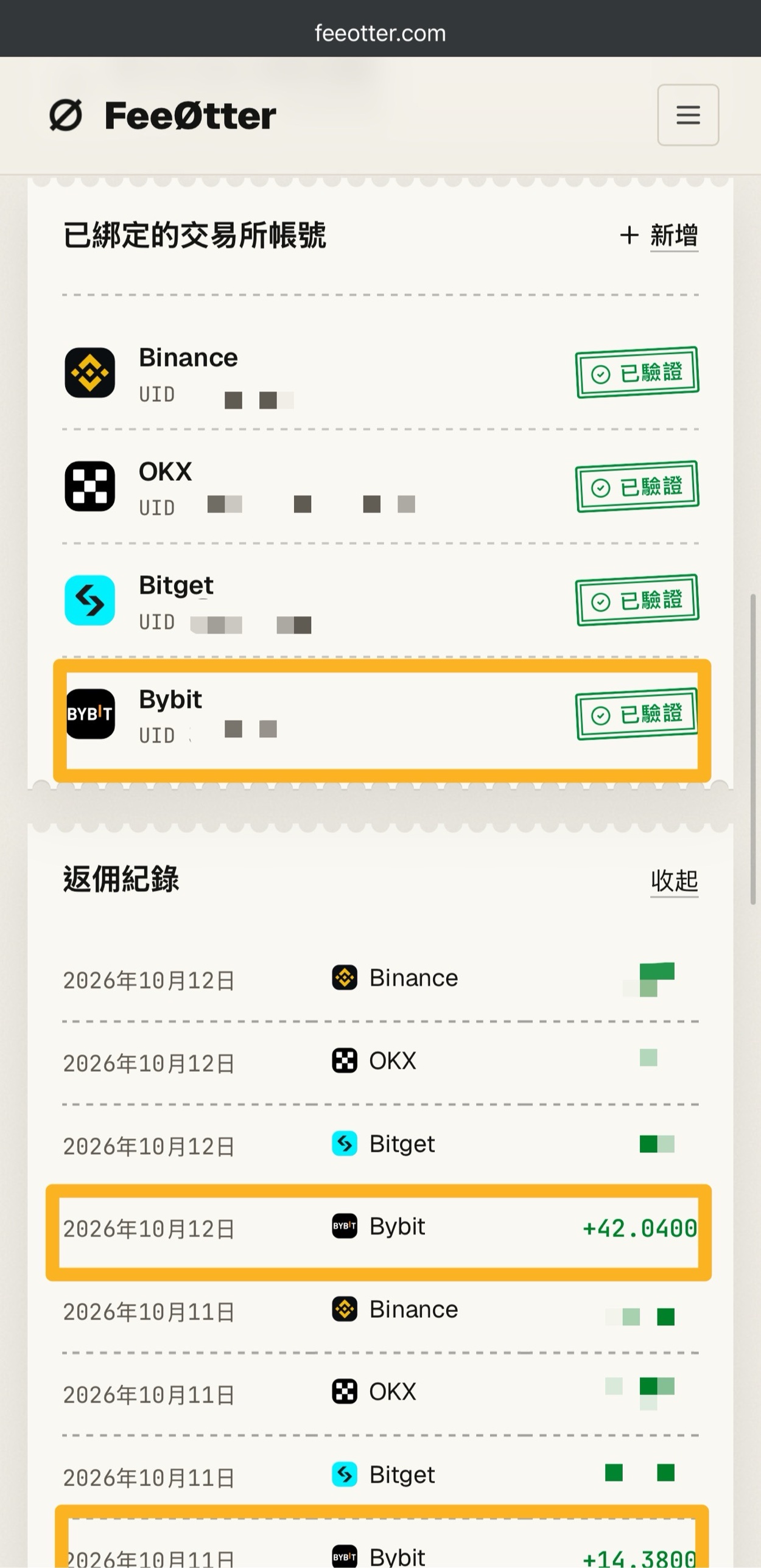
For Bybit, this site has no automatic exchange rebate; the rebate channel is Fee Otter. The extra rebate is paid by Fee Otter, not by the exchange and not by Kevin Wu. How it works is explained in Bybit fee rebate (Fee Otter), and below is a screenshot of my own Fee Otter dashboard.
FAQ
What does “KOL referral code” mean?
A KOL referral code is a code that an exchange’s affiliate program (also called a partner program) issues to approved partners. The referrer’s commission is higher than a regular user’s, and the rebate they can share with invitees may also be higher. A regular referral code is the code every user can get on the referral page. The two look the same on the sign-up page; the difference is which set of rules applies behind them.
Will I pay higher fees if I sign up with a KOL referral code?
No. Fees are charged at the exchange’s published rates, and both the referrer’s commission and your rebate are paid by the exchange out of the fees it collects. The type of referral code you use only affects how much is refunded afterward, not the rate you pay when you place an order.
A referral code advertises a 40% or 50% rebate. Why don’t I get that much?
Usually because that figure is the referrer’s commission rate, not your rebate rate. An affiliate commission of “up to 50%” means the referrer gets at most 50%; how much goes to you is a separate question. At Binance, OKX, MEXC and Gate, the cap on what can be shared with invitees is 20%. For how the rate is split and which figures get added together, see how to read rebate percentage claims.
How do Binance’s regular and KOL referral codes differ?
On spot, both can give invitees at most 20%; the difference is mainly in futures and duration. A regular Binance user starts with 20% commission on spot and 10% on futures, and futures count for only 1 year. Once the referrer’s assessed commission reaches 30% or more, futures have no 1-year limit, and the futures rebate shared with invitees is also capped at 20%. Once the invitee reaches VIP 3 or above, both commission and rebate stop.
Do OKX regular user referral codes give a rebate?
They give no fee rebate. OKX regular user referrals give promotional rewards (fixed crypto amounts, capped each period), and invitees take part in new-user rewards. Fee rebates come only with affiliate (partner) codes, with an invitee rate between 0% and 20% that you can see on the app’s “My Rewards” page.
I already signed up with a regular referral code. Can I switch to a KOL code?
On most exchanges, the referral can’t be changed once it’s bound. If no code is bound yet, some exchanges let you add one later: Binance within 30 days of sign-up, before any deposit or trade; MEXC within 30 days of sign-up; Bybit within 14 days, and only with affiliate program codes; Pionex within 14 days (only 3 days once you’ve placed a trade). If a code is already bound, it comes down to each exchange’s switching rules; see the guide to switching referral codes and can you add a referral code after sign-up.
Can rebates from KOL referral codes be cancelled?
Yes, under the same conditions as regular referral codes. Self-referrals, multiple accounts and wash trading are disqualified, calculation stops once you reach certain VIP levels (Binance VIP 3, OKX VIP7), and fees on zero-fee trades or fees offset by vouchers or trial funds don’t count. Each exchange’s details are in rebate cancellation rules, and the steps to check when a rebate hasn’t arrived are in what to do if your referral rebate hasn’t arrived.
If a code only pays a rebate after I send a DM or my UID, is it a KOL code?
That kind of rebate is not the exchange’s automatic rebate. An exchange’s invitee rebate is calculated automatically once the referral relationship is set up and is paid directly into your account. Anything that requires a DM, UID registration or manual payout is money handled separately by the referrer or a third party, and you need to check its terms and risks separately. Common warning signs are listed in rebate scam warning signs, and the different rebate channels are compared in rebate site comparison.
To understand how referral codes themselves work first, see what is a referral code and the rebate glossary. To compare each exchange’s automatic rebate, see the exchange referral code overview, and to see how much you actually pay in fees after the rebate, see actual fees after referral rebates. Among Taiwan’s exchanges, MAX and BitoPro also have referral offers; their guides are on the Traditional Chinese version of this site.