


Updated Rules checked 2026-10-17
How much a referral code rebate saves you in a year depends first on how much you pay in fees, and only second on the rebate percentage. A beginner who buys crypto every month with TWD 30,000 (New Taiwan dollars) on an exchange with a 0.1% spot fee, such as Binance, OKX or Bitget, pays about 12 USDT in fees a year, so every 10 percentage points of rebate gives back just 1.2 USDT. Someone who trades 1,000,000 USDT of futures notional a month, all as taker, pays about 6,000 USDT a year, and the same 10 percentage points come to 600 USDT.
I took four common types of trader (a beginner buying on a schedule, an active spot trader, a high-frequency futures trader, and someone using copy trading or grid bots), gave each a monthly trading volume, and worked out a year of fees at the official VIP 0 rates of Binance, OKX, Bitget, MEXC, Gate, BingX, Pionex, Ourbit and Bybit. Then, using the exchange’s current automatic fee rebate on this site’s referral codes, I calculated how much each exchange pays back per month. The rebate rates sync with the exchanges every day, so the calculator tables below update with them.
If your volume is small, switching to a cheaper withdrawal network may save you more than the rebate. If your volume is large, check VIP tiers and time limits first, because some exchanges stop paying the rebate once you reach a certain tier. All of these exceptions are covered below.
Key points: the rebate is calculated on the fees you actually pay, not on the amount you trade, so yearly savings = yearly fees × rebate percentage. With 1,000 USDT of spot a month, all as taker, on an exchange with a 0.1% spot fee, a year of fees is 12 USDT; with 50,000 USDT of spot a month it is 600 USDT; with 1,000,000 USDT of futures a month at a 0.05% taker fee it is 6,000 USDT. Binance’s futures rebate runs for 12 months from when you open your futures account (no limit only if the referrer’s futures commission is 30% or higher), and the spot rebate also stops once you reach VIP 3 or above. Bybit has no automatic fee rebate from the exchange, and Ourbit spot currently has zero fees, so neither offers an exchange rebate on spot.
The figures below were checked against official pages on 2026-10-17 (data check date) and are provided for reference.
How much can a rebate save in a year, and how is it calculated?
There are only two steps: yearly fees = monthly volume × fee rate × 12; yearly rebate = yearly fees × rebate percentage. The exchange refunds part of the fee, not part of the trade. For example, if you trade 10,000 USDT and pay a 10 USDT fee, a 10% rebate gives back 1 USDT, not 1,000 USDT.
Most exchanges use “net fees”: Binance calculates after deducting maker rebates (Binance affiliate program basics), OKX excludes fees covered by rebate cards, trial funds and vouchers (OKX affiliate program rules), and MEXC calculates after bonuses and discounts. Fees covered by vouchers earn no rebate either; the difference between the two is explained in fee vouchers vs referral code rebates.
The assumptions for the four scenarios are below. The volumes are round numbers chosen for easy math, not recommended trading volumes:
| Scenario | Monthly volume | Yearly volume | Order type |
|---|---|---|---|
| 1. Beginner buying on a schedule | Spot 1,000 USDT (about TWD 30,000, a rough estimate assuming 1 USDT ≈ 30 TWD) | 12,000 USDT | All taker (market buys) |
| 2. Active spot trader | Spot 50,000 USDT | 600,000 USDT | Half maker, half taker |
| 3. High-frequency futures | Futures notional 1,000,000 USDT | 12,000,000 USDT | All taker (upper-bound scenario) |
| 4. Copy trading, grid bots | Pionex spot grid 37,500 USDT; copy trading 400,000 USDT | 450,000 / 4,800,000 USDT | Depends on how the bot or lead trader places orders |
All fees are the official rates for regular users (VIP 0). Each section below first lists a year of fees, then “how much every 10 percentage points of rebate gives back per year.” You can work out that column without knowing the rebate percentage, and it converts easily to any rate: on 600 USDT of fees, every 10 percentage points gives back 60 USDT, so multiply by however many times 10 your rate is.
Is a rebate worth it for a beginner buying TWD 30,000 of crypto a month?
With 1,000 USDT of spot a month, all as market orders (taker), the yearly volume is 12,000 USDT. A year of fees at each exchange:
| Exchange | Spot Taker (VIP 0) | Monthly fees | Yearly fees | Yearly refund per 10% rebate | Official source |
|---|---|---|---|---|---|
| Binance | 0.1% | 1 USDT | 12 USDT | 1.2 USDT | Binance fee page |
| OKX | 0.1% | 1 USDT | 12 USDT | 1.2 USDT | OKX trading fee FAQ |
| Bitget | 0.1% | 1 USDT | 12 USDT | 1.2 USDT | Bitget trading fee FAQ |
| MEXC | 0.05% | 0.5 USDT | 6 USDT | 0.6 USDT | MEXC fee page |
| Gate | 0.1% | 1 USDT | 12 USDT | 1.2 USDT | Gate fee page |
| BingX | 0.1% | 1 USDT | 12 USDT | 1.2 USDT | BingX spot fee explainer |
| Pionex | 0.05% | 0.5 USDT | 6 USDT | 0.6 USDT | Pionex trading fee overview |
| Bybit | 0.1% | 1 USDT | 12 USDT | No exchange rebate | Bybit fee structure |
| Ourbit | 0% | 0 | 0 | No fees, so no rebate | Ourbit fee announcement |
At this volume, every 10 percentage points of rebate gives back 1.2 USDT a year, roughly TWD 36. Entering a referral code at sign-up costs you nothing extra, but if you are choosing a referral code to save money, a few costs matter more than the rebate for a beginner:
- Withdrawal network: Binance charges 1.5 USDT to withdraw USDT over TRC20 but only 0.01 USDT over BEP20 (Binance deposit and withdrawal fee page, checked 2026-10-12). One extra TRC20 withdrawal (cash-out) costs more than a full year of the per-10% rebate. Network fees at each exchange are compared in USDT withdrawal fees compared.
- Platform token discount: paying Binance spot fees with BNB gives 25% off (Binance BNB fee discount), turning 12 USDT into 9 USDT, or 3 USDT less a year.
- The fee rate itself: MEXC and Pionex charge 0.05% spot taker, or 6 USDT a year, half of what a 0.1% exchange charges; Ourbit spot currently has zero fees.
If you buy crypto with TWD directly on Taiwan’s MAX or BitoPro, the fees and referral code perks follow a different set of rules.
How much do you get back trading 50,000 USDT of spot a month?
At 50,000 USDT a month, that is 25,000 USDT as maker and 25,000 USDT as taker. At Binance, Bitget, Gate and BingX, VIP 0 spot maker and taker are both 0.1%, so placing maker orders saves nothing; OKX is 0.08% maker and 0.1% taker; MEXC is 0% maker and 0.05% taker, so only the taker half pays fees.
| Exchange | Maker / Taker | Monthly fees | Yearly fees | Yearly refund per 10% rebate | Yearly fees after platform token discount |
|---|---|---|---|---|---|
| Binance | 0.1% / 0.1% | 50 USDT | 600 USDT | 60 USDT | BNB 25% off: 450 USDT |
| OKX | 0.08% / 0.1% | 20 + 25 = 45 USDT | 540 USDT | 54 USDT | OKB cannot be used for fees |
| Bitget | 0.1% / 0.1% | 50 USDT | 600 USDT | 60 USDT | BGB 20% off: 480 USDT |
| MEXC | 0% / 0.05% | 0 + 12.5 = 12.5 USDT | 150 USDT | 15 USDT | MX 20% off: 120 USDT |
| Gate | 0.1% / 0.1% | 50 USDT | 600 USDT | 60 USDT | GT 10% off: 540 USDT |
| BingX | 0.1% / 0.1% | 50 USDT | 600 USDT | 60 USDT | No platform token discount |
| Pionex | 0.05% / 0.05% | 25 USDT | 300 USDT | 30 USDT | — |
| Bybit | 0.1% / 0.1% | 50 USDT | 600 USDT | No exchange rebate | MNT 25% off: 450 USDT |
Platform token discount sources: Binance BNB fee discount, Bitget BGB fee deduction, MEXC MX discount update announcement, Gate fee page, Bybit FAQ on paying fees with MNT; OKX states that OKB cannot be used to pay trading fees (OKX: how to reduce trading fees). MEXC’s 0.05% is the rate its fee page lists for “most trading pairs”; some small-cap pairs have a higher taker fee.
What this table shows most clearly is the gap in fee rates between exchanges: on the same 50,000 USDT a month, MEXC costs 150 USDT a year while Binance, Bitget, Gate and BingX cost 600 USDT, a difference of 450 USDT. That gap is bigger than any single exchange’s rebate. A rebate comes after you pick an exchange and refunds part of that exchange’s fees.
A platform token discount and a rebate can be used together, but they multiply rather than add. The rebate is calculated on the fees you actually pay after the discount, so a year of Binance spot fees actually paid = 600 × 0.75 × (1 − rebate percentage). Adding BNB’s 25% straight to the rebate percentage gives a number that is too high. How the “40%” and “55%” in referral code headlines are put together is explained in how the rebate percentages in referral code headlines are calculated.
With 1,000,000 USDT of futures a month, how far apart are the yearly fees and the rebate?
This assumes 1,000,000 USDT of futures notional a month, all as market orders (taker), which is the highest-fee case. Futures use leverage: if the market moves against you, your position may be liquidated and you may lose your entire margin. Notional value is the size of the position, not the margin: open a 10,000 USDT position at 10x leverage and your margin is 1,000 USDT, but the fee is charged on 10,000 USDT. How futures fees are calculated is covered in how futures fees are calculated.
| Exchange | Futures Maker / Taker (VIP 0) | Monthly fees (all taker) | Yearly fees | Yearly refund per 10% rebate | Yearly savings if 20% becomes maker |
|---|---|---|---|---|---|
| Binance | 0.02% / 0.05% | 500 USDT | 6,000 USDT | 600 USDT | 720 USDT |
| OKX | 0.02% / 0.05% | 500 USDT | 6,000 USDT | 600 USDT | 720 USDT |
| Bitget | 0.02% / 0.06% | 600 USDT | 7,200 USDT | 720 USDT | 960 USDT |
| MEXC | 0% / 0.02% | 200 USDT | 2,400 USDT | 240 USDT | 480 USDT |
| Gate | 0.02% / 0.05% | 500 USDT | 6,000 USDT | 600 USDT | 720 USDT |
| BingX | 0.02% / 0.05% | 500 USDT | 6,000 USDT | 600 USDT | 720 USDT |
| Pionex | 0.02% / 0.05% | 500 USDT | 6,000 USDT | 600 USDT | 720 USDT |
| Ourbit | 0.02% / 0.04% | 400 USDT | 4,800 USDT | 480 USDT | 480 USDT |
| Bybit | 0.02% / 0.055% | 550 USDT | 6,600 USDT | No exchange rebate | 840 USDT |
Fee sources: Binance futures fee explainer (updated 2026-05-01), OKX trading fee FAQ, Bitget trading fee FAQ, MEXC futures fee adjustment announcement (standard rate for Taiwan users on BTC and ETH futures: 0% / 0.02%), Gate fee page, BingX perpetual futures fee schedule, Pionex trading fee overview, Ourbit fee announcement, Bybit fee structure (updated 2026-09-02).
The last column is what you save by moving 200,000 USDT from taker to maker, calculated as 200,000 × the fee gap × 12. Binance’s maker and taker fees differ by 0.03%, which saves 720 USDT a year, more than every 10 percentage points of rebate (600 USDT). At high volume, look at order type and the rebate together, since you can save on both at once. How to tell maker from taker is explained in maker vs taker fees, and you can estimate holding costs including funding rates with the perpetual futures cost calculator.
At this volume, two more things matter. First, Binance’s futures rebate has a time limit: the referrer earns futures commission only for 12 months from when the invitee opens a futures account, and the limit is lifted only if the referrer passes the 30% futures commission review. Once the referrer’s period ends, the invitee’s futures rebate also stops, and it resumes only if the referrer reaches 30% or more (Binance Referral Pro FAQ, updated 2026-08-05). So the Binance futures estimate above is certain only for the first year. Second, Gate counts only 40% of futures volume toward VIP volume, so 1,000,000 USDT of futures a month counts as only about USD 400,000. That exceeds the USD 240,000 30-day volume threshold for VIP 3, which lowers the futures taker fee from 0.05% to 0.048% (Gate VIP page), for yearly fees of about 5,760 USDT.
Do copy trading and grid bot fees earn a rebate too?
Bots and copy trading often generate volume many times larger than your principal, so fees take up a large share of it. The two examples below reuse the assumptions from two other articles on this site:
- Pionex spot grid: 1,000 USDT invested across 32 grids, assuming 20 grids complete per day, for about 37,500 USDT of trades a month (the calculation is in Pionex grid bot fees). At 0.05% per trade, fees are 18.75 USDT a month and 225 USDT a year, equal to 22.5% of the principal. Pionex’s official futures grid example trades about 75,000 USDT a month; at a 0.02% maker fee that is 180 USDT a year.
- Futures copy trading: copying with 1,000 USDT, the lead trader uses 5x each time (5,000 USDT notional) and makes 40 round trips a month, for 400,000 USDT of trades (the calculation is in the real cost of copy trading). At a 0.05% taker fee, fees are 200 USDT a month and 2,400 USDT a year, 2.4 times the principal.
Pionex calls its referral code benefit a fee reduction. It is based on the fees you actually generate and includes bot trades, but excludes tokenized US stock spot and MEME (Pionex rebate rules v3); the Futures Moon bot charges no trading fees while running, so there is nothing to reduce. On copy trading, Binance states that your inviter can earn referral commission from your lead trading or copy trading fees (Binance futures copy trading FAQ); Bitget, OKX, BingX and MEXC do not state officially whether copy trading fees count toward the rebate, so the most reliable check is to look at your rebate records after a week of copy trading.
Keep in mind that the rebate only refunds part of the fees and will not make up for copy trading or grid losses. With 40 round trips, the lead trader’s gross return has to exceed 20% before you can even cover the fees; the full table is in the real cost of copy trading.
Yearly fees for all four trader types
Here are the results side by side. The last column is the exchange’s current automatic fee rebate on this site’s referral codes, synced with the exchanges daily; the yearly refund = the yearly fees in a column × this percentage.
| Exchange | Beginner: spot 1,000 USDT/month | Active spot: 50,000 USDT/month | High-frequency futures: 1,000,000 USDT/month | Current automatic fee rebate on this site’s referral code |
|---|---|---|---|---|
| Binance | 12 USDT | 600 USDT | 6,000 USDT (rebate for the first 12 months only) | 20% |
| OKX | 12 USDT | 540 USDT | 6,000 USDT | 20% |
| Bitget | 12 USDT | 600 USDT | 7,200 USDT | 20% |
| MEXC | 6 USDT | 150 USDT | 2,400 USDT | 20% |
| Gate | 12 USDT | 600 USDT | 6,000 USDT (about 5,760 after VIP 3) | 20% |
| BingX | 12 USDT | 600 USDT | 6,000 USDT | 45% |
| Pionex | 6 USDT | 300 USDT | 6,000 USDT | 15% (fee reduction) |
| Ourbit | 0 (zero spot fees) | 0 (zero spot fees) | 4,800 USDT | No spot rebate; futures 50% |
| Bybit | 12 USDT | 600 USDT | 6,600 USDT | No automatic fee rebate from the exchange; see the next section |
The same rebate percentage is worth 500 times more to a high-frequency futures trader than to a beginner. How much a rebate saves comes down mainly to volume: if your volume is small, look at withdrawal networks and exchange fee rates first; if it is large, then compare rebate percentages, VIP tiers and time limits. The effective fees at each exchange after the rebate are listed in actual fees after referral code rebates; for a ranking by fee rate alone, see exchanges with the lowest fees.
Exchange-by-exchange estimates at current rebate rates
Each table below uses the official VIP 0 fee rate and the exchange’s current automatic fee rebate on this site’s referral codes, with rates synced daily. The first column is the monthly volume and the third column is the amount refunded per month; multiply by 12 for a year. If an exchange’s promotion is paused, its table is not shown.
Binance
Spot 0.1%: 1,000 USDT is the beginner scenario and 50,000 USDT is the active spot scenario.
| Monthly volume | Fees (0.1%) | Auto rebate (20%) | Net fees |
|---|---|---|---|
| 1,000 USDT | 1 USDT | 0.2 USDT | 0.8 USDT |
| 50,000 USDT | 50 USDT | 10 USDT | 40 USDT |
Example at a spot fee rate of 0.1% and the current 20% automatic rebate (rate updated 2026-10-24). Your exchange statement prevails.
USDⓈ-M futures taker 0.05%: 400,000 USDT is the copy trading scenario and 1,000,000 USDT is the high-frequency futures scenario. The futures rebate covers only the first 12 months after you open a futures account (when the referrer’s futures commission is below 30%).
| Monthly volume | Fees (0.05%) | Auto rebate (20%) | Net fees |
|---|---|---|---|
| 400,000 USDT | 200 USDT | 40 USDT | 160 USDT |
| 1,000,000 USDT | 500 USDT | 100 USDT | 400 USDT |
Example at a futures fee rate of 0.05% and the current 20% automatic rebate (rate updated 2026-10-24). Your exchange statement prevails.
OKX
The beginner scenario is all taker, so it uses 0.1%; the active spot scenario is half maker (0.08%) and half taker (0.1%), an average of 0.09%; high-frequency futures uses the 0.05% taker fee.
| Monthly volume | Fees (0.1%) | Auto rebate (20%) | Net fees |
|---|---|---|---|
| 1,000 USDT | 1 USDT | 0.2 USDT | 0.8 USDT |
Example at a spot fee rate of 0.1% and the current 20% automatic rebate (rate updated 2026-10-24). Your exchange statement prevails.
| Monthly volume | Fees (0.09%) | Auto rebate (20%) | Net fees |
|---|---|---|---|
| 50,000 USDT | 45 USDT | 9 USDT | 36 USDT |
Example at a spot fee rate of 0.09% and the current 20% automatic rebate (rate updated 2026-10-24). Your exchange statement prevails.
| Monthly volume | Fees (0.05%) | Auto rebate (20%) | Net fees |
|---|---|---|---|
| 1,000,000 USDT | 500 USDT | 100 USDT | 400 USDT |
Example at a futures fee rate of 0.05% and the current 20% automatic rebate (rate updated 2026-10-24). Your exchange statement prevails.
Bitget
Spot 0.1% (beginner, active spot); futures taker 0.06% (high-frequency futures).
| Monthly volume | Fees (0.1%) | Auto rebate (20%) | Net fees |
|---|---|---|---|
| 1,000 USDT | 1 USDT | 0.2 USDT | 0.8 USDT |
| 50,000 USDT | 50 USDT | 10 USDT | 40 USDT |
Example at a spot fee rate of 0.1% and the current 20% automatic rebate (rate updated 2026-10-24). Your exchange statement prevails.
| Monthly volume | Fees (0.06%) | Auto rebate (20%) | Net fees |
|---|---|---|---|
| 1,000,000 USDT | 600 USDT | 120 USDT | 480 USDT |
Example at a futures fee rate of 0.06% and the current 20% automatic rebate (rate updated 2026-10-24). Your exchange statement prevails.
MEXC
MEXC spot maker is 0%, and only taker orders pay 0.05%: 1,000 USDT is the beginner scenario and 25,000 USDT is the taker half of the active spot scenario. Futures taker is 0.02%.
| Monthly volume | Fees (0.05%) | Auto rebate (20%) | Net fees |
|---|---|---|---|
| 1,000 USDT | 0.5 USDT | 0.1 USDT | 0.4 USDT |
| 25,000 USDT | 12.5 USDT | 2.5 USDT | 10 USDT |
Example at a spot fee rate of 0.05% and the current 20% automatic rebate (rate updated 2026-10-24). Your exchange statement prevails.
| Monthly volume | Fees (0.02%) | Auto rebate (20%) | Net fees |
|---|---|---|---|
| 1,000,000 USDT | 200 USDT | 40 USDT | 160 USDT |
Example at a futures fee rate of 0.02% and the current 20% automatic rebate (rate updated 2026-10-24). Your exchange statement prevails.
Gate
Spot 0.1%; USDT perpetual futures taker 0.05% (VIP 0).
| Monthly volume | Fees (0.1%) | Auto rebate (20%) | Net fees |
|---|---|---|---|
| 1,000 USDT | 1 USDT | 0.2 USDT | 0.8 USDT |
| 50,000 USDT | 50 USDT | 10 USDT | 40 USDT |
Example at a spot fee rate of 0.1% and the current 20% automatic rebate (rate updated 2026-10-24). Your exchange statement prevails.
| Monthly volume | Fees (0.05%) | Auto rebate (20%) | Net fees |
|---|---|---|---|
| 1,000,000 USDT | 500 USDT | 100 USDT | 400 USDT |
Example at a futures fee rate of 0.05% and the current 20% automatic rebate (rate updated 2026-10-24). Your exchange statement prevails.
BingX
Spot 0.1%; USDT perpetual futures taker 0.05%.
| Monthly volume | Fees (0.1%) | Auto rebate (45%) | Net fees |
|---|---|---|---|
| 1,000 USDT | 1 USDT | 0.45 USDT | 0.55 USDT |
| 50,000 USDT | 50 USDT | 22.5 USDT | 27.5 USDT |
Example at a spot fee rate of 0.1% and the current 45% automatic rebate (rate updated 2026-10-24). Your exchange statement prevails.
| Monthly volume | Fees (0.05%) | Auto rebate (45%) | Net fees |
|---|---|---|---|
| 1,000,000 USDT | 500 USDT | 225 USDT | 275 USDT |
Example at a futures fee rate of 0.05% and the current 45% automatic rebate (rate updated 2026-10-24). Your exchange statement prevails.
Pionex (fee reduction)
Spot is 0.05% per trade: 1,000 USDT is the beginner scenario, 37,500 USDT is the spot grid scenario, and 50,000 USDT is the active spot scenario. Futures grid uses the 0.02% maker fee, and 75,000 USDT is the monthly volume in the official futures grid example. The reduced amount is paid afterward in USDT to your main account.
| Monthly volume | Fees (0.05%) | Auto rebate (15%) | Net fees |
|---|---|---|---|
| 1,000 USDT | 0.5 USDT | 0.08 USDT | 0.43 USDT |
| 37,500 USDT | 18.75 USDT | 2.81 USDT | 15.94 USDT |
| 50,000 USDT | 25 USDT | 3.75 USDT | 21.25 USDT |
Example at a spot fee rate of 0.05% and the current 15% automatic rebate (rate updated 2026-10-24). Your exchange statement prevails.
| Monthly volume | Fees (0.02%) | Auto rebate (15%) | Net fees |
|---|---|---|---|
| 75,000 USDT | 15 USDT | 2.25 USDT | 12.75 USDT |
Example at a futures fee rate of 0.02% and the current 15% automatic rebate (rate updated 2026-10-24). Your exchange statement prevails.
Ourbit
Ourbit spot currently has zero fees and no rebate, so only futures is calculated: taker 0.04%, 1,000,000 USDT a month.
| Monthly volume | Fees (0.04%) | Auto rebate (50%) | Net fees |
|---|---|---|---|
| 1,000,000 USDT | 400 USDT | 200 USDT | 200 USDT |
Example at a futures fee rate of 0.04% and the current 50% automatic rebate (rate updated 2026-10-24). Your exchange statement prevails.
Each exchange’s referral code and sign-up link are on these pages: Binance referral code, OKX referral code, Bitget referral code, MEXC referral code, Gate referral code, BingX referral code, Pionex referral code, Ourbit referral code. A referral code usually has to be entered at sign-up. You can add one later on Binance within 30 days of registering if you have not yet deposited or traded, on MEXC within 30 days of registering, and on Pionex within 14 days (within 3 days if you have placed an order); OKX does not allow adding one after the account is created. Each exchange’s rules are in can you add a referral code after signing up.
Bybit has no exchange rebate, so how does the math work?
Bybit’s referral program gives invitees a welcome gift and task rewards; it does not say officially that invitees receive a share of the fee commission (Bybit referral program FAQ). So whichever referral code you use to sign up for Bybit, the exchange does not refund any fees.
To get part of your Bybit fees back, you need to go through a rebate site. The Fee Otter rebate page lists Bybit at 40%, settled daily (viewed 2026-10-17). This extra rebate is paid by Fee Otter, not by the exchange and not by Kevin Wu; it is first credited to your Fee Otter dashboard and reaches your account only after you request a withdrawal, and the rate may also change, so Fee Otter’s page is what counts. Using the 40% on that page: a beginner gets 12 × 40% = 4.8 USDT a year, an active spot trader 600 × 40% = 240 USDT, and a high-frequency futures trader 6,600 × 40% = 2,640 USDT, which brings the futures taker fee to about 0.033%.
Below is a screenshot of my own Fee Otter dashboard, showing Bybit rebates actually credited:
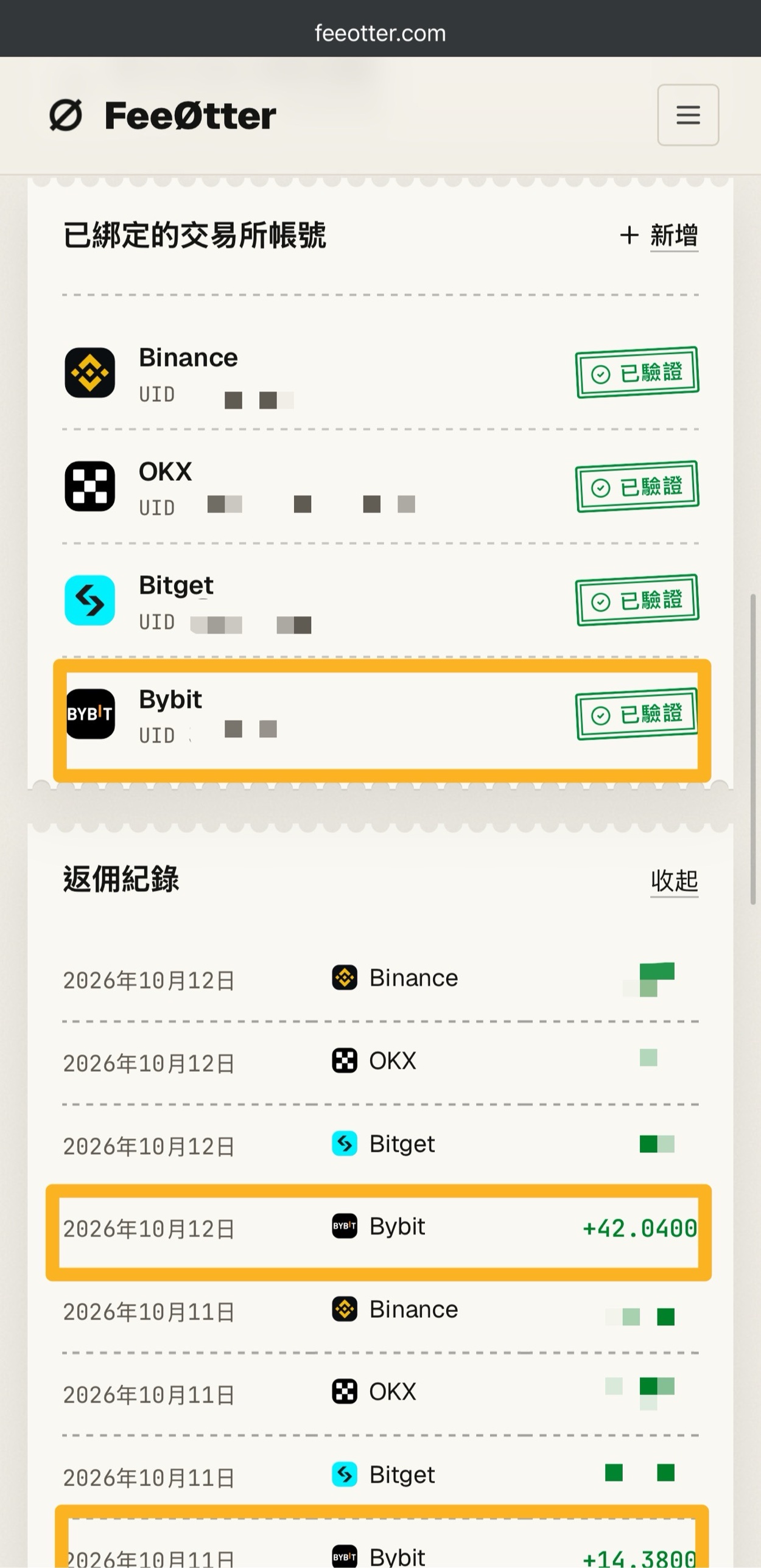
The steps for signing up, binding your UID and withdrawing are in Bybit fee rebate: Fee Otter.
Does the answer change with a higher VIP tier or a platform token discount?
All four scenarios in this article stay at VIP 0. Binance VIP 1 requires holding 5 BNB plus conditions such as USD 1 million of spot or USD 5 million of futures in 30 days; OKX and Bitget both set the VIP 1 futures threshold at 5 million in 30 days; Bybit’s is USD 10 million; MEXC’s is 10 million USDT a month. Only Gate, with its low thresholds, moves the high-frequency futures scenario up to VIP 3. Beyond these volumes, the rebate rules change:
- Binance: commission on spot and margin stops being calculated at VIP 3 and above, and futures applies only to regular users and VIP 1–2 (Binance Referral Pro FAQ).
- OKX: for traders at VIP 5 and VIP 6, commission is no longer calculated once that month’s commission reaches the cap, and it does not apply at VIP 7 and above (OKX affiliate program rules).
- MEXC: accounts registered with a referral code cannot get MEXC VIP (MEXC VIP program upgrade announcement). Futures orders placed through the API have separate fee rates and no rebate.
- Platform tokens: discounts with BNB, BGB, MX or GT reduce the fees you actually pay, and the base for the rebate shrinks with them. Combined, the two multiply: amount paid = fee × (1 − discount) × (1 − rebate percentage).
After an upgrade the fee rate drops but the rebate may stop, so the total cost is not necessarily lower; how each exchange weighs this is covered in does the referral rebate continue after a VIP upgrade.
How do you confirm you are actually getting the rebate?
The figures in this article are estimates; the actual amounts are whatever the exchange’s credit records show. Check in this order:
- First confirm the referral link is in place; how to check at each exchange is in how to check whether your referral code is bound.
- Find the exchange’s rebate records: Binance converts the rebate to USDC every hour and pays it to your Spot account within 6 hours; on OKX, go to the app menu → User Center → “My rewards”; MEXC pays the day after you trade, so check your funding records; Gate pays the rebate to your spot account after the trade completes; Pionex shows it under “Invitee Cashback” in the app; Ourbit shows it under “Self-rebate records” on the referral page.
- Divide one day’s rebate by the fees you actually paid that same day, and you have your rebate percentage. If it looks low, first rule out zero-fee trading pairs, fees covered by vouchers and VIP thresholds, then go through what to do if you did not receive your rebate step by step.
Each exchange’s referral code page on this site includes screenshots of rebates actually credited. The rebate rates sync with each exchange’s official settings every day; the values at the start and end of each month, along with the dates they changed, are in the monthly rebate rate report, and how the sync works is explained in rebate data methodology.
What are the risks and limits of rebates?
- A rebate does not make trading profitable: it only refunds part of the fees. If you trade more to earn more rebate, your fees rise too, and what comes back is always less than the extra you paid.
- Futures and leverage: if the market moves against you, your position may be liquidated and you may lose your entire margin; the rebate will not make up for that.
- Rates and rules change: exchanges can adjust rebate caps and time limits, such as Binance’s 12-month limit on futures; a rebate site’s extra rebate may also change.
- Rebates can be clawed back: for self-referral, multiple accounts, wash trading and similar behavior, exchanges will cancel or claw back rebates; each exchange’s rules are in rules for cancelled rebates. If a “rebate” asks you to pay first or guarantees profits, read rebate scam warning signs first.
FAQ
How much can a referral code rebate save in a year?
Yearly savings = yearly fees × rebate percentage. At VIP 0 rates, 1,000 USDT of spot a month means about 12 USDT in fees a year, 50,000 USDT of spot a month about 600 USDT, and 1,000,000 USDT of futures a month, all as taker, about 6,000 USDT; every 10 percentage points of rebate gives back 1.2, 60 and 600 USDT respectively.
Is a rebate worth it if I only buy a few tens of thousands of TWD of crypto a month?
It is worth entering, but the amount is small. With TWD 30,000 a month (about 1,000 USDT), a year of fees is about 12 USDT, and every 10 percentage points of rebate gives back 1.2 USDT. Entering a referral code costs nothing extra, but at this volume you save more by choosing a cheap withdrawal network (Binance charges 0.01 USDT on BEP20 and 1.5 USDT on TRC20) and an exchange with lower fees.
Is the rebate based on the trade amount or on the fees?
On the fees. If you trade 10,000 USDT and pay 10 USDT in fees, a 10% rebate gives back 1 USDT. Most exchanges calculate on net fees, so amounts covered by vouchers or trial funds do not count.
Does Binance’s futures rebate have a time limit?
Yes. The referrer earns futures commission for only 12 months from when the invitee opens a futures account, and the limit is lifted only if the referrer passes the 30% futures commission review; once the period ends, the invitee’s futures rebate also stops. No time limit is stated for spot, but it stops once you reach VIP 3 or above.
Can a platform token discount and a rebate be used together?
Yes, but the effect multiplies. After the 25% BNB discount on Binance spot, the rebate is calculated on the discounted fees, so amount paid = original fee × 0.75 × (1 − rebate percentage). Adding the 25% straight to the rebate percentage overstates what you save.
Do you get a rebate signing up for Bybit with a referral code?
Not from the exchange itself. Bybit gives invitees a welcome gift and task rewards, not a fee refund. To get fees back you need a rebate site; for example, Fee Otter’s page lists Bybit at 40%, paid by Fee Otter, and its page is what counts.
Do copy trading and grid bot fees earn a rebate?
Pionex’s fee reduction includes bot trades, and Binance states that copy trading fees count toward referral commission; Bitget, OKX, BingX and MEXC do not state officially whether copy trading counts. Copying with 1,000 USDT at 40 round trips a month means about 2,400 USDT in fees a year, 2.4 times the principal, so the rebate on this kind of trading is usually much larger than on scheduled buying.
Does Ourbit spot have a rebate?
No. Ourbit spot currently has zero fees, so there is no fee to refund and no rebate; futures fees are 0.02% maker and 0.04% taker, and only futures trading earns a rebate.
To understand how referral codes work, start with what is a referral code; the difference between KOL referral codes and regular ones is in KOL referral codes vs regular referral codes. Futures beginners can start with the Binance futures guide. Every exchange’s referral code and automatic fee rebate is listed in crypto exchange referral codes, and terms are defined in the referral rebate glossary.