

Binance
20%auto fee rebate
Futures taker after rebate 0.04%
Referral code
Main link not opening? Use the backup linkKEVINWUShow the screenshot that proves the rebate rate
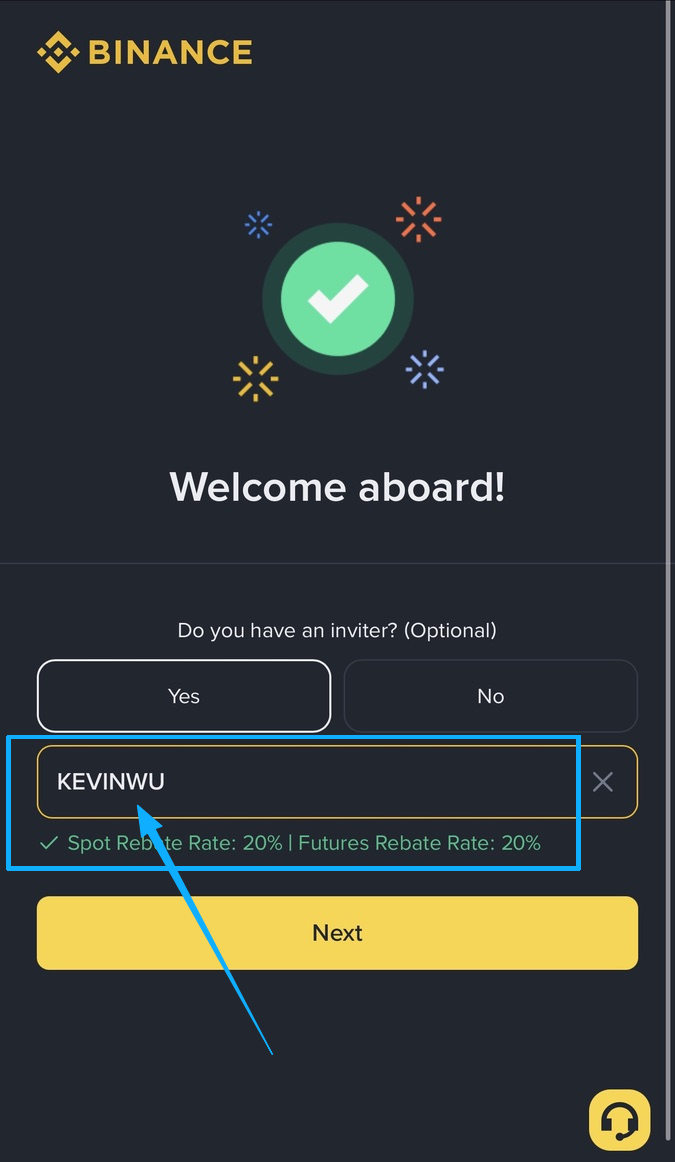
A crypto exchange referral code is the invitation code you enter at sign-up. After you sign up with one, the exchange automatically refunds a percentage of the fees you actually pay to your account, and the percentage differs by exchange. Bybit is the exception: the exchange has no rebate for invitees. The cards below list each exchange’s current rate, referral code and sign-up link. After the cards, you’ll find whether you can add a code after sign-up, what you actually pay in fees after the rebate, and an FAQ.
Futures taker after rebate 0.04%
KEVINWU
Futures taker after rebate 0.04%
KEVINWU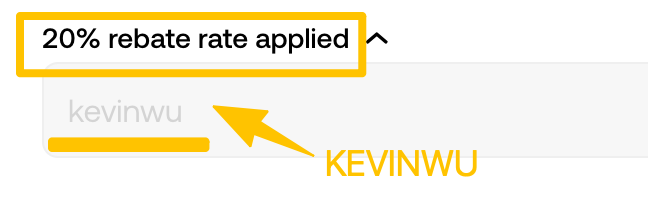

Futures taker after rebate 0.016%
mexc-KEVINWU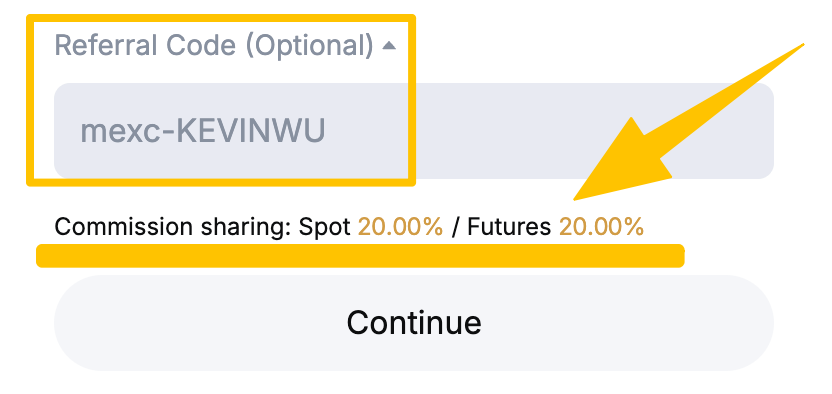

Futures taker after rebate 0.048%
KEVINWU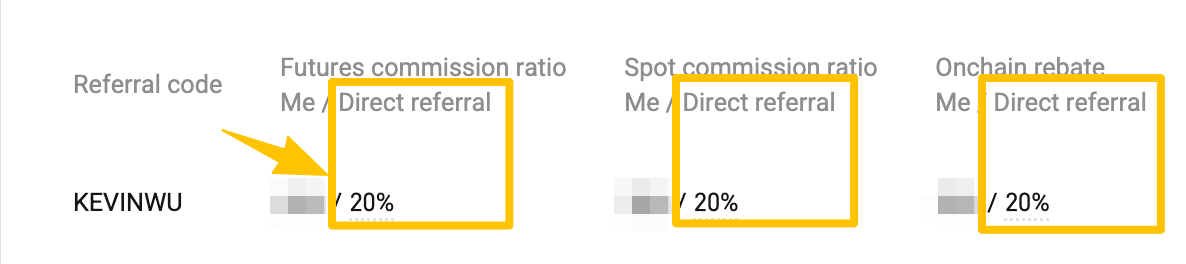

Futures taker after rebate 0.04%
KEVINXYZ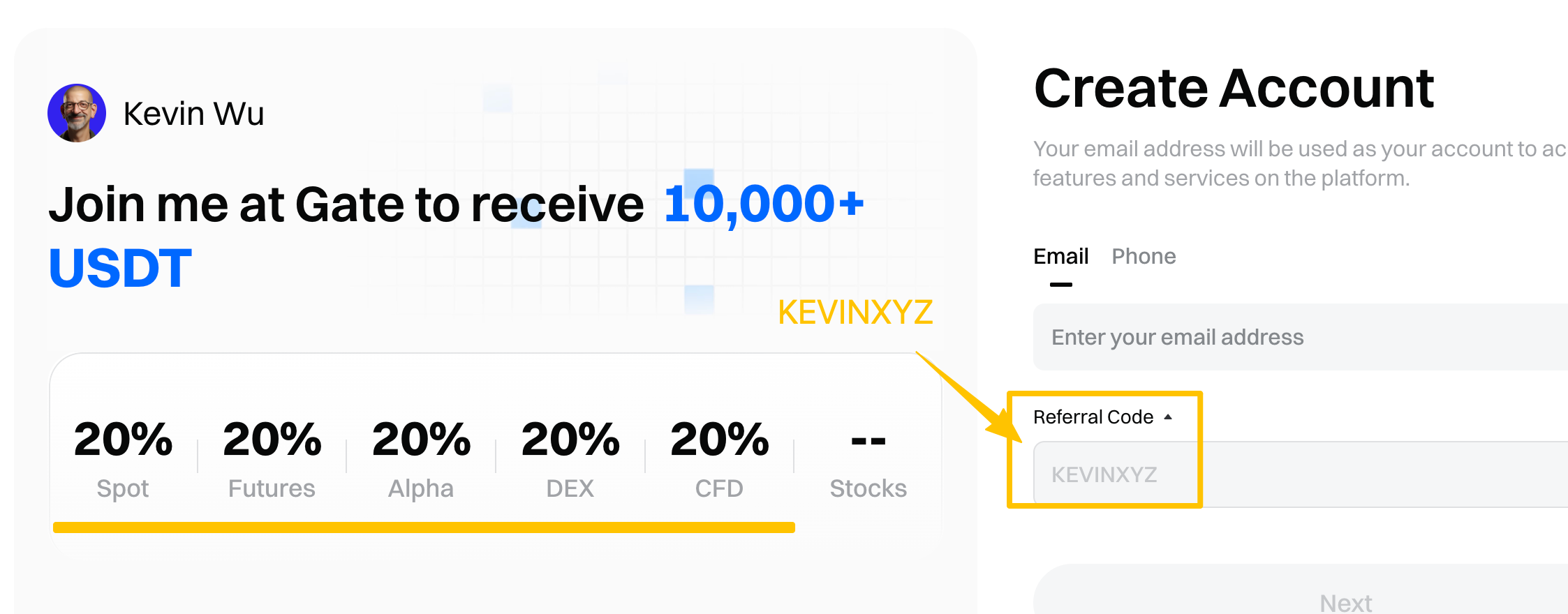

KEVINWU
Futures taker after rebate 0.02%
KEVINWU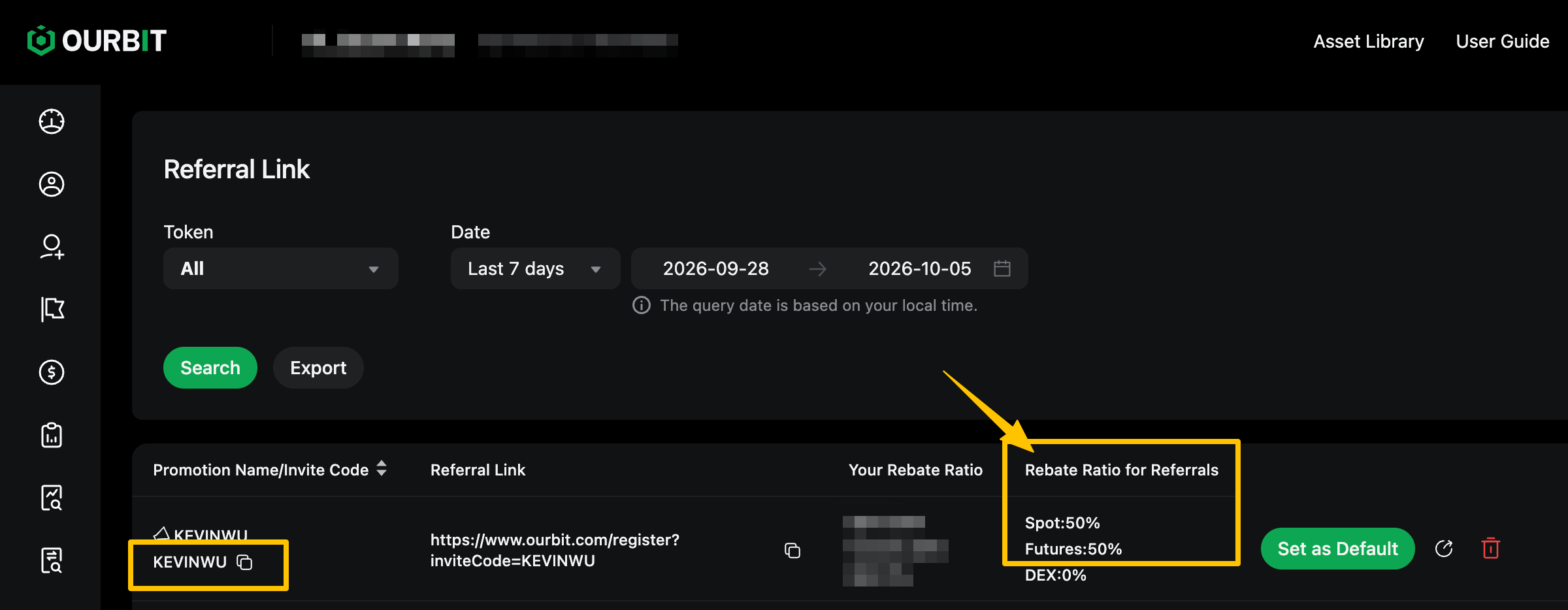

Futures taker after rebate 0.0275%
KEVINWU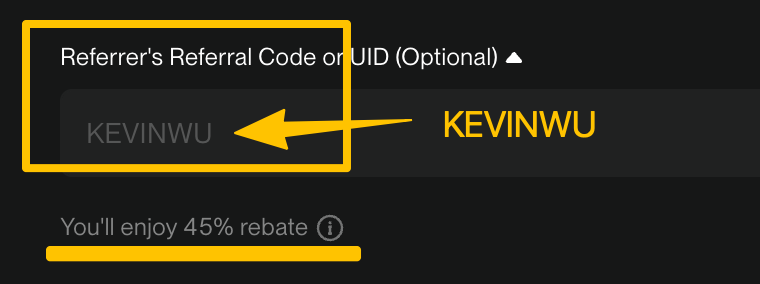

Futures taker after rebate 0.032%
kevinwu

Futures taker after rebate 0.024%
KEVINWU

KEVIN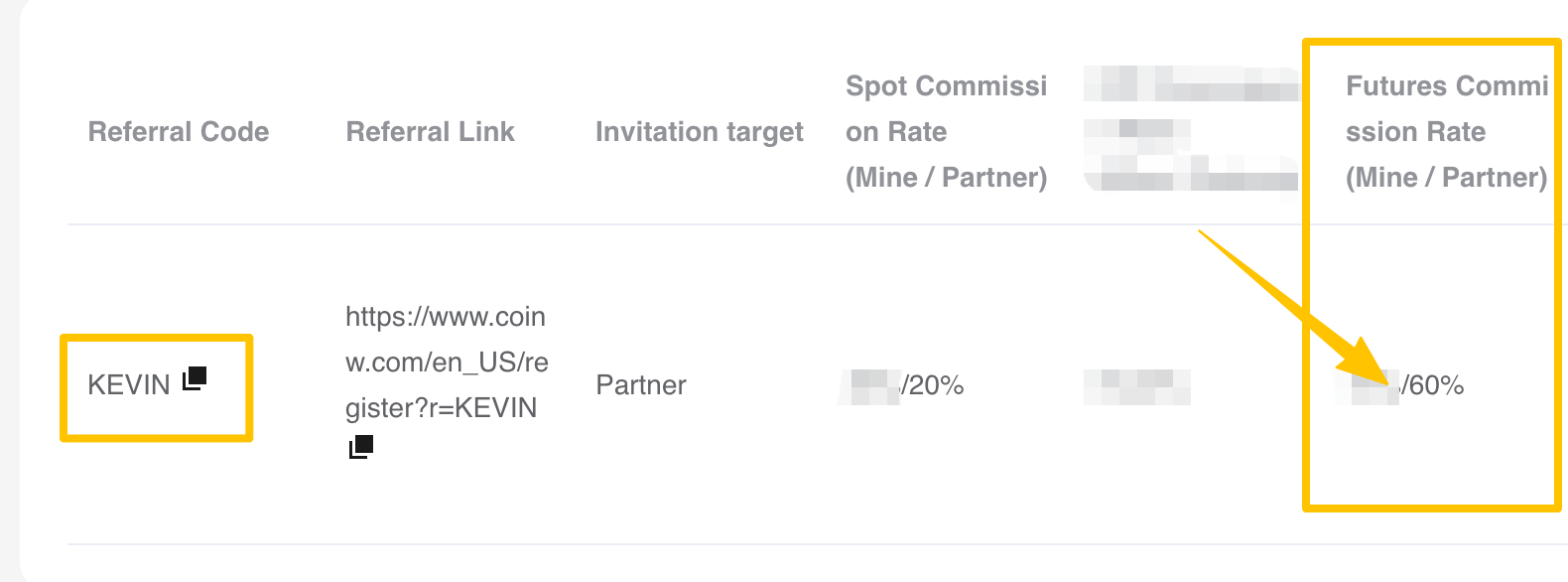

Futures taker after rebate 0%
QPFyk4yqV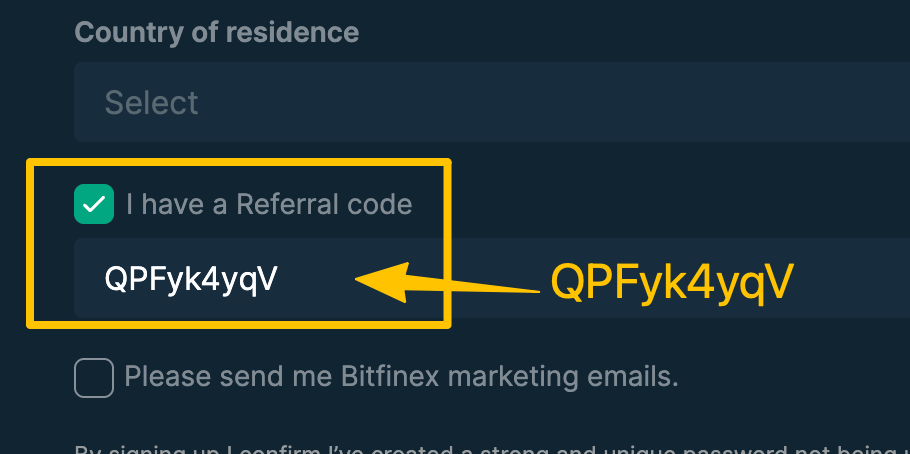

Futures taker after rebate 0.0425%
KEVINWU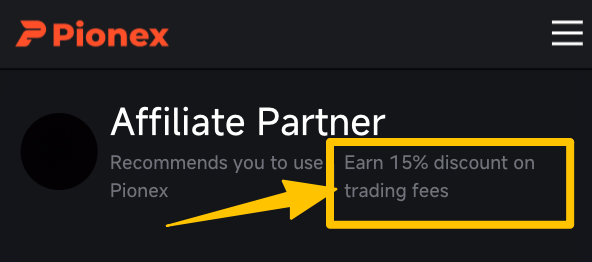

Futures taker after rebate 0.024%
KEVINWU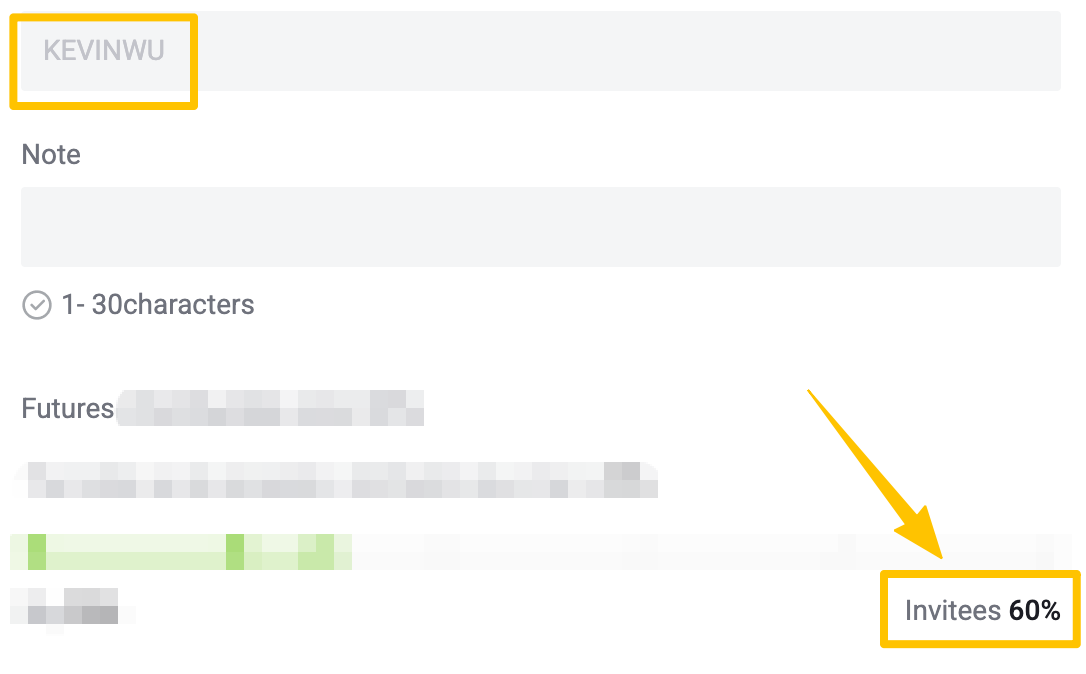

Futures taker after rebate 0.042%
KEVINWU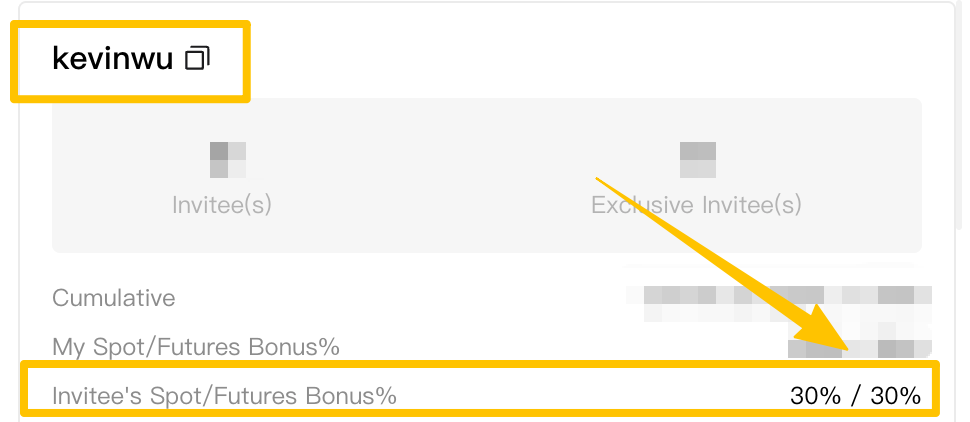
No exchanges match.
Rates are the automatic fee rebates (fee discounts) set by each exchange, compiled for reference. Updated 2026-10-23; the exchange's own page always prevails.
By default, the cards follow CoinGecko’s exchange ranking by Trust Score (checked 2026-10-22). The sort menu switches the order to rebate rate from highest to lowest, futures fee after the rebate from lowest to highest, or name. Every exchange follows the same rules, and the order isn’t adjusted for any partnership; the rules are in the exchange ranking methodology. For how the data is synced and verified, see how the rebate data is compiled. If an exchange pauses its partnership, it’s removed from this page automatically.
The “auto fee rebate (fee discount)” on this page is the part the exchange itself returns to the user’s account. You don’t apply for it, and no one else handles the money. For comparison, the Binance affiliate program guide says invitees get back at most 20%, and the OKX affiliate FAQ gives a range of 0% to 20%. Several exchanges in the cards above rebate more than that, which puts them in the highest tier available.
Key points
The exchange’s automatic rebate goes straight back to your account from the exchange and is calculated on the fees you actually pay, not on the trade amount.
Few exchanges let you add a referral code after sign-up: Binance and MEXC within 30 days of sign-up, Pionex within 14 days (only 3 if you’ve placed a trade order), and BingX before your first deposit. OKX doesn’t allow adding one; you can only submit a switch request.
If you sign up for Bybit with a referral code, the exchange doesn’t refund any fees to invitees. To get part of them back, you have to go through the rebate site Fee Otter, and Fee Otter pays it.
What gets refunded differs by exchange: Pionex’s benefit is a fee discount, Ourbit spot currently has zero fees so only futures and DEX have rebates, and Bitfinex’s trading fees are 0, so its referral code returns fees on margin funding and Borrow.
To compare costs, look at the fee after the rebate, which is the official Taker rate × (1 − rebate rate). The table below is recalculated every day with the latest rates.
The add-later rules and benefit scope were checked against each exchange’s official pages on 2026-10-14 (KuCoin rechecked on 2026-10-22). Rebate rates sync with the exchanges every day (the date is shown on the cards). Provided for reference.
The table below shows which trades each referral code’s benefit applies to, and whether you can still add a code if you forgot it at sign-up. Rebate rates change, so they aren’t in the table; see the cards above.
| Exchange | What the referral benefit covers | Can you add one after sign-up? | Official source |
|---|---|---|---|
| Binance | Spot (including margin) and USDⓈ-M futures | Yes: within 30 days of sign-up, before any deposit or trade | Referral Pro FAQ |
| OKX | Spot and futures | No: only takes effect at sign-up; after that you have to submit a switch request | OKX referral program FAQ |
| Bybit | The exchange has no fee rebate for invitees; the rebate channel is Fee Otter | Within 14 days of sign-up, affiliate codes only | Bybit: adding an affiliate code |
| Bitget | Spot and futures | No add-later process found | Bitget affiliate FAQ |
| MEXC | Spot and futures, with separate rates | Yes: within 30 days of sign-up | MEXC affiliate FAQ |
| Gate | Spot, futures and more (excluding fiat trading) | No add-later process found | Gate referral FAQ |
| BingX | Spot and futures | Yes: before your first deposit, and before you’ve invited any friends | BingX registration FAQ |
| KuCoin | Spot (including margin) and futures | You can submit a Link Referrer request, which KuCoin reviews; the conditions aren’t published | KuCoin referral program |
| HTX | Spot and futures | No add-later process found | HTX referral program rules |
| XT.COM | Futures and spot, with separate rates | No add-later process found | XT.COM referral guide |
| WEEX | Futures and spot, with separate rates | No add-later process found; the referral can’t be changed after successful sign-up | WEEX sign-up help |
| Pionex | Fee discount on spot, leveraged tokens and futures (excluding stock token spot and MEME) | Yes: within 14 days of sign-up; within 3 days if you’ve placed a trade order | Pionex: refill referral code |
| Ourbit | Futures and DEX (spot currently has zero fees, so no rebate) | Yes: while the account has no referrer bound | Ourbit invite page rules |
| Bitfinex | Refunds of margin funding and Bitfinex Borrow fees, decreasing month by month (trading fees are currently 0) | No add-later process found; the terms state you can’t refer someone who is already a Bitfinex user | Bitfinex affiliate program terms |
“No add-later process found” means the exchange’s official help center doesn’t describe a way to add a referral code after sign-up; what you see in your account and what support tells you are what count. The exchanges that do allow adding one all state that a referral can’t be changed once it’s bound. Each exchange’s steps, and how to turn the deadlines into dates, are in can you add a referral code after signing up? If you’re already bound to someone else’s referral code, see the guide to switching referral codes.
Actual fee = official Taker rate × (1 − the exchange’s automatic rebate rate). The table below uses each exchange’s official VIP 0 Taker rate for USDT-margined perpetual futures, sorted from lowest to highest. Rebate rates sync with the exchanges every day, so the order updates too; clicking an official rate opens the exchange’s fee page.
| Exchange | Standard futures taker fee | auto fee rebate | After the rebate |
|---|---|---|---|
| Bitfinex | 0% | — | 0% |
| MEXC | 0.02% | 20% | 0.016% |
| Ourbit | 0.04% | 50% | 0.02% |
| KuCoin | 0.06% | 60% | 0.024% |
| XT.COM | 0.06% | 60% | 0.024% |
| BingX | 0.05% | 45% | 0.0275% |
| WEEX | 0.08% | 60% | 0.032% |
| Binance | 0.05% | 20% | 0.04% |
| OKX | 0.05% | 20% | 0.04% |
| Gate | 0.05% | 20% | 0.04% |
| HTX | 0.06% | 30% | 0.042% |
| Pionex | 0.05% | 15% | 0.0425% |
| Bitget | 0.06% | 20% | 0.048% |
Fees are each exchange's published VIP 0 taker rates; after the rebate = fee × (1 − automatic rebate). Rebate rates synced 2026-10-23. Actual fees vary by VIP level, pair and product; your exchange statement prevails.
An exchange with a low official rate doesn’t necessarily have a high rebate rate, so look at both together. Take 1,000,000 USDT of futures volume a month, all as taker: MEXC, with an official Taker rate of 0.02%, charges 200 USDT before rebates; Bitget, at 0.06%, charges 600 USDT. Bybit isn’t in the table. For spot, see actual fees after referral rebates; for a ranking that also covers Maker fees, platform token discounts and VIP tiers, see lowest-fee crypto exchanges.
Futures use leverage: if the price moves against you, your position may be forcibly liquidated, and fees are only part of the cost.
The automatic rebate is an official exchange setting, and you can check it in two places:
Each exchange guide has a screenshot of the rebate rate and explains where to look it up. Where to see which referrer you’re bound to after sign-up, and where rebate records show up, is covered in the referral code lookup guide.
Binance referral codeOKX referral codeGate referral codeBitget referral codeMEXC referral codeBingX referral codePionex referral codeKuCoin referral codeBitfinex referral codeWEEX referral codeXT.COM referral codeHTX referral codeOurbit referral codeA referral code is an invitation code an exchange issues to a referrer. Enter it in the referral code (invitation code) field at sign-up, and your account is tied to that referrer. Once bound, you get the benefit the referrer has set; at most exchanges, that’s an automatic refund of part of your trading fees. When you reach the sign-up page through a referral link, the code is usually filled in automatically; before submitting, check that the code in the field matches the one on the card. OKX and XT.COM both warn that if you download the app first and then sign up, the referral may not bind; see will a referral code bind if you sign up in the app?
The difference is in fees: without a referral code, you pay the full fee; with one, the exchange refunds a percentage of the fees you actually pay. Take Binance’s USDⓈ-M futures Taker rate of 0.05% (Binance futures fee guide): with 100,000 USDT in monthly volume, the fee is 100,000 × 0.05% = 50 USDT, and the rebate is that 50 USDT multiplied by the rebate rate.
If you sign up with this site’s Binance referral code, the current exchange automatic rebate is 20%, so the amount you get back each month is 50 USDT times that rate.
At some exchanges, yes, but the windows are short. Binance and MEXC allow it within 30 days of sign-up (Binance also requires no deposits or trades), Pionex within 14 days of sign-up, or only 3 days if you’ve placed a trade order, BingX before your first deposit, and Ourbit as long as the account has no referrer. At Bybit, within 14 days of sign-up you can add only an affiliate’s code; OKX doesn’t allow adding one, only a switch request; KuCoin takes a Link Referrer request under Self-Service in the Help Center, which it reviews, without published time limits or conditions (checked 2026-10-22); and no add-later process can be found for Bitget, Gate, HTX, XT.COM or WEEX. Full conditions are in can you add a referral code after signing up?
The exchange’s automatic rebate is paid straight into your account by the exchange, with no application needed, and the timing differs by exchange. Binance converts it to USDC every hour and pays it to your spot account within 6 hours; Gate pays it to your spot account automatically once the trade completes, taking 1–2 hours in special cases; XT.COM pays it to your spot account the day after the trade (T+1); MEXC pays it the day after the trade; Pionex pays it in USDT to your main account, with records updated hourly; Ourbit pays it the next morning (UTC+8) in the fee currency. Other exchanges don’t state the timing officially. If you haven’t received it, work through what to do if your referral rebate hasn’t arrived item by item.
With a referral code, the exchange’s automatic rebate goes straight from the exchange into your account, with no third party involved. A rebate site is an exchange affiliate: it receives commission from the exchange and then pays part of it to you separately. A rebate site’s extra rebate goes through its own reports, settlement and payouts, so if the rebate site stops operating, you lose that part; the exchange’s automatic rebate isn’t affected. Some rebate sites’ referral codes also carry an exchange automatic rebate, so you can get both at once. For how to compare them, see how to choose a rebate site and the rebate glossary.
Under Bybit’s referral program, the referrer earns commission and the invitee gets task rewards and new-user bonuses; Bybit doesn’t state that invitees can share in a fee rebate (Bybit referral program FAQ). To get part of your Bybit fees back, you can use the rebate site Fee Otter: sign up with its Bybit referral code, then bind your UID on Fee Otter. This rebate is paid by Fee Otter, not the exchange and not Kevin Wu, and the rate is as shown on Fee Otter’s page. An account within 14 days of sign-up that doesn’t have a referrer yet can also add Fee Otter’s affiliate ID. For the process and risks, see Bybit fee rebate: getting fees back with Fee Otter.
At most exchanges, no. The ones that allow adding a code all state that a referral can’t be changed or removed once it’s bound. Official channels are few: OKX lets you submit a switch request, which the system reviews, usually within 24 hours, and requests must be 30 days apart; Binance’s affiliate switch only applies to accounts that don’t have a referrer yet; KuCoin lets you request Unlink Referrer, which it reviews, but it doesn’t say whether you can then link a different referrer. Deleting your account and signing up again isn’t a good idea: Binance states that if it detects an account closed and a new one opened to get referral benefits, it has the right to terminate the new account’s referral commission. For each exchange’s options, see the guide to switching referral codes.
Once a day. The rates in the cards and in the actual-fee table sync with the exchanges’ settings every day, and the last update date is shown on the cards; if an exchange changes its rate or pauses its partnership, this page changes with it. The add-later rules, benefit scope and official fee rates are text I compiled by checking official pages, and the verification date is shown above the cards. The exchange’s current page prevails.
If you haven’t signed up yet, the safest way to avoid mistakes is to go in through the sign-up link on a card and check the referral code field before you submit. Don’t trust any rebate service that asks for your password, verification codes or API keys; common tactics are covered in how to spot a rebate scam, and cases where rebates are cancelled or withheld are in when rebates get cancelled.