


Updated Rules checked 2026-10-17
For regular users (VIP 0), Bybit and MEXC charge very different fees. On USDT-margined futures, Bybit charges Maker 0.02% and Taker 0.055%, while MEXC’s standard rate is Maker 0% and Taker 0.02%; on major-coin spot, Bybit charges 0.1% / 0.1% and MEXC 0% / 0.05%. The rebates also come from different places. If you sign up to MEXC with a referral code, the exchange itself refunds part of your net fees; Bybit doesn’t refund invitees, so you need a rebate site such as Fee Otter to get fees back, and the money is paid by a third party. Even if you get back the 40% Fee Otter lists for Bybit, futures Taker comes to about 0.033%, still higher than MEXC’s 0.02% before any rebate.
On security, Bybit lost 401,346 ETH (about 1.5 billion USD) in a hack on 2025-02-21; withdrawals kept running and the gap was filled in about 72 hours. As of 2026-10-12, we found no major public incident of MEXC’s platform wallets being hacked, but in 2025 MEXC froze about 3.1 million USD belonging to one trader, then apologized and unfroze it. The two also differ a lot in size: in the latest proof-of-reserves snapshots, users hold 56,131 BTC on Bybit, about 13.7 times MEXC’s 4,106.57 BTC.
If you mainly trade futures, often use market orders, mostly trade major coins, or only think of entering a referral code after signing up, choose MEXC, which leaves a 30-day window to add one later. If you want TradFi products such as options and forex CFDs, run algorithmic trading through the API (MEXC charges a separate 0.06% / 0.08% for API futures), or care more about platform size and not paying an extra fee when liquidated, Bybit is the better fit. Neither exchange lists Taiwan among its restricted regions, and neither offers a way to deposit New Taiwan dollars (TWD); both support the Plasma network, and on 2026-10-12 USDT withdrawals cost 0 on both sides.
Sign up to MEXC with referral code mexc-KEVINWU and the exchange automatically refunds 20%; spot and futures rates are set separately.
Key points:
1. VIP 0 futures: Bybit 0.02% / 0.055%, MEXC standard rate 0% / 0.02%; major-coin spot: Bybit 0.1% / 0.1%, MEXC 0% / 0.05%. With 200,000 USDT of futures plus 20,000 USDT of spot a month, all as Taker, you pay 130 USDT on Bybit and 50 USDT on MEXC.
2. Bybit has no automatic rebate from the exchange. Fee Otter’s rebate page lists Bybit at 40% (checked 2026-10-17), paid by Fee Otter; MEXC’s referral rebate is refunded directly by the exchange and calculated on net fees.
3. Fixing a missing referral code: MEXC lets you bind one yourself within 30 days of sign-up; on Bybit you can only add a partner’s affiliate code within 14 days, after which the only route is reassignment after 180 days of inactivity.
4. Maximum BTC leverage: Bybit 150x, MEXC 500x; Bybit charges no liquidation fee on perpetual contracts.
5. Bybit lost about 1.5 billion USD in ETH to a hack on 2025-02-21, and withdrawals kept running; we found no record of MEXC’s platform wallets being hacked, but MEXC faced a dispute over a frozen account in 2025.
The data below was checked against official pages on 2026-10-17 (data check date) and is provided for reference.
How do Bybit and MEXC differ?
| Item | Bybit | MEXC |
|---|---|---|
| Spot Maker / Taker (VIP 0) | 0.1% / 0.1% | 0% / 0.05% (major coins; many smaller-coin pairs charge 0.08% or 0.2% Taker) |
| USDT-margined futures Maker / Taker (VIP 0) | 0.02% / 0.055% | 0% / 0.02% (standard rate; some contracts charge 0.01% / 0.04% or more) |
| Platform-token discount | MNT: 25% off spot (0.075%), 10% off USDT perpetuals (Taker 0.0495%); not available for inverse contracts, copy trading or API | MX: 20% off both spot and futures (spot Taker 0.04%, futures Taker 0.016%) |
| Referral code rebate | No automatic rebate from the exchange; Fee Otter rebate | 20% |
| Adding a referral code after sign-up | Main accounts with no referrer can add a partner’s affiliate code within 14 days of sign-up (a regular user’s referral code can’t be added) | Main accounts with no referrer can bind one themselves within 30 days of sign-up |
| Switching referrers | No switch request; accounts registered after 2025-09-01 with under 1 USD in trading volume for 180 consecutive days can be reassigned | Can’t be changed or removed once bound |
| Identity verification requirement | All products and services require Standard individual verification first | MEXC states that identity verification is required to use the relevant services; two levels, Primary and Advanced |
| Unverified accounts | Can’t deposit or trade; withdrawals capped at 20,000 USDT a day and 100,000 USDT a month | Deposits may not be credited, and withdrawals prompt you to verify first; no limits are officially listed |
| Restricted regions (Taiwan) | Taiwan isn’t on the 2026-10-16 restricted-service list | Taiwan isn’t listed in the 2026-10-13 terms of use |
| TWD deposit options | No TWD bank deposits; the P2P TWD market had 0 USDT buy and 0 sell ads (checked 2026-10-13) | No TWD bank deposits; TWD isn’t among the 60 fiat currencies on P2P (checked 2026-10-11) |
| Maximum BTC futures leverage | 150x (first tier, positions up to 300,000 USDT) | 500x (tier 1, up to 12 BTC) |
| Number of USDT perpetuals | 798 (2026-10-17) | 1,085 (2026-10-17) |
| Funding settlement | 416 every 8 hours, 380 every 4 hours; BTC cap/floor ±0.333% | 572 every 8 hours, 508 every 4 hours; BTC cap/floor ±0.18% |
| Fees on liquidation | No liquidation fee on perpetual or delivery contracts | The margin ratio formula includes a liquidation fee; the official explanation doesn’t state the rate |
| Copy trading / grid | Classic copy trading (USDT perpetuals), Copy Trading Pro, TradFi copy trading; spot and futures grid, DCA, Martingale, combo strategies | Futures copy trading (including AI traders); futures grid, spot grid, spot DCA |
| Copy trading profit share | Classic copy trading: 10%–15% depending on trader level, withheld daily and settled every Monday | 10% by default, traders can apply to adjust it, up to 50% in private mode; settled daily |
| Cheapest USDT withdrawal network and fee | Plasma 0 USDT (minimum 2); BEP20 0.15, TRC20 1.3, ERC20 0.8 | Plasma 0 USDT (minimum 10); BEP20 0.01, TRC20 0.5, ERC20 0.094 |
| Proof of reserves (latest snapshot) | 2026-09-23, 40th snapshot: BTC 104%, ETH 103%, USDT 110% (verified by Hacken) | 2026-09-10: BTC 297%, ETH 111%, USDT 119% (verified by Hacken) |
| Protection fund | We found no separate user protection fund; futures have a separate insurance fund | Guardian Fund of 100 million USDT plus 2,000 BTC; MEXC states it’s a company commitment, not statutory compensation |
| Major security incidents | 401,346 ETH (about 1.5 billion USD) stolen on 2025-02-21; withdrawals kept running, gap filled in about 72 hours | No major public incident of platform wallets being hacked (as of 2026-10-12); froze about 3.1 million USD of a user’s funds in 2025, later unfroze them and apologized |
Fee sources: Bybit trading fee structure (updated 2026-09-02), Bybit FAQ on paying trading fees with MNT, Bybit fees overview, MEXC fee overview, MEXC futures trading FAQ and the MEXC MX fee discount announcement (the 50% discount for holding 500 MX is currently suspended; only the 20% MX deduction remains). Identity verification comes from the Bybit individual KYC FAQ, Bybit KYC level benefits (updated 2026-10-06) and the MEXC KYC FAQ. Leverage, contract counts and funding settlement intervals were counted from the two exchanges’ official public APIs on 2026-10-17 (Bybit contract specs, Bybit risk limits, MEXC contract details), covering USDT perpetuals currently trading; they change as contracts are listed and delisted. USDT withdrawal fees are from the Bybit deposit and withdrawal status page and the MEXC fee overview on 2026-10-12, and may change daily. Sources for the other rows are given in the relevant sections below.
How much do Bybit and MEXC fees differ?
Suppose someone trades 200,000 USDT of USDT-margined futures and 20,000 USDT of major-coin spot a month, all at the official VIP 0 rates:
| Monthly fees (USDT) | Bybit | Bybit (MNT discount on) | MEXC | MEXC (MX deduction on) |
|---|---|---|---|---|
| Futures 200,000, all Taker | 110 | 99 | 40 | 32 |
| Spot 20,000, all Taker | 20 | 15 | 10 | 8 |
| Total (all Taker) | 130 | 114 | 50 | 40 |
| Total (all switched to Maker) | 60 | 51 | 0 | 0 |
The formula is trade value times the fee rate: futures cost 200,000 × 0.055% = 110 USDT on Bybit and 200,000 × 0.02% = 40 USDT on MEXC; spot costs 20,000 × 0.1% = 20 USDT on Bybit and 20,000 × 0.05% = 10 USDT on MEXC. With every order as Taker, you pay 80 USDT more a month on Bybit, 2.6 times what MEXC charges, and most of the gap comes from futures Taker (0.055% vs 0.02%). If every order is Maker, MEXC’s 0% Maker rate means you pay nothing at all; on Bybit, futures Maker at 0.02% comes to 40 USDT, and because spot Maker and Taker cost the same, limit orders save nothing there, so spot is still 20 USDT.
The platform-token discounts have different limits. Bybit’s MNT must cover the whole fee, or the entire fee is charged at the full rate, and it doesn’t apply to copy trading, API or liquidation orders; MEXC’s MX deduction works on both spot and futures. You bear the token’s price swings yourself. Both exchanges let you place Maker-only orders, and both call them Post-Only; see Maker vs Taker fees for details. Futures fees are charged on position value, not on margin; leverage magnifies the position, and if the price moves against you the position may be force-liquidated and you lose your margin.
Three exceptions to MEXC’s low fees
The first is smaller coins. MEXC sets fees per trading pair: its spot fee table on 2026-10-11 listed 1,984 pairs, 1,116 of them at 0% / 0.08% and 178 at 0% / 0.2%. In the official futures API on 2026-10-17, 896 of the 1,085 USDT perpetuals were at 0% / 0.02% and 103 had zero fees, but 62 were at 0.01% / 0.04% and 20 at 0.04% / 0.1%. A spot Taker fee of 0.2% is twice Bybit’s, and a futures Taker fee of 0.1% is also higher than Bybit’s 0.055%, so check the rate on the trading page before trading smaller coins (MEXC fees guide).
The second is the API. Since 2026-06-01, MEXC charges a separate Maker 0.06% and Taker 0.08% on futures orders placed through the API; web and app rates don’t apply, and there is no rebate (MEXC API futures fee announcement). The Bybit trading fee structure doesn’t list a separate API rate; API orders just can’t use the MNT discount, so for algorithmic traders Bybit’s 0.02% / 0.055% actually works out cheaper. The third is the new-user offer: new users in Chinese-speaking regions who complete advanced identity verification get a combined zero-fee allowance of up to 3 million USD on BTC, ETH and GOLD futures, and MEXC reserves the right to change or end it at any time (MEXC new-user futures fee announcement, 2026-06-04). Trades within this allowance carry no fees, so they earn no rebate either.
How much rebate would Bybit need to match MEXC’s fees?
A rebate refunds part of the fees you actually paid. To find how far Bybit’s 0.055% futures Taker fee has to fall to match MEXC, work backwards from what you pay on Bybit = 0.055% × (1 − rebate rate). The thresholds are:
| Comparison | What you pay on MEXC | Minimum Bybit rebate |
|---|---|---|
| MEXC with no rebate, Bybit without MNT | 0.02% | 63.6% |
| MEXC with no rebate, Bybit with MNT (0.0495%) | 0.02% | 59.6% |
| MEXC with MX deduction and no rebate, Bybit without MNT | 0.016% | 70.9% |
The formula is 1 − what you pay on MEXC ÷ Bybit’s rate, for example 1 − 0.02 ÷ 0.055 = 63.6%. Fee Otter lists Bybit at 40%, still well short of every one of these thresholds, so on futures Taker alone, MEXC before any rebate is cheaper than Bybit after its rebate, and MEXC’s own referral rebate brings it lower still. Bybit can come out cheaper in the cases mentioned above: API trading, and smaller coins where MEXC charges higher fees.
Calculator: MEXC futures (Taker 0.02%)
| Monthly volume | Fees (0.02%) | Auto rebate (20%) | Net fees |
|---|---|---|---|
| 10,000 USDT | 2 USDT | 0.4 USDT | 1.6 USDT |
| 100,000 USDT | 20 USDT | 4 USDT | 16 USDT |
| 1,000,000 USDT | 200 USDT | 40 USDT | 160 USDT |
Example at a futures fee rate of 0.02% and the current 20% automatic rebate (rate updated 2026-10-24). Your exchange statement prevails.
Sign up with this site’s MEXC referral code and the exchange’s automatic rebate is 20%, updated in sync with the exchange. MEXC states that rebates are calculated on net fees, so with the MX deduction on, they’re based on the discounted amount you actually pay. Maker 0% orders and zero-fee trades carry no fees and therefore no rebate, so in practice rebates only come from Taker orders.
Bybit: get fees back through Fee Otter
Bybit’s referral program gives invitees a welcome gift and trading task rewards; it doesn’t state that invitees get a share of fees as a rebate (Bybit referral program FAQ, updated 2026-10-10). Fee Otter’s rebate page lists Bybit at 40% (checked 2026-10-17). All of it is an extra rebate from Fee Otter, paid by Fee Otter, not by the exchange or by Kevin Wu. The trader above pays 130 USDT on Bybit, or 78 USDT after 40% back, still 28 USDT more than the 50 USDT on MEXC before any rebate.
Below is a screenshot of my own Fee Otter dashboard, showing Bybit rebates actually credited:
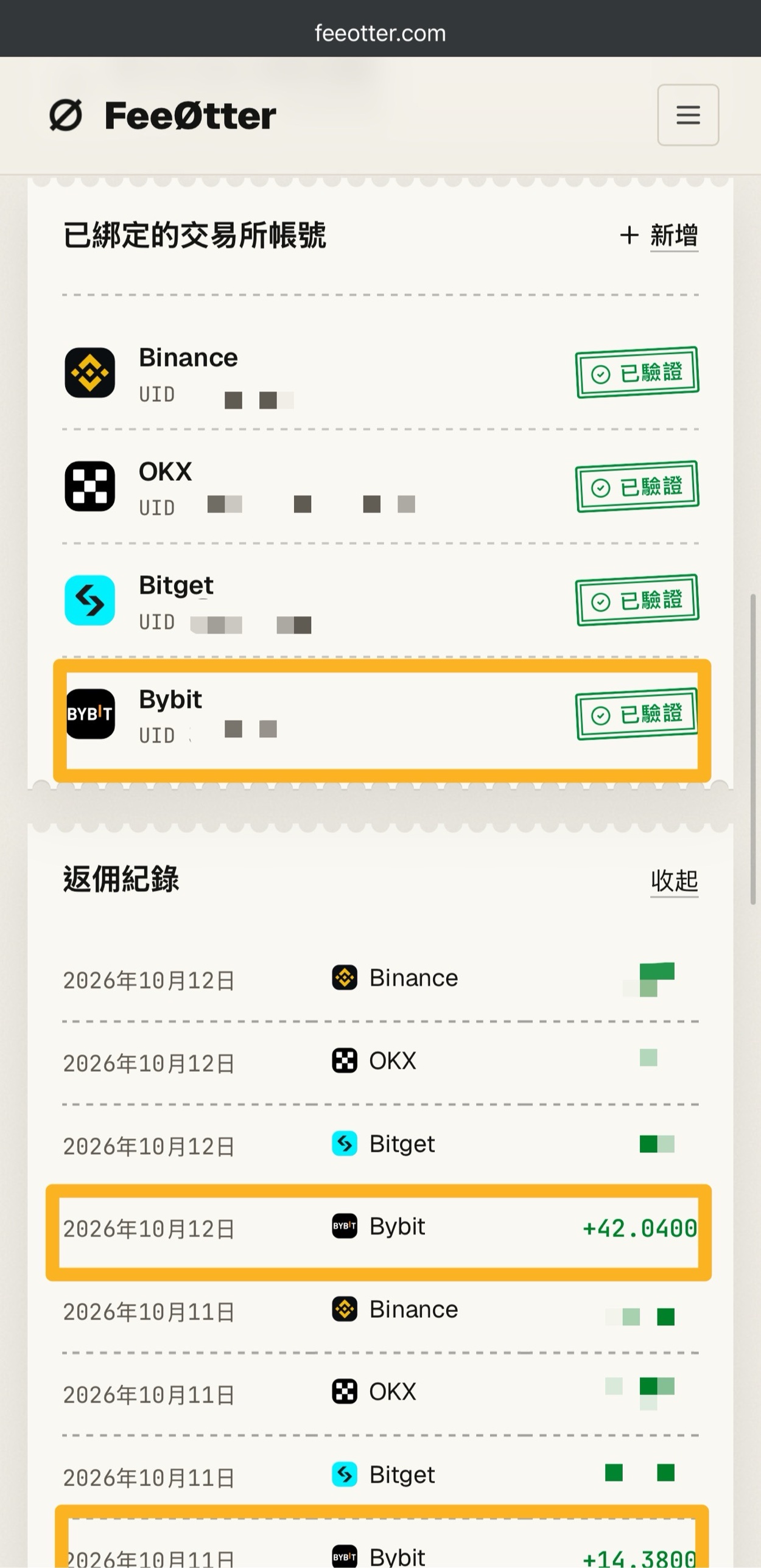
This money is held in your Fee Otter account and has to be withdrawn separately, and there’s a risk that the third party changes its rates or stops operating; the rate on Fee Otter’s current page is what counts. Bybit doesn’t state whether turning on the MNT discount affects the rebate. For the steps to sign up and link your UID, see Bybit rebate: get fees back with Fee Otter; fees after rebates for each exchange are listed in Actual fees after referral rebates. For full fee rates, VIP thresholds and withdrawal fees, see Bybit fees and MEXC fees; to run your own numbers, use the perpetual futures cost calculator.
VIP doesn’t matter much for most people. Bybit VIP 1 requires 100,000 USD in assets or 10 million USD in 30-day futures volume and lowers futures Taker to 0.04% (Bybit VIP program introduction), still twice MEXC’s rate; MEXC’s rules don’t allow invited users to join its VIP program (MEXC VIP program upgrade announcement).
How do Bybit and MEXC futures terms compare?
For futures you also need to look at leverage caps, liquidation distance and funding fees. The figures below come from the official APIs and help pages, read on 2026-10-17:
| Futures terms | Bybit | MEXC |
|---|---|---|
| Maximum BTC futures leverage | 150x | 500x |
| BTC first-tier position cap / maintenance margin rate | 300,000 USDT / 0.33% | 12 BTC / 0.1% |
| USDT perpetuals capped at 25x or less | 610 (76%) | 659 (61%) |
| 10x isolated long: price drop that triggers liquidation | About 9.70% | About 9.9% (official formula excludes the liquidation fee) |
| USDT perpetuals settling funding every 4 hours | 380 (48%) | 508 (47%) |
| BTC funding rate cap/floor | ±0.333% | ±0.18% |
| Liquidation fee | None on perpetual or delivery contracts | Charged; the official explanation doesn’t state the rate |
| Bankruptcy losses | Covered by the insurance fund, with auto-deleveraging (ADL) if it falls short | Covered by the insurance fund, and users don’t take on extra debt; auto-deleveraging if it falls short |
Leverage data comes from the Bybit risk limit API and the MEXC contract details API; liquidation rules follow the Bybit liquidation process, the MEXC futures liquidation FAQ and the MEXC insurance fund FAQ; funding follows the Bybit introduction to funding rates and the MEXC funding rate explanation. Liquidation distance is calculated with an assumed BTC entry price of 80,000 USDT, chosen for easy math, and the first-tier maintenance margin rate.
500x applies only to BTC and ETH on MEXC and drops to 200x for positions above 12 BTC; at 500x, a price move of about 0.1% against you triggers liquidation. Most smaller-coin contracts on both exchanges are capped at just 20–25x. Bybit charges no liquidation fee, but the lowest tier is closed at the bankruptcy price, so once liquidation is triggered you still lose the remaining margin.
Funding is paid between longs and shorts, not collected by the platform, and you don’t pay it if you close before settlement; with MEXC’s low fees, funding more easily becomes your main cost. On a 10,000 USDT position at 0.01% per settlement, holding for 3 days costs 9 USDT in funding (every 8 hours) or 18 USDT (every 4 hours), while opening and closing with Taker orders costs only 4 USDT on MEXC and 11 USDT on Bybit. Before holding a position, check the countdown next to the funding rate on the trading page. See What is the funding rate for how it works, and use the liquidation price calculator to estimate your liquidation price. Setup steps, cross and isolated margin, and take-profit/stop-loss settings for both exchanges are covered in the Bybit futures guide and the MEXC futures guide.
How do Bybit and MEXC referral rebate rules differ?
On MEXC, the partner shares commission with you and the exchange pays it straight into your account. Bybit has no such mechanism: a rebate site earns commission from Bybit’s partner (affiliate) program and passes part of it on to you:
| Rule | Bybit (via Fee Otter) | MEXC |
|---|---|---|
| Who pays the rebate | Fee Otter, credited to your Fee Otter account | The exchange, directly to your MEXC account |
| Calculation basis | Partner commission is based on “trading fees − market maker rebates − bonuses/vouchers” | Net fees = fees − bonuses − vouchers − other discounts; the amount after the MX deduction is what counts |
| Duration | Partner commission is for life, but the relationship may end after 180 consecutive days without trading | Not publicly stated |
| VIP limit | Total fee rebates for VIP accounts under a partner are capped at 50% | Invited users can’t join the MEXC VIP program |
| Payout timing | Per Fee Otter’s rebate page: settled daily, withdrawals reviewed manually, paid within 3 business days, up to 5 times a month | Paid before 09:00 (UTC+8) the day after the trade |
| Trades with no rebate | Fees offset by bonuses or vouchers; users who receive other discounts “may not contribute” commission | Maker 0% orders, zero-fee pairs, API orders, and fees offset by vouchers or trial funds |
| Adding a referral code later | Main accounts with no referrer can add a partner’s affiliate code within 14 days of sign-up; it can’t be removed once added | Main accounts with no referrer can bind one themselves within 30 days of sign-up; the referrer must have registered before you |
| Changing referrers | No switch request; for accounts registered after 2025-09-01 with under 1 USD in trading volume for 180 consecutive days, trading again through a new partner’s link reassigns the account | Can’t be changed or removed once bound |
| Checking the binding | The account info page shows the bound affiliate code | “My Inviter” on the Invite Friends page |
Bybit’s rules come from the Bybit affiliate program FAQ (updated 2026-09-19), the Bybit guide to adding and checking an affiliate code and section 7.7 of the Bybit affiliate terms; MEXC’s rules come from the MEXC referral rules, the MEXC affiliate FAQ (2026-07-20) and the MEXC self-service referrer linking guide.
If you’ve just signed up, MEXC gives you more room to fix things: within 30 days, enter the referrer’s invitation code or UID on the self-service binding page to add it. Bybit allows only 14 days and accepts only a partner’s affiliate code; after 14 days, the only route officially described is 180 days of inactivity. Bybit also has a formal identity transfer feature; see Bybit referral rebind for details. On MEXC, a binding can’t be changed once made; see the MEXC referral rebind guide. To confirm who you’re bound to, see How to check your referral code binding.
Do Bybit and MEXC both require identity verification? What should users in Taiwan know?
Identity verification: both require verification for normal use; the difference is whether an unverified account can still withdraw. Bybit states that all products and services require at least Standard individual verification; unverified accounts can’t deposit or trade but can still withdraw, up to 20,000 USDT a day and 100,000 USDT a month, rising to 1 million USDT a day after Standard. MEXC states that users must complete identity verification to use the relevant products and services. Its KYC FAQ lists two pop-ups: “funds restricted, cannot be credited” when depositing, and a request to complete real-name verification first when withdrawing. Primary verification allows withdrawals of 80 BTC a day, Advanced 200 BTC. The number of accounts differs too: each person can have only one verified account on Bybit, while on MEXC the same identity can verify up to two accounts. For the steps, see the Bybit KYC guide and the MEXC KYC guide.
Restricted regions: Bybit’s service-restricted countries (updated 2026-10-16) include the United States, mainland China, Hong Kong, Singapore, Canada and other regions; the MEXC terms of use (updated 2026-10-13) list the United States, the United Kingdom, Canada, Hong Kong, Singapore, Malaysia, mainland China, Kazakhstan and other regions. Neither list includes Taiwan. If you travel abroad often or have residency elsewhere, check the exchange restricted countries list first.
TWD deposits and withdrawals: neither exchange offers direct New Taiwan dollar bank deposits. On 2026-10-13, the Bybit P2P TWD market had 0 USDT buy ads and 0 sell ads; on 2026-10-11, TWD wasn’t among the 60 fiat currencies supported on MEXC P2P. The practical route is the same for both: buy USDT with TWD on a local Taiwanese platform (such as MAX or BitoPro), transfer it to the exchange, and reverse the route to cash out. The cheapest network from Bybit to MAX is Aptos (0.002 USDT), and from MEXC to MAX it’s Avalanche C-Chain (0.000074 USDT), both as of 2026-10-12; see USDT withdrawal fees compared for each network’s fees.
App: when we checked, both apps were available on the Taiwan App Store. The developer of the Bybit app is Bybit Fintech Limited and the developer of the MEXC app is Onechain Technology Ltd; both websites are available in Traditional Chinese.
What are Bybit and MEXC each good at?
Bybit‘s strengths are its range of derivatives and its size. It offers options and TradFi (perpetuals and CFDs on assets such as forex and gold), and users’ BTC holdings are about 13.7 times MEXC’s.
- Copy trading: Classic copy trading supports only USDT perpetuals. Lead traders take 10%–15% of net profit depending on their level, withheld daily and settled every Monday, with a minimum of 100 USDT (Bybit copy trading profit sharing explained); copy trading can’t use the MNT discount.
- Trading bots: spot grid, futures grid, DCA, Martingale and combo strategies (Bybit trading bots).
- Options and TradFi: options at VIP 0 are Maker 0.02%, Taker 0.03%; the verification permissions table lists TradFi perpetual contracts and contracts for difference (CFDs).
- Earn: on 2026-10-13, USDT flexible savings paid 6.87% APR on the first 200 USDT and 1.87% on the amount above that (Bybit Earn API); there are also Launchpool, Launchpad and the Bybit Card.
MEXC‘s strengths are fees and the number of contracts. On 2026-10-17 it had 1,085 USDT perpetuals trading, about 36% more than Bybit’s 798, and 1,801 tradable spot pairs (read from the MEXC spot API on 2026-10-11). If you want to trade futures on smaller coins, you have more to choose from.
- Copy trading: futures copy trading, including AI traders you can follow (MEXC copy trading). The profit share is 10% by default; traders can apply to adjust it, up to 50% in private mode. The previous day is settled daily between 00:00 and 01:00, the profit share is frozen when a profitable trade is closed, and apart from trading fees, funding and the profit share there are no other charges (MEXC profit-sharing rules).
- Trading bots: futures grid (long, short or neutral, from just 10 USDT, MEXC futures grid), spot grid and spot DCA.
- Earn: standard USDT flexible savings pays 6.0% APR on the first 200 USDT, 2.5% from 200 to 500 USDT and 0.3% above 500 USDT; Earn Plus pays higher tier rates on larger amounts, about 5.35% on 10,000 USDT (snapshot of 2026-10-13, MEXC Earn).
- Other: gold and silver perpetuals (up to 1,000x on 2026-10-17), US stock futures, Launchpad, pre-market trading, DEX+ on-chain trading and a futures demo account; P2P charges no fees.
Copy trading costs include fees too. Copy trades are usually orders that fill immediately, and MEXC states that copy trading uses IOC limit orders and pays the Taker rate (MEXC copy trading glossary). Copying a trader who makes 40 round trips a month with 1,000 USDT at 5x leverage costs 5,000 × 0.055% × 2 × 40 = 220 USDT in fees on Bybit and 80 USDT on MEXC. See The cost of copy trading for the full calculation.
How do Bybit and MEXC compare on proof of reserves and security?
Both publish proof of reserves monthly, both are verified by the security firm Hacken, and both let you check your own account with a Merkle tree:
- Bybit: the latest is the 40th snapshot, taken at 03:00 (UTC) on 2026-09-23 and covering the top 50 tokens by assets managed on the platform: BTC 104%, ETH 103%, USDT 110%. Users hold 56,131 BTC and the platform 58,721 BTC (Bybit proof of reserves page, Hacken verification report, Bybit press release of 2026-09-30).
- MEXC: the latest is the 2026-09-10 snapshot: BTC 297%, ETH 111%, USDT 119%, USDC 111%. Users hold 4,106.57 BTC and the platform 12,202.13 BTC (MEXC proof of reserves, MEXC September proof of reserves press release).
A high reserve ratio doesn’t mean a large platform: MEXC’s BTC reserve ratio is nearly 3 times Bybit’s, yet its users’ BTC holdings are only about 7% of Bybit’s. Where the extra coins come from, and whether there are matching liabilities, can’t be seen from PoR. When I checked on 2026-10-17, I didn’t find a new October report from either exchange. The major incidents for each are as follows:
- Bybit hack on 2025-02-21: the ETH multisig cold wallet was tampered with during a transfer to a warm wallet, and 401,346 ETH was stolen. An FBI notice on 2025-02-26 attributed the attack to North Korea, with the loss around 1.5 billion USD (FBI notice). Bybit said client assets remained backed 1:1, kept processing withdrawals, and within about 72 hours replenished about 447,000 ETH through emergency loans, large deposits and purchases (The Block, CNBC report).
- MEXC frozen-account dispute in 2025: in July 2025, MEXC froze about 3.1 million USD belonging to a trader under its risk-control rules. After the case became public, MEXC’s chief strategy officer apologized on 2025-10-31, said the funds had been unfrozen, and said MEXC would set up a fast track for handling account issues (DL News). As of 2026-10-12, we found no major public incident of MEXC’s platform wallets being hacked.
- Regulatory record: Japan’s Financial Services Agency has issued warnings to both for operating without registration, and in February 2025 it asked Apple and Google to remove the Bybit, MEXC and other apps in Japan (The Defiant); the unregistered platforms named by the Philippine SEC in August 2025 included both (Cointelegraph). Bybit was also ordered by Malaysia’s Securities Commission on 2024-12-27 to disable its local website and app (Securities Commission Malaysia), and Thailand’s SEC has blocked Bybit and other platforms since 2025-06-28 (The Block).
The two risks differ in nature. Bybit’s case was a platform hack, covered by company loans and purchases, and withdrawals never stopped; MEXC’s dispute was an individual account frozen by risk controls. On protection funds, we found no separate user protection fund at Bybit; MEXC’s Guardian Fund stood at 100 million USDT plus 2,000 BTC according to a press release at the end of September 2026 (MEXC press release), and MEXC states that this is a company commitment, not a statutory compensation scheme (MEXC security explainer). Proof of reserves isn’t deposit insurance; coins you won’t trade for a long time can be moved to a wallet you control yourself. For comparisons across exchanges, see Exchange security records and Proof of reserves comparison; full details are in the Bybit review and the MEXC review.
How do you transfer from Bybit to MEXC? Which USDT network is cheapest?
Moving funds between the two means an on-chain withdrawal, with a fixed fee per withdrawal charged by the sending exchange. The table below covers the 13 networks open for USDT withdrawals on both exchanges on 2026-10-12, in USDT; each cell shows “fee (minimum withdrawal)”:
| Network | Withdraw from Bybit to MEXC | Withdraw from MEXC to Bybit |
|---|---|---|
| Plasma | 0 (min. 2) | 0 (min. 10) |
| Polygon | 0.07 (min. 1) | 0.0065 (min. 5) |
| Avalanche C-Chain | 0.1 (min. 10) | 0.000074 (min. 4) |
| Arbitrum One | 0.1 (min. 1) | 0.05 (min. 1) |
| TON | 0.15 (min. 1) | 0.017 (min. 8) |
| BEP20 (BNB Smart Chain) | 0.15 (min. 10) | 0.01 (min. 0.2) |
| Aptos | 0.002 (no minimum officially listed) | 0.1 (min. 10) |
| Kaia | 0.1 (min. 1) | 1 (min. 2) |
| Celo | 0.5 (min. 1) | 0.05 (min. 2) |
| Solana | 0.5 (min. 10) | 0.18 (min. 10) |
| Optimism | 1 (min. 1) | 0.0078 (min. 3) |
| ERC20 | 0.8 (min. 6) | 0.094 (min. 8) |
| TRC20 | 1.3 (min. 2.6) | 0.5 (min. 2) |
The figures were read on 2026-10-12 from the Bybit deposit and withdrawal status page and the MEXC fee overview. This table only confirms the withdrawal side of each exchange. Bybit labels Plasma and Arbitrum One as USDT0, while MEXC’s labels don’t mention USDT0, so before transferring, check the receiving exchange’s deposit page to confirm it has the same network and accepts deposits on it. Withdrawal fees change with on-chain conditions; the amount shown on the withdrawal page before you confirm is what counts.
Plasma is the cheapest in both directions, with a withdrawal fee of 0; next come Aptos from Bybit (0.002) and Avalanche C-Chain from MEXC (0.000074). If you usually use TRC20, a 1,000 USDT round trip costs 1.8 USDT. For small amounts, watch the minimum withdrawal: MEXC’s Plasma minimum is 10 USDT, while BEP20 needs only 0.2 USDT.
- On the receiving exchange (for example MEXC), open the deposit page, choose USDT and the network you want, and copy the deposit address specific to that network.
- On the sending exchange (for example Bybit), open the withdrawal page, choose USDT, paste the address and select the same network; if you choose the wrong network, the funds may be lost permanently.
- The first time you send to a new address, send a small amount and confirm it arrives before sending a large one; a test on Plasma costs no withdrawal fee.
Referral rebates refund trading fees only, not withdrawal fees. For full fees on each network across 13 exchanges, and the cheapest routes into and out of MAX and BitoPro, see USDT withdrawal fees compared.
Bybit or MEXC: which should you choose?
- Beginners mainly buying major-coin spot: choose MEXC. Major coins such as BTC and ETH cost Maker 0%, Taker 0.05%, versus 0.1% on Bybit, and if you forget the referral code you can still add it within 30 days of sign-up. Before trading smaller coins, check whether the pair charges 0.08% or 0.2%.
- Futures, with frequent market orders: choose MEXC. Futures Taker is 0.02% vs 0.055%; on 200,000 USDT of futures a month you pay 40 USDT on MEXC and 110 USDT on Bybit, and Bybit is still more expensive after getting 40% back through Fee Otter.
- Options, forex CFDs or copying TradFi strategies: choose Bybit. It offers options, TradFi perpetuals and CFDs, plus TradFi copy trading; MEXC has gold and silver perpetuals and US stock futures, but the products on its website include no options or CFDs.
- Algorithmic trading through the API: choose Bybit. MEXC charges a separate 0.06% / 0.08% for API futures, with no rebate; Bybit’s fee page lists no separate API rate, and VIP 0 futures are 0.02% / 0.055%.
- Only the lowest fees matter: choose MEXC with Post-Only orders and the MX deduction. It’s the cheaper of the two on both major coins and standard contracts, and with Maker orders both futures and major-coin spot cost 0.
- Platform size and no extra liquidation fee matter more: choose Bybit. Users’ BTC holdings are about 13.7 times MEXC’s, and perpetuals carry no liquidation fee; the trade-off is higher fees and rebates that come through a third party.
Many people open both: regular futures and major coins on MEXC, and options, TradFi or algorithmic trading on Bybit, which also spreads the risk of something going wrong at one platform. Each requires its own identity verification. MEXC’s referral code must be added within 30 days at the latest, while the Bybit rebate site has to be set up at sign-up (within 14 days at the latest).
How the data in this article was checked
Fees, identity verification, and the rules for adding and switching referral codes were checked against both exchanges’ official help centers and fee pages between 2026-10-11 and 10-17; contract counts, leverage and funding settlement intervals come from the official APIs, read on 2026-10-17; USDT withdrawal fees and P2P come from official pages between 2026-10-11 and 10-13; reserves are taken from each exchange’s most recent report; and incidents were cross-checked against official announcements and news reports. For the method, see How we compile rebate data; for disclosure of referral links, see Referral and rebate disclosure.
Frequently asked questions
Which has lower fees, Bybit or MEXC?
MEXC, on both futures and major-coin spot. At VIP 0, MEXC futures are Maker 0%, Taker 0.02%, versus 0.02% / 0.055% on Bybit; major-coin spot is 0% / 0.05% on MEXC and 0.1% / 0.1% on Bybit. With 200,000 USDT of futures plus 20,000 USDT of spot a month, all as Taker, you pay 50 USDT on MEXC and 130 USDT on Bybit. The exceptions are MEXC’s API futures (0.06% / 0.08%) and some smaller-coin pairs, where fees are higher than Bybit’s.
Can I use Bybit and MEXC at the same time?
Yes. They’re separate companies, so just sign up and complete identity verification on each. Within a single exchange, Bybit allows only one verified account per person and MEXC up to two. Referral codes are handled separately: MEXC lets you bind one within 30 days, while Bybit only lets you add a partner’s affiliate code within 14 days. To move USDT between them, use Plasma; on 2026-10-12 the withdrawal fee was 0 in both directions.
Should users in Taiwan choose Bybit or MEXC?
Conditions for users in Taiwan are similar on both, so choose by how you trade: MEXC if you mainly trade regular futures and major coins, Bybit for options, TradFi or algorithmic trading. Neither restricted-region list includes Taiwan, both apps are on the Taiwan App Store, and neither offers New Taiwan dollar deposits; for both, you first buy USDT with TWD on a local platform and then transfer it over.
Which is safer, Bybit or MEXC?
Neither can be called absolutely safe. Bybit lost about 1.5 billion USD in ETH to a hack on 2025-02-21; withdrawals kept running and the gap was filled in about 72 hours. We found no major public incident of MEXC’s platform wallets being hacked, but in 2025 MEXC froze about 3.1 million USD belonging to one trader, then apologized and unfroze it. On reserves, Bybit’s 2026-09-23 snapshot shows BTC 104% and USDT 110%, and MEXC’s 2026-09-10 snapshot shows BTC 297% and USDT 119%, but users’ BTC holdings on Bybit are about 13.7 times those on MEXC.
Which pays more in referral rebates?
Looking at the exchanges themselves, MEXC has a rebate and Bybit doesn’t. MEXC’s referral rebate is refunded directly by the exchange, calculated on net fees and paid the next day. Bybit’s referral code doesn’t refund fees to invitees, so you need a rebate site: for example, Fee Otter’s rebate page lists Bybit at 40% (checked 2026-10-17), paid by Fee Otter. Look at the fees as well as the rate: Bybit’s futures Taker would need a rebate of at least 63.6% to match MEXC’s 0.02% before any rebate.
This site’s MEXC referral code currently gets an automatic rebate from the exchange of 20%; spot and futures rates are set separately.
What is the maximum futures leverage on Bybit and MEXC?
For BTC futures, up to 150x on Bybit and up to 500x on MEXC, in both cases only for the lowest position tier; most smaller-coin contracts on both exchanges are capped at 25x or less (official APIs, 2026-10-17). At 500x on MEXC, a price move of about 0.1% against you triggers liquidation.
Which network should I use to send USDT from Bybit to MEXC?
Plasma. On 2026-10-12 the withdrawal fee was 0 in both directions, although withdrawals from MEXC require at least 10 USDT; TRC20 costs 1.3 and 0.5 USDT respectively. Before transferring, check that the receiving exchange’s deposit page has the same network.
I’ve already signed up. Can I still add a referral code?
On MEXC, within 30 days; on Bybit, only within 14 days, and only a partner’s affiliate code. MEXC bindings can’t be changed; on Bybit, after 14 days the only route left is reassignment after 180 days of inactivity.
To sign up directly, see MEXC referral code for MEXC; for Bybit, the rebate method is in Bybit rebate: get fees back with Fee Otter. Fee details are in Bybit fees and MEXC fees; if you already have an account, see Bybit referral rebind and the MEXC referral rebind guide for the switching rules. Actual fees after rebates for each exchange are in Actual fees after referral rebates; for the cheapest exchanges, see Low-fee exchanges compared; for how much rebates actually save, see How much can referral rebates save; and for other exchanges’ referral codes and rebates, see Crypto exchange referral codes. To compare other pairings, see OKX vs Bybit, Binance vs Bybit, Bybit vs Bitget, OKX vs MEXC, Bitget vs MEXC, Binance vs MEXC and MEXC vs Gate.