


Updated Rules checked 2026-10-11
Binance and Bybit charge the same spot fees: for a regular user (VIP 0), Maker and Taker are both 0.1%. Their platform-token discounts match too, with BNB and MNT each taking 25% off spot fees and 10% off futures fees. The differences are in the futures Taker fee and in rebates. Binance’s USDⓈ-M futures Taker fee is 0.05%, against 0.055% on Bybit. Sign up to Binance with a referral code and the exchange itself refunds part of your fees; Bybit doesn’t, so to get fees back there you need a rebate site such as Fee Otter.
Choose Binance if you mainly trade spot, want a wide choice of coins, or would rather have rebates paid directly by the exchange without going through a third party. Choose Bybit if you mainly trade perpetual futures, often trade futures on less popular coins, or want to trade TradFi products such as gold and forex in the same account; Bybit lists considerably more futures contracts, which makes it the better fit. Neither exchange is on the anti-money-laundering registration list of Taiwan’s Financial Supervisory Commission (FSC), and neither P2P market showed any New Taiwan dollar (TWD) listings, so funding an account from Taiwan works the same way on both.
Sign up with this site’s Binance referral code KEVINWU and the exchange’s automatic fee rebate is 20%, on both spot (including margin) and USDⓈ-M futures.
The information below was checked against both exchanges’ official pages on 2026-10-11 and is provided for reference.
What’s the difference between Binance and Bybit?
| Item | Binance | Bybit |
|---|---|---|
| Spot Maker / Taker (VIP 0) | 0.1% / 0.1% | 0.1% / 0.1% |
| Futures Maker / Taker (VIP 0) | USDⓈ-M 0.02% / 0.05% | 0.02% / 0.055% (same rates for USDT, USDC and inverse contracts) |
| Platform-token discount | BNB: 25% off spot (0.075%), 10% off USDⓈ-M futures (Taker 0.045%) | MNT: 25% off spot (0.075%), 10% off futures (Taker 0.0495%); not available for inverse contracts, bots or copy trading |
| Referral code rebate | 20% (refunded directly by the exchange) | No automatic rebate from the exchange; Fee Otter rebate |
| Adding a referral code after sign-up | Within 30 days of sign-up, with no deposits or trades yet and no referrer, you can add one yourself | Main accounts with no referrer can add an affiliate code within 14 days of sign-up (a regular user’s referral code can’t be added later) |
| Switching referrers | A referrer can’t be changed once set; accounts with no referrer that have already traded can have an affiliate submit a switch request | No switch requests; accounts registered after 2025-09-01 with less than 1 USD in trading volume for 180 consecutive days can be reassigned |
| Identity verification | New users must complete “Verified” verification before they can deposit and trade | Standard individual verification is required before using any product or service |
| Withdrawals from unverified accounts | Older unverified accounts are switched to “withdrawal only”: you can withdraw, cancel orders, close positions and redeem; limits are shown on the “Identity Verification” page | No deposits or trading; withdrawals capped at 20,000 USDT a day and 100,000 USDT a month |
| Taiwan FSC registration | Not on the FSC’s anti-money-laundering registration list (2026-09-29 list) | Not on the FSC’s anti-money-laundering registration list (2026-09-29 list) |
| TWD deposits | This site found no TWD bank deposit channel; P2P offers TWD, but there were no listings when checked | This site found no TWD bank deposit channel; P2P had no TWD listings when checked |
| Copy trading / grid | Futures copy trading and spot copy trading; spot grid, futures grid, DCA, rebalancing, TWAP and arbitrage | USDT perpetual copy trading, plus Copy Trading Pro and TradFi copy trading; spot grid, futures grid, DCA, martingale and combo strategies |
| Proof of reserves | Monthly snapshots verified with zk-SNARKs; 2026-10-01 snapshot: BTC 100.35%, USDT 103.88% | Monthly reports verified by Hacken; 2026-09-23 snapshot: all 50 coins above 100% |
| Listings (spot coins / USDⓈ-M perpetuals) | 507 / 568 | 391 / 858 |
Fee sources: Binance spot fee page, Binance futures fee guide, Binance BNB discount guide, Bybit trading fee structure, Bybit FAQ on paying trading fees with MNT. Identity verification sources: Binance identity verification guide, Bybit individual KYC FAQ (updated 2026-08-20) and Bybit benefits of different KYC levels (updated 2026-10-06). Listing counts were taken on 2026-10-12 from both exchanges’ official public APIs (Binance spot, Binance USDⓈ-M futures, Bybit spot, Bybit USDⓈ-M futures) and count spot coins and USDT and USDC perpetual futures in trading status; they change as pairs are listed and delisted. Sources for the other rows are given in the sections below.
How much do Binance and Bybit fees differ?
Spot fees are identical: at VIP 0, Maker and Taker are both 0.1%, so limit orders aren’t any cheaper. The futures Maker fee is also the same at 0.02%; only the Taker fee differs, 0.05% on Binance and 0.055% on Bybit, a gap of 0.5 USDT for every 10,000 USDT of taker volume. Say someone trades 200,000 USDT of USDⓈ-M futures and 20,000 USDT of spot each month, at the official VIP 0 rates:
| Monthly fees (USDT) | Binance | Binance (BNB discount on) | Bybit | Bybit (MNT discount on) |
|---|---|---|---|---|
| Futures 200,000, all Taker | 100 | 90 | 110 | 99 |
| Spot 20,000, all Taker | 20 | 15 | 20 | 15 |
| Total (all Taker) | 120 | 105 | 130 | 114 |
| Total (futures all switched to Maker) | 60 | 51 | 60 | 51 |
The fee is the trade value times the rate: for example, Bybit futures come to 200,000 × 0.055% = 110 USDT and Binance to 200,000 × 0.05% = 100 USDT. With market orders only, Bybit costs 10 USDT more a month. Switch the futures trades to limit orders and both come to 200,000 × 0.02% + 20,000 × 0.1% = 60 USDT, no difference at all. With the platform-token discounts on, the gap narrows to 9 USDT. BNB has to be held in the matching spot or USDⓈ-M futures account. MNT has to be held in the Unified Trading Account and must cover the whole fee; if it doesn’t, the full fee is charged at the regular rate. Either way, you carry the token’s price swings yourself.
On both exchanges, futures fees are charged on the position value, not the margin; with leverage, a price move against you can get the position liquidated and cost you the entire margin. The funding rate on perpetual futures isn’t a fee: both exchanges state that it’s paid between longs and shorts and the platform doesn’t collect it (Binance funding rate guide, Bybit funding fee calculation). For full VIP thresholds and withdrawal fees, see Binance fees and Bybit fees.
VIP tiers make little difference for most people. Since 2026-07-21, Binance VIP 1 requires holding 5 BNB first, plus meeting one of these: 1 million USD in 30-day spot volume, 5 million USD in futures volume, or 100,000 USD in assets. Even then, the spot Taker fee at VIP 1 and VIP 2 stays at 0.1% (Binance VIP program update announcement). Bybit VIP 1 takes 100,000 USD in assets, or 1 million USD in 30-day spot volume or 10 million USD in futures volume, and lowers the futures Taker fee to 0.04% (Introduction to the Bybit VIP program). Below that kind of volume, limit orders and rebates save you more.
Binance: your cost after the referral rebate
Binance’s rebate is refunded directly by the exchange and calculated on net fees. Binance caps the invitee’s rebate at 20% (Binance affiliate program basics, Binance Referral Pro update announcement), so if the trader above uses only Taker orders and gets 20%, the monthly cost is 120 × 0.8 = 96 USDT. The calculator below uses the official futures Taker rate of 0.05%, and the rebate rate stays in sync with the exchange.
| Monthly volume | Fees (0.05%) | Auto rebate (20%) | Net fees |
|---|---|---|---|
| 10,000 USDT | 5 USDT | 1 USDT | 4 USDT |
| 100,000 USDT | 50 USDT | 10 USDT | 40 USDT |
| 1,000,000 USDT | 500 USDT | 100 USDT | 400 USDT |
Example at a futures fee rate of 0.05% and the current 20% automatic rebate (rate updated 2026-10-23). Your exchange statement prevails.
This site’s Binance referral code currently carries an automatic fee rebate of 20%. Binance doesn’t state whether the rebate is calculated on fees before or after the BNB discount.
Bybit: getting fees back through Fee Otter
Bybit’s referral program gives invitees a welcome gift and task rewards; Bybit doesn’t say that invitees get a share of their fees back (Bybit referral program FAQ). Fee Otter’s rebate page lists Bybit at 40% (checked 2026-10-11). All of it is an extra rebate from Fee Otter, paid by Fee Otter, not by the exchange and not by Kevin Wu. The same trader paying 130 USDT on Bybit would pay 78 USDT after 40% back. In terms of the futures Taker rate, 0.055% comes to about 0.033% after the rebate, lower than the 0.04% Binance users pay after the official maximum of 20%.
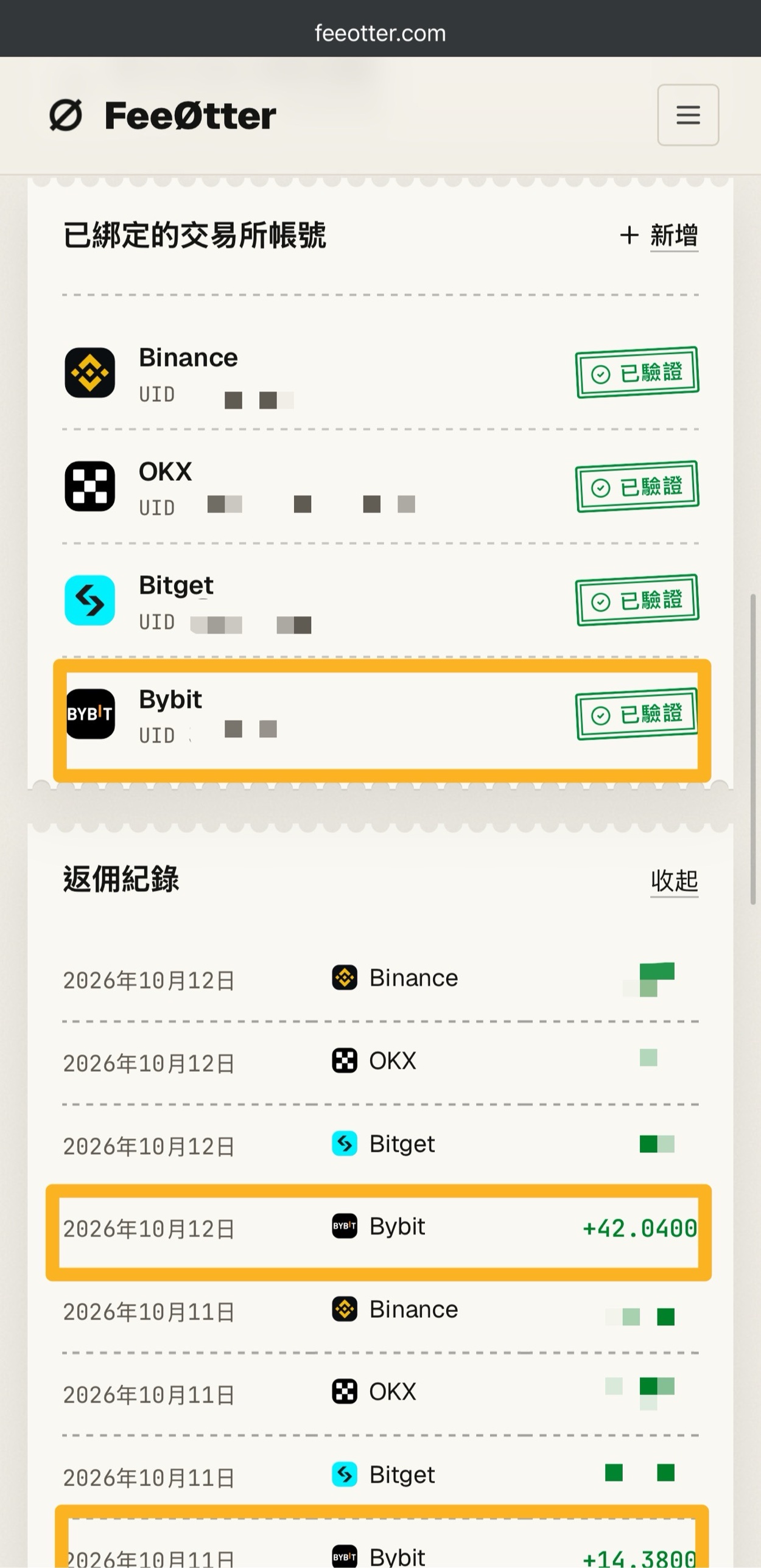
This money goes into your Fee Otter account, not your Bybit account; you have to request a withdrawal separately, and you take on the risk that a third party changes its rate or shuts down. Fee Otter’s rebate page also lists Binance, at 40% (20% automatic from the exchange + 20% extra from Fee Otter) (checked 2026-10-11). If you use Fee Otter on both, Binance’s futures Taker comes to about 0.03% after the rebate, still slightly below Bybit’s 0.033%; rates may change, and Fee Otter’s page at the time is what counts. Bybit doesn’t state whether turning on the MNT discount affects the rebate. Its affiliate program FAQ says users who receive other discounts “may not contribute” to the commission, so if you’re unsure, ask Fee Otter first.
How do Binance and Bybit rebate rules differ?
The rebates come from different places, so the rules differ a lot. On Binance, your referrer shares part of their own commission with you and the exchange pays it out. Bybit has no such mechanism: rebate sites take the commission they earn through Bybit’s affiliate program and pass part of it on to you.
| Rule | Binance | Bybit (through Fee Otter) |
|---|---|---|
| Who pays the rebate | Refunded directly by the exchange | Paid by Fee Otter into your Fee Otter account |
| Rate | Official cap of 20%; this site’s referral code rate is in the table above | Fee Otter’s rebate page lists 40% (checked 2026-10-11) |
| Calculation basis | Net fees (after market maker rebates) | Affiliate commission is calculated on “trading fees − market maker rebates − bonuses/vouchers”; Fee Otter calculates on the fees you actually pay |
| Duration | No term stated for spot; futures run for 12 months from opening the futures account (no limit if the referrer’s commission rate is 30% or more) | Bybit states that affiliate commission is for life, but the relationship may end if the user doesn’t trade for 180 consecutive days |
| VIP limits | Stops at VIP 3 or above and resumes when you drop back to VIP 2 or below | Total fee rebates for VIP accounts under an affiliate are capped at 50%; Fee Otter doesn’t mention any VIP limit |
| Payout | Converted to USDC every hour and paid to your spot account within 6 hours | Fee Otter settles daily; withdrawals are reviewed manually, paid within 3 business days, at most 5 times a month |
| Adding a code later | Within 30 days of sign-up, with no deposits or trades and no referrer, on the add-referral page | Main accounts with no referrer can add an affiliate code within 14 days of sign-up; it can’t be removed once added |
| Changing referrers | A referrer can’t be changed once set; accounts with no referrer that have already traded can request an affiliate switch (under 5,000 USD in trading volume in the 90 days before submitting, and 150,000 USD within 30 days after) | You can’t switch yourself; accounts registered after 2025-09-01 with less than 1 USD in trading volume for 180 consecutive days are reassigned if they come back and trade through a new affiliate’s link |
| Regions with no commission | From 2026-07-01, users registered in the European Economic Area can’t take part; no commission when the invitee is a Hong Kong resident | European Economic Area, Hong Kong, and from 2026-07-01 Australia |
Binance’s rules come from the Binance Referral Pro FAQ, the Binance affiliate switch FAQ and the Binance referral program supplementary notes; Bybit’s rules come from the Bybit affiliate program FAQ (updated 2026-09-19), Bybit’s guide to adding an affiliate code and sections 7.7 and 11.3 of the Bybit affiliate terms. Fee Otter’s settlement and withdrawal terms are taken from its rebate page and terms of service (checked 2026-10-11).
What futures traders most need to watch is the 12-month term on Binance’s futures rebate: a year after you open the futures account, the futures rebate may stop. Bybit describes affiliate commission as lifelong, so as long as you keep trading there’s no time limit at Bybit’s level; Fee Otter’s own rules are whatever its page says. If you’ve already signed up, Binance gives you more options: within 30 days and with no deposit you can add a referrer yourself, and if you’ve traded but have no referrer you can still request a switch. Bybit only has a 14-day window to add a code; after that, the only route is reassignment after 180 days of inactivity. For the detailed conditions, see Binance referral code rebind and Bybit referral code rebind.
Neither exchange accepts using multiple accounts to get around the rules. Binance states that if you close an account and open a new one for referral benefits, or reuse the same identity details, commission on the new account may be terminated; Bybit states that each person can have only one identity-verified account.
Do Binance and Bybit both require identity verification? What should users in Taiwan know?
Both exchanges require identity verification before you can deposit and trade; the difference is what an unverified account can still do. Binance states that all new users must complete “Verified” verification before using products such as deposits and trading. Older accounts that haven’t completed it are switched to “withdrawal only”, leaving withdrawals, order cancellation, closing positions and redemptions, and Binance asks users to check their daily withdrawal limit after verification on the “Identity Verification” page. Bybit states that all products and services require at least Standard individual verification. Unverified accounts can’t deposit or trade, but withdrawals aren’t affected, up to 20,000 USDT a day and 100,000 USDT a month; after Standard verification the limit is 1 million USDT a day with no monthly cap. For the documents each exchange requires, the verification steps and review times, see the Binance KYC guide and the Bybit KYC guide.
Their registration status in Taiwan is the same. The list on the Securities and Futures Bureau’s virtual asset service providers page, updated 2026-09-29, shows 11 businesses that have completed anti-money-laundering registration, and neither Binance nor Bybit is on the FSC’s list. In practice, this means that if a dispute arises with either exchange, Taiwan’s Securities and Futures Investors Protection Center and Financial Ombudsman Institution don’t apply (FSC statement of 2022-11-23), and frozen accounts or withdrawal restrictions can only be handled under the platform’s own terms. The FSC’s plan of 2026-08-04 also says the Travel Rule is expected to be extended to transfers between domestic and offshore providers by the end of 2027 (FSC press release), after which the process for moving crypto from a domestic platform to an offshore exchange may change.
Getting TWD in and out also works the same way on both. This site found no TWD bank deposit channel on either exchange. Binance’s P2P currency menu includes TWD, but when checked on 2026-10-12 the Binance P2P TWD market had 0 USDT buy and sell ads, and Bybit P2P likewise had no TWD listings. The workable route is to buy USDT with TWD on a registered domestic platform (such as MAX or BitoPro) and transfer it to the exchange; to cash out, reverse the steps.
As for apps, when checked on 2026-10-12 both were available on the Taiwan App Store: the Binance app (developer Binance Switzerland AG) and the Bybit app (developer Bybit Fintech Limited). Both interfaces are available in Traditional Chinese.
What are Binance and Bybit each best at?
Binance’s strength is spot. It has 507 spot coins in trading status, about 30% more than Bybit’s 391, giving people who want small-cap and newly listed coins more choice. It also offers both futures and spot copy trading, and the BNB discount applies to spot and futures alike.
- Copy trading: futures copy trading lets you copy with a fixed amount or a fixed ratio, and there’s also spot copy trading.
- Trading bots: the Binance trading bots page lists spot grid, futures grid, DCA, rebalancing, TWAP and arbitrage.
- Earn and new coins: Simple Earn, Launchpool.
- On-chain: Binance Wallet.
Bybit’s strength is derivatives. It has 858 USDⓈ-M perpetual futures in trading status, half again as many as Binance’s 568, so people who often trade futures on less popular coins are more likely to find the pair they want. It also offers options and puts TradFi products such as gold and forex in the same account.
- Copy trading: classic copy trading supports only USDT perpetuals, and lead traders take 10% to 15% of followers’ net profit depending on their level; the verification benefits table also lists Copy Trading Pro and TradFi copy trading.
- Trading bots: the Bybit trading bots page lists spot grid, futures grid, DCA, martingale and combo strategies.
- Options and TradFi: options at VIP 0 are Maker 0.02% and Taker 0.03%; the verification benefits table lists TradFi perpetual futures and contracts for difference (CFDs).
- Earn and new coins: Bybit Earn (Easy Earn, On-Chain Earn and more), Launchpool, Launchpad; the Bybit Card requires advanced individual verification before you can apply.
How do Binance and Bybit compare on proof of reserves and security record?
Both exchanges publish proof of reserves and do it in a similar way: they take a snapshot of user balances, put it in a Merkle tree and compare it against public on-chain wallets, and users can check for themselves that their account was included.
- Binance: the Binance proof of reserves page takes a snapshot once a month and verifies it with zk-SNARKs. When checked on 2026-10-12, the latest was the 2026-10-01 00:00 UTC snapshot: BTC 100.35%, ETH 100.00%, USDT 103.88%, USDC 108.26%.
- Bybit: the latest audit on the Bybit proof of reserves page covers the 2026-09-23 03:00 UTC snapshot. The Hacken verification report published on Bybit’s website (dated 2026-09-29) covers 50 coins and lists every one of them at a reserve ratio above 100%.
As for major incidents, both exchanges have been hacked, and in both cases the platform absorbed the loss:
- Binance, 2019-05-07: hackers obtained a large number of users’ API keys and 2FA codes and withdrew 7,000 BTC from the hot wallet (about 2% of Binance’s BTC holdings). Binance announced that its SAFU user protection fund would cover the full amount and user funds would not be affected; deposits and withdrawals were suspended, with the security review expected to take a week (Binance security incident announcement).
- Binance, 2023-11-21: Binance admitted to violating the US Bank Secrecy Act, operating an unlicensed money transmitting business and violating sanctions law, and agreed to pay more than 4 billion USD; founder Changpeng Zhao (CZ) also pleaded guilty and stepped down as CEO (US Department of Justice press release). This was a compliance case, not a loss of user assets.
- Bybit, 2025-02-21: a routine transfer from a cold wallet to a warm wallet was intercepted, and about 1.5 billion USD in ETH and other assets was stolen; in a notice dated 2025-02-26, the US FBI attributed the attack to North Korea (FBI notice). According to CNBC, Bybit replaced nearly 447,000 ETH in less than 72 hours through emergency loans and large deposits, user withdrawals stayed open throughout, and Hacken’s reserve audit confirmed the reserves had been restored.
Reports at the time called the Bybit hack the largest theft in crypto history; in both thefts the platform bore the loss. Proof of reserves only reflects the moment of the snapshot, and keeping assets on an exchange long term is a risk in itself. Hacks, withdrawal suspensions and regulatory records for 13 exchanges are collected in exchange safety records.
Binance or Bybit: which should you choose?
- Beginners who mainly trade spot: choose Binance. It has 507 spot coins, and the rebate is paid by the exchange straight into your spot account, with no need to sign up to a rebate site and link your UID.
- High-frequency futures traders and those who often trade less popular coins: choose Bybit. It has 858 USDⓈ-M perpetual futures, half again as many as Binance. Its Taker fee is 0.005 percentage points higher, but with 40% back through Fee Otter it comes to about 0.033%. Bybit describes affiliate commission as lifelong, with no 12-month term like Binance’s futures rebate.
- Those who only want the lowest fees: choose Binance. Its official futures Taker fee is lower to begin with (0.05% vs 0.055%), and if you use Fee Otter on both, Binance still comes out lower after the rebate, at 0.03% against Bybit’s 0.033%.
- Copy traders: to copy spot trades, choose Binance, which offers both spot and futures copy trading; to copy TradFi strategies such as gold and forex, choose Bybit.
- Already signed up without a referral code: Binance gives you a better chance. An account that has already traded can still request an affiliate switch, while Bybit offers no way to add a code after 14 days.
- Those who care about compliance in Taiwan: neither exchange is on the FSC’s anti-money-laundering registration list, so on this point there’s no difference. For getting TWD in and out, and for assets you plan to hold long term, a registered domestic platform or your own wallet is the safer choice.
The two exchanges’ strengths don’t overlap much, and plenty of people open accounts on both: spot and small caps on Binance, futures on less popular coins or TradFi on Bybit. Each account needs its own identity verification, and the referral code or rebate site has to be set up separately on each at sign-up.
Still weighing other exchanges? If you’d rather not hold a platform token and prefer strategy trading, see Binance vs OKX and OKX vs Bybit; to compare Bybit with Bitget, which has a more complete copy trading offering, see Bybit vs Bitget. Each exchange’s fees, rebates, proof of reserves and restricted regions are covered in full in the Binance review and the Bybit review.
How do you transfer from Binance to Bybit, and what does it cost?
There is no internal transfer between the two, so USDT has to go out as an on-chain withdrawal: first go to the deposit page on the receiving exchange, choose USDT and a network and copy the address, then go to the withdrawal page on the sending exchange, choose the same network and paste it. The sending exchange charges the withdrawal fee, a fixed amount per withdrawal no matter how much you send. According to the Binance deposit and withdrawal fee page and the Bybit deposit and withdrawal status page as of 2026-10-12, the cheapest networks open on both sides are:
- Binance → Bybit: use BEP20, 0.01 USDT (minimum withdrawal 5 USDT).
- Bybit → Binance: use Aptos, 0.002 USDT; Bybit’s data doesn’t list a minimum withdrawal for Aptos, so check it on the withdrawal page. Bybit’s Plasma costs 0 USDT, but Bybit labels Plasma as USDT0 and Binance doesn’t, so check the contract address on the deposit page first.
On the commonly used TRC20, Binance charges 1.5 USDT and Bybit 1.3 USDT. Fees can change at any time, so go by the amount shown on the withdrawal page before you confirm, and make sure the receiving exchange’s deposit page offers the same network; if you pick the wrong network, the funds may not be recoverable. For every network’s fee and minimum withdrawal at 13 exchanges, see USDT withdrawal fees compared.
FAQ
Which has lower fees, Binance or Bybit?
Binance, slightly. Spot is 0.1% on both and the futures Maker fee is 0.02% on both; the only difference is the futures Taker fee, 0.05% on Binance and 0.055% on Bybit. With 200,000 USDT of futures and 20,000 USDT of spot a month, all as market orders, you pay 120 USDT on Binance and 130 USDT on Bybit; with the platform-token discounts on, it’s 105 and 114 USDT.
Can I use Binance and Bybit at the same time?
Yes. They’re different companies, so you just sign up and complete identity verification on each. What you can’t do is open several verified accounts on the same exchange: Bybit states that each person can have only one identity-verified account, and Binance states that reusing identity details will terminate referral commission.
Should people in Taiwan use Binance or Bybit?
In terms of conditions in Taiwan, there’s no difference: neither is on the FSC’s anti-money-laundering registration list, neither P2P market showed TWD listings, and both apps are on the Taiwan App Store. So it comes down to how you trade: choose Binance if you mainly trade spot, and Bybit if you mainly trade futures, especially on less popular coins. On both, you deposit by buying USDT with TWD on a registered domestic platform and transferring it over, and in a dispute neither is covered by Taiwan’s Securities and Futures Investors Protection Center or Financial Ombudsman Institution.
Which is safer, Binance or Bybit?
Both have been hacked and both platforms absorbed the losses, so neither can be called absolutely safe. Binance lost 7,000 BTC in 2019 and covered it in full with the SAFU fund; Bybit lost about 1.5 billion USD on 2025-02-21, kept withdrawals open throughout and closed the gap in about 72 hours. On reserves, Binance’s 2026-10-01 snapshot showed BTC 100.35% and USDT 103.88%; Bybit’s 2026-09-23 snapshot put all 50 coins above 100%.
Which pays a bigger referral code rebate?
Looking at the exchanges alone, Binance pays a rebate and Bybit doesn’t: Binance’s referral code rebate is refunded directly by the exchange, with an official cap of 20%, while Bybit’s referral codes don’t refund fees to invitees. Through a rebate site, Fee Otter’s rebate page lists Bybit at 40%, all of it paid by Fee Otter (checked 2026-10-11).
This site’s Binance referral code currently carries an automatic fee rebate from the exchange of 20%, on both spot and USDⓈ-M futures.
Binance’s referral code, sign-up link and rebate rules are in Binance referral code, rate details are in Binance fees, and if you’ve already signed up, see Binance referral code rebind. How to get a Bybit rebate is covered in Bybit rebate: getting fees back with Fee Otter, rates are in Bybit fees, and the rules for adding and switching codes are in Bybit referral code rebind. The actual fees on each exchange after rebates are compiled in Actual fees after referral rebates; for other exchanges’ referral codes and automatic rebates, see All exchange referral codes.
Sources: this article was checked against both exchanges’ official pages from 2026-10-11 to 2026-10-12. Fees are based on the Binance spot fee page, the Binance futures fee guide, the Bybit trading fee structure and the Bybit FAQ on paying trading fees with MNT; rebates and switching on the Binance Referral Pro FAQ, the Binance affiliate switch FAQ, the Bybit affiliate program FAQ and the Bybit guide to adding an affiliate code; identity verification on the Binance identity verification guide and the Bybit individual KYC FAQ; Taiwan registration status on the Securities and Futures Bureau’s “virtual asset service providers” section; reserves on the Binance proof of reserves page and the Bybit proof of reserves page; and major incidents on the Binance security incident announcement, the US Department of Justice press release and the FBI notice. Listing counts come from both exchanges’ official public APIs, and USDT withdrawal fees are the figures on both exchanges’ official fee pages on 2026-10-12.