


Updated Rules checked 2026-10-11
For regular Bybit users (VIP 0), spot fees are Maker 0.1% and Taker 0.1%, and futures fees are Maker 0.02% and Taker 0.055%. If you turn on paying fees with MNT, spot fees drop to 75% of the normal rate and futures fees to 90%.
Bybit has no automatic exchange rebate. This extra rebate is paid by Fee Otter, not by the exchange and not by Kevin Wu; the rate is whatever Fee Otter's page shows (checked 2026-10-22).
Bybit works differently from most exchanges: if you sign up with a referral code, the exchange doesn’t refund any fees to the invitee. To get part of your fees back, you have to go through a rebate site. Fee Otter’s rebate page lists Bybit at 40% (checked 2026-10-11). This extra rebate is paid by Fee Otter, not the exchange, and not Kevin Wu. Based on the futures Taker fee of 0.055%, the actual cost after the 40% comes to about 0.033%.
The fees below were checked against Bybit’s official pages on 2026-10-19 and are provided for reference.
Key points:
1. For regular Bybit users (VIP 0), spot fees are 0.1% for both Maker and Taker, and futures are Maker 0.02% and Taker 0.055% (checked against the official fee page on 2026-10-11).
2. Turn on paying fees with MNT and you get 25% off spot and 10% off futures; inverse contracts aren’t eligible.
3. Futures fees are calculated on position value: with 1,000 USDT of margin at 10x, opening and closing with market orders costs 11 USDT in total.
4. Bybit’s referral code doesn’t refund any fees to the invited user. To get part of your fees back, you need to go through the rebate site Fee Otter; this rebate is paid by Fee Otter, not the exchange and not Kevin Wu, at the rate as shown on Fee Otter’s page.
5. Checked on 2026-10-12, withdrawing USDT from Bybit costs 1.3 USDT on TRC20 and 0.15 USDT on BEP20, and 0 on Plasma, labeled USDT0.
What are Bybit’s spot and futures fees?
| Market | Maker | Taker | With MNT discount (Maker / Taker) | Notes |
|---|---|---|---|---|
| Spot (crypto-to-crypto pairs) | 0.1% | 0.1% | 0.075% / 0.075% | Fee is deducted from the coin you receive |
| USDT/USDC contracts (USDT and USDC perpetual and delivery) | 0.02% | 0.055% | 0.018% / 0.0495% | Calculated on order value |
| Inverse contracts (coin-margined) | 0.02% | 0.055% | Not applicable | Fee charged in the underlying coin |
| Options | 0.02% | 0.03% | Not listed in the MNT terms | — |
The fees come from Bybit’s trading fee structure (official page updated 2026-09-02), and the MNT discount comes from Bybit’s FAQ on paying trading fees with MNT (checked 2026-10-11). Bybit uses the same futures rates for USDT, USDC and inverse contracts. Bybit also states that actual rates may vary by region, and that the “My Fee Rates” page in your own account is what counts.
Bybit fees vs. other exchanges: VIP 0 spot and futures rates at 13 exchanges
Bybit’s spot rate for regular users, 0.1%, matches most large exchanges. Its futures Taker rate of 0.055% is slightly higher than the 0.05% at Binance and OKX and ranks 8th lowest among the 13 exchanges this site covers. The table shows each exchange’s official VIP 0 rates without a platform-token discount, using USDT perpetuals for futures.
| Exchange | Spot Maker | Spot Taker | Futures Maker | Futures Taker |
|---|---|---|---|---|
| MEXC | 0% | 0.05% | 0% | 0.02% |
| Ourbit | 0% | 0% | 0.02% | 0.04% |
| Binance | 0.1% | 0.1% | 0.02% | 0.05% |
| OKX | 0.08% | 0.1% | 0.02% | 0.05% |
| Gate | 0.1% | 0.1% | 0.02% | 0.05% |
| BingX | 0.1% | 0.1% | 0.02% | 0.05% |
| Pionex | 0.05% | 0.05% | 0.02% | 0.05% |
| Bybit | 0.1% | 0.1% | 0.02% | 0.055% |
| Bitget | 0.1% | 0.1% | 0.02% | 0.06% |
| KuCoin | 0.1% | 0.1% | 0.02% | 0.06% |
| HTX | 0.2% | 0.2% | 0.02% | 0.06% |
| XT | 0.2% | 0.2% | 0.02% | 0.06% |
| WEEX | 0.1% | 0.1% | 0.02% | 0.08% |
Sources: Bybit from Bybit’s trading fee structure (checked 2026-10-19); the other 12 from this site’s fee guide for each exchange (checked against official pages 2026-10-11 to 10-17). Sorted by futures Taker, lowest first.
A few exceptions: KuCoin’s spot rate is for class A coins (BTC, ETH and others), and classes B and C cost more; MEXC’s spot rate is the one it gives for “most trading pairs”; Ourbit’s futures rate is its standard rate, while the futures Taker rate it announced for VIP 0 users in Taiwan is 0.05%; HTX’s futures rate is for USDT-margined perpetuals, and the HTX user agreement bars users in Taiwan from trading derivatives.
How to read it: if you trade futures with market orders, Bybit costs 0.005 percentage points more than exchanges charging 0.05%, which adds 10 USDT to opening and closing a 100,000 USDT position. Bybit’s futures Maker rate of 0.02% is the same as at most exchanges; only MEXC charges 0%. On spot, Bybit charges 0.1% like Binance, Bitget and Gate; MEXC, Pionex and Ourbit are cheaper, and HTX and XT, at 0.2%, cost more. Once referral rebates or a rebate site are factored in, the order changes again; see actual exchange fees after referral rebates.
Maker vs. Taker
Bybit’s definition: an order that goes onto the order book and waits for someone else to fill it is a Maker order; an order that fills immediately against an existing order on the book is a Taker order. Market orders are always Taker orders. A limit order priced so that it fills right away also counts as Taker. A limit order with “Post-Only” checked is cancelled automatically if it would fill immediately, so it can’t end up as a Taker order (Bybit on Maker vs. Taker, Post-Only explained).
Example: you place an order worth 10,000 USDT on the BTCUSDT perpetual. Filled as a market order, the fee is 10,000 × 0.055% = 5.5 USDT; placed below the current price to wait for a fill, the fee is 10,000 × 0.02% = 2 USDT. For the same order, the Taker fee is 2.75 times the Maker fee. Bybit’s own example buys 2 BTC at 60,000 USDT and closes at 61,000 USDT: Maker on both sides costs 48.4 USDT in total, Taker on both sides 133.1 USDT. For the gap between Maker and Taker rates across 13 exchanges, see Maker vs Taker fees.
Spot doesn’t have this difference: at VIP 0, spot Maker and Taker are both 0.1%, so placing a limit order isn’t any cheaper.
How much are Bybit spot fees, and which coin are they deducted from?
| Spot pairs | Maker | Taker |
|---|---|---|
| Crypto-to-crypto pairs (e.g. BTC/USDT) | 0.1% | 0.1% |
| Fiat-to-crypto pairs (30-day volume under 100,000 USD) | 0.15% | 0.2% |
Bybit’s spot formula is “filled quantity × fee rate”, and the fee is charged in the coin you receive (Bybit spot fees explained, updated 2026-09-10). If you buy BTC with 1,000 USDT, the fee is 1 USDT worth of BTC, taken straight out of the BTC you receive, so a little less BTC arrives than you saw when placing the order. The other way around, when you sell BTC for USDT, the fee comes out of the USDT you receive. Unfilled portions and cancelled orders aren’t charged.
Bybit’s fee page doesn’t list any zero-fee pairs, but it states that spot trades executed at zero fees don’t count toward spot trading volume. Commission in Bybit’s affiliate program is calculated from fees, so trades with no fee produce no rebate, and Fee Otter’s terms likewise state that only trades where a fee was actually charged count.
How are Bybit futures fees calculated?
| Contract | Maker | Taker | Fee currency |
|---|---|---|---|
| USDT perpetual and delivery | 0.02% | 0.055% | USDT |
| USDC perpetual | 0.02% | 0.055% | USDC |
| Inverse contracts (e.g. BTCUSD) | 0.02% | 0.055% | Underlying coin (e.g. BTC) |
Bybit’s futures formula is “fee = filled order value × fee rate”. For USDT and USDC contracts, order value is quantity × fill price; for inverse contracts it’s quantity ÷ fill price, which is why the fee is charged in the underlying coin, such as BTC. Every fill is charged a fee, and the fee comes out of your account balance without touching your initial margin (Bybit futures fees explained, updated 2026-08-05). For how notional value is calculated, with worked examples for 13 exchanges, see how futures fees are calculated.
Fees are charged on position value, not on margin. Open a position with 1,000 USDT of margin at 10x leverage and the position value is 1,000 × 10 = 10,000 USDT. Opening with a market order costs 10,000 × 0.055% = 5.5 USDT; closing at the same price with a market order costs another 5.5 USDT, so opening and closing costs 11 USDT in total, or 1.1% of your margin. If you open and close with limit orders that rest on the book: 10,000 × 0.02% × 2 = 4 USDT.
The higher the leverage, the bigger the position behind the same margin, and the fee grows in proportion. If you close at a higher price than you opened, the closing fee is slightly higher too. Leverage also magnifies losses: a small move against you can trigger liquidation and wipe out your entire margin. Before opening a position, you can estimate the liquidation price with the liquidation price calculator and add up fees and funding together with the perpetual futures cost calculator.
Bybit’s official inverse contract example: 10,000 contracts of BTCUSD filled at 8,000 USD have an order value of 10,000 ÷ 8,000 = 1.25 BTC, a Taker fee of 0.0006875 BTC and a Maker fee of 0.00025 BTC. When an inverse delivery contract settles automatically at expiry, or a position is closed because the pair is delisted, Bybit charges a flat 0.05% delivery fee regardless of VIP tier (same futures fees article). Bybit also states that perpetual and delivery contracts carry no liquidation fee (Bybit fees overview).
How much do you pay to trade 1,000, 10,000 or 100,000 USDT?
At VIP 0 with market orders, spot trades of 1,000, 10,000 and 100,000 USDT cost 1, 10 and 100 USDT in fees. Opening and closing a futures position of the same value with market orders costs 1.1, 11 and 110 USDT in total.
| Trade size (position value) | Spot market order (0.1%) | Futures market open + close (0.055% × 2) | Futures limit (Maker) open + close (0.02% × 2) |
|---|---|---|---|
| 1,000 USDT | 1 USDT | 1.1 USDT | 0.4 USDT |
| 10,000 USDT | 10 USDT | 11 USDT | 4 USDT |
| 100,000 USDT | 100 USDT | 110 USDT | 40 USDT |
Calculated from the VIP 0 rates in Bybit’s trading fee structure (checked 2026-10-19), assuming you close at the opening price; funding fees and slippage are not included.
Spot is charged per side: once when you buy and again when you sell, so buying 10,000 USDT of a coin and selling all of it costs about 20 USDT round trip. For futures, the amount is the position value, not the margin: a 10,000 USDT position can be 1,000 USDT of margin at 10x or 500 USDT at 20x, and the fee is 11 USDT either way. With the MNT discount turned on, the 10,000 USDT spot trade drops to 7.5 USDT and the futures market open and close to 9.9 USDT.
These are the fees you pay Bybit. Bybit’s referral code doesn’t refund any fees to the invited user; to get part of them back, you need to go through the rebate site Fee Otter. This rebate is paid by Fee Otter, not the exchange and not Kevin Wu, at the rate shown on Fee Otter’s page. For monthly costs after the rebate, see the estimate under “What you actually pay after a rebate site” below.
How Bybit VIP tiers work
| Tier | Asset balance | 30-day spot volume | 30-day futures volume | Spot Maker / Taker | Futures Maker / Taker |
|---|---|---|---|---|---|
| VIP 0 | — | — | — | 0.1% / 0.1% | 0.02% / 0.055% |
| VIP 1 | 100,000 USD | 1 million USD | 10 million USD | 0.0675% / 0.08% | 0.018% / 0.04% |
| VIP 2 | 250,000 USD | 5 million USD | 25 million USD | 0.065% / 0.0775% | 0.016% / 0.0375% |
| VIP 3 | 500,000 USD | 10 million USD | 50 million USD | 0.0625% / 0.075% | 0.014% / 0.035% |
| VIP 4 | 1 million USD | 25 million USD | 100 million USD | 0.05% / 0.06% | 0.012% / 0.032% |
| VIP 5 | 2 million USD | 50 million USD | 250 million USD | 0.04% / 0.05% | 0.01% / 0.032% |
| Supreme VIP | — | 100 million USD | 500 million USD | 0.03% / 0.045% | 0% / 0.03% |
The thresholds come from Bybit’s VIP program introduction (updated 2026-07-30), and the fees from Bybit’s trading fee structure. A few rules:
- Meeting any one of asset balance, spot volume or futures volume is enough to move up. The table also lists other criteria such as 30-day average net borrowing, and from VIP 4 up, the futures volume route also requires API trading to be no more than 20% of volume.
- VIP tiers update daily at 7:00 UTC (15:00 Taiwan time), and fee changes take effect within 5 minutes of the update.
- If you no longer qualify, you get a 14-day grace period during which you keep your VIP rates; the tier is removed only if you still don’t qualify when it ends.
- Subaccounts use the main account’s rates, and volume from subaccounts, trading bots and copy trading all counts toward VIP volume (Bybit VIP FAQ).
VIP 1 takes 10 million USD in 30-day futures volume, roughly 330,000 USD a day on average, or 100,000 USD in assets held in your account. That’s hard to reach for someone with typical trading volume. Once you’re there, the futures Taker fee drops from 0.055% to 0.04%, a cut of about 27%. For how VIP and rebates interact, see does your referral rebate survive a VIP upgrade.
How do you use MNT to get a discount on Bybit fees?
Bybit lets you pay fees with MNT (Mantle) at a discount, which works like the platform-token discounts on other exchanges. According to Bybit’s FAQ on paying trading fees with MNT (updated 2026-03-30):
- Discount: you pay 75% of the spot fee and 90% of the futures fee, applied on top of your existing VIP rate.
- What it covers: spot, spot margin, USDT perpetual and delivery, USDC perpetual, and pre-market trading. It doesn’t apply to inverse contracts, nor to trading bots, copy trading (followers), RFQ, API orders or liquidation orders.
- Who can use it: regular users and VIPs can; market makers, institutions, Pro users and API users can’t.
- How to turn it on: on the website, find “Fee Rate” on the trading page and switch on “Using MNT for fee discount”; in the app, tap the three-dot icon on the trading page and switch on the same option. Spot and futures are set separately, and the main account and each subaccount have to turn it on individually.
- Deduction conditions: only transferable MNT in your Unified Trading Account (UTA) can be used. If you don’t have enough MNT to cover the full fee when you place an order, the fee is charged in the original settlement currency instead. There’s no partial deduction, so there’s no discount either.
To put numbers on it: in the futures example with 11 USDT for opening and closing, MNT brings that down to 9.9 USDT, saving 1.1 USDT. For a 1,000 USDT spot trade, the fee drops from 1 USDT to 0.75 USDT worth of MNT. Bybit doesn’t state whether you still get a rebate after turning on MNT; the rebate section below covers that.
Is the funding rate a Bybit trading fee?
Holding a perpetual contract also brings funding fees, calculated as “position value × funding rate”. When the rate is positive, longs pay shorts; when it’s negative, shorts pay longs. Bybit states that funding fees are paid directly between longs and shorts, not to the exchange, and that if you fully close your position before the settlement time, you neither pay nor receive anything (Bybit funding fee calculation, updated 2026-05-12). For settlement intervals and rate caps across 13 exchanges, see what the funding rate is.
The settlement interval depends on the trading pair. Contracts that settle every 8 hours do so at 0:00, 8:00 and 16:00 UTC, which is 08:00, 16:00 and 24:00 Taiwan time. When the funding rate hits its cap, the system automatically switches to hourly settlement.
Take the 10,000 USDT position from earlier: at a funding rate of 0.01%, each settlement is 1 USDT, or 3 USDT for three settlements a day. Hold for 4 days with the rate staying at a positive 0.01%, and funding comes to 12 USDT, more than the 11 USDT in Taker fees for opening and closing. The actual rate changes every period and can be negative, and the longer you hold, the more this cost matters. Funding fees aren’t trading fees, so they earn no rebate.
What does Bybit charge for deposits, withdrawals and other services?
| Item | What Bybit says |
|---|---|
| On-chain deposits, internal transfers on Bybit | Bybit charges nothing |
| On-chain withdrawals | A fixed fee per coin and network, the same no matter how much you withdraw |
| Sending to another Bybit account (internal transfer) | No withdrawal fee |
| Convert | No regular trading fee; the rate is the best quote from several market makers, refreshed every 15 seconds; orders over 50,000 USD use OTC pricing; some countries or regions may charge an additional fee |
| P2P | No trading fee for buyers or sellers (with a few currency exceptions; the fee table doesn’t include the New Taiwan dollar (TWD)); payment channels may charge their own fees |
| Buying crypto, fiat deposits and withdrawals | Varies by currency and payment method, charged by the service provider and shown on the order page |
| Spot margin, loans | Interest accrues hourly on borrowed funds; liquidations in spot margin and crypto loans carry a 2% liquidation fee |
The above is based on the Bybit fees overview, Bybit crypto withdrawal FAQ, Bybit Convert guide and Bybit P2P fees explained (checked 2026-10-11). You can see the withdrawal fee and minimum withdrawal for each coin and network on Bybit’s deposit and withdrawal status page, or in the withdrawal window once you’ve picked the coin and network.
Because the withdrawal fee is a fixed amount, withdrawing 100 USDT ten times costs ten times as much as withdrawing 1,000 USDT once. Convert has no trading fee; the cost is built into the quote, so compare it with the spot price before you convert.
USDT withdrawal fees: according to Bybit’s official data from 2026-10-12, USDT costs 1.3 USDT on TRC20 (minimum withdrawal 2.6 USDT), 0.8 USDT on ERC20, 0.15 USDT on BEP20, 0.07 USDT on Polygon and 0 on Plasma, labeled USDT0 (minimum 2 USDT). Aptos costs 0.002 USDT, but the official data doesn’t list its minimum withdrawal. For fees and minimum withdrawals by network on 13 exchanges, see USDT withdrawal fees compared.
How to check your own fee tier
- Website: hover over your profile picture in the top right corner to see your VIP tier; click “My Fee Rates” in the menu, or go straight to Bybit’s My Fee Rates page.
- App: tap the top left corner to open your profile settings, where you’ll see your VIP tier, then tap “My Fee Rates”.
The “My Fee Rates” page shows your current rates for each market and how much more volume you need to reach the next VIP tier. Bybit states that rates may vary by region, so go by this page rather than the public fee table alone.
What you actually pay after a rebate site
Start with Bybit itself: Bybit’s referral program FAQ (updated 2026-10-10) says the referrer earns commission on the invitee’s fees and the invitee gets a new-user gift and task rewards. It doesn’t say the invitee receives any share of the fees. So Bybit has no “enter a referral code and get an automatic fee rebate” like other exchanges do.
Rebate sites work through Bybit’s affiliate program. According to Bybit’s affiliate program FAQ (updated 2026-09-19), an affiliate’s commission base is “trading fees − market maker rebates − bonuses/coupons”. The rebate site then passes part of that commission on to you, so only trading fees you actually pay generate a rebate. Funding fees, zero-fee trades and fees covered by coupons don’t.
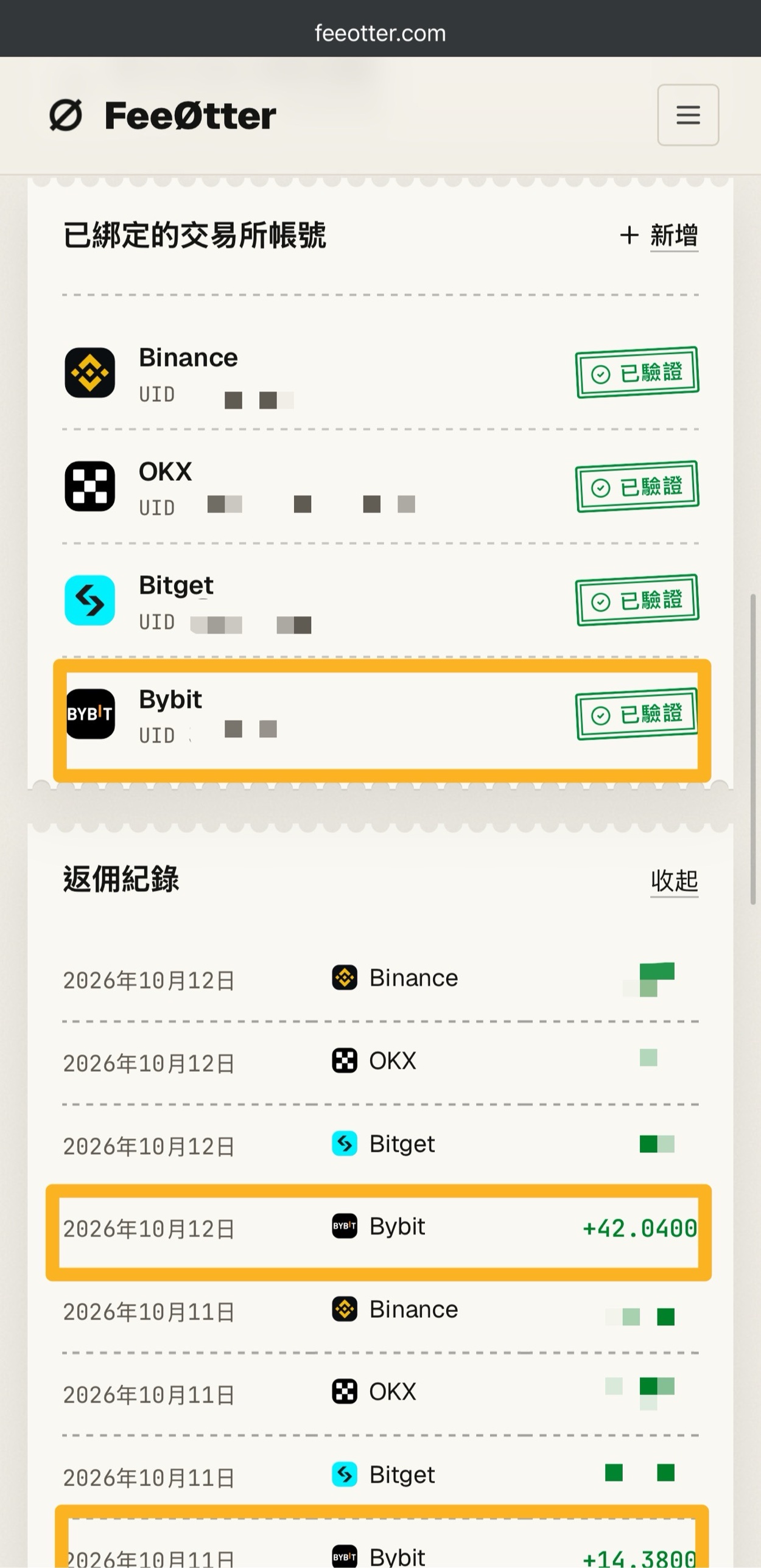
Fee Otter’s rebate page lists Bybit at 40% (checked 2026-10-11), all of it an extra rebate from Fee Otter, not paid by the exchange, and not by Kevin Wu. The rebate is based on the fees you actually pay and is credited to your Fee Otter account, not your Bybit account. The steps for signing up, binding your UID and withdrawing are in how to get a Bybit rebate.
Estimate: monthly cost after the 40%
| Scenario | Fee rate | Monthly volume | Fees | Fee Otter 40% | Actual cost | Effective rate |
|---|---|---|---|---|---|---|
| Futures, all market orders | 0.055% | 300,000 USDT | 165 USDT | 66 USDT | 99 USDT | 0.033% |
| Futures, all limit orders (Maker) | 0.02% | 300,000 USDT | 60 USDT | 24 USDT | 36 USDT | 0.012% |
| Futures, all market orders | 0.055% | 1,000,000 USDT | 550 USDT | 220 USDT | 330 USDT | 0.033% |
| Spot | 0.1% | 50,000 USDT | 50 USDT | 20 USDT | 30 USDT | 0.06% |
How it’s calculated: fees = monthly volume × official VIP 0 rate; rebate = fees × 40%; actual cost = fees − rebate. With 300,000 USDT a month in futures volume, all market orders, you pay 165 USDT in fees, Fee Otter returns 66 USDT, and you actually pay 99 USDT. The Taker rate after the rebate, 0.033%, is lower than the VIP 1 Taker rate of 0.04%. The percentage may change; Fee Otter’s current page takes precedence. For other exchanges’ fees after rebates, see actual exchange fees after referral rebates. For the official VIP 0 rates of 13 exchanges ranked from lowest to highest, see lowest-fee crypto exchanges ranked.
Can you use the MNT discount and a rebate together?
Bybit doesn’t say. Its MNT terms don’t mention commission, while its affiliate program FAQ says users who take part in other Bybit programs or receive rebates, discounts, rewards or other benefits “may not contribute” to the affiliate’s commission, meaning they may not count. A rebate site’s money comes from that commission, so ask Fee Otter first whether the MNT discount reduces or removes your Fee Otter rebate. On percentages alone, MNT saves 25% on spot and 10% on futures, both less than 40%; if you can only have one, keeping the rebate saves more.
If you already have a Bybit account
A main account registered less than 14 days ago with no referrer can add an affiliate’s code itself. After 14 days, or once you have a referrer, Bybit has no feature that lets users change their referrer themselves. For the conditions and steps, see the Bybit referral switch guide; for other exchanges’ add-on rules, see can you add a referral code after sign-up.
How can you save on Bybit fees? 5 ways
Ranked for futures traders with typical volume, from biggest impact to smallest:
- Use limit orders for futures: going from Taker 0.055% to Maker 0.02% cuts each fee by 63.6%. With 300,000 USDT a month in futures volume, fees fall from 165 USDT to 60 USDT. For orders that don’t need to fill right away, use a limit order with Post-Only. At VIP 0, spot is 0.1% on both sides, so this only helps with futures.
- Get fees back through a rebate site: Fee Otter lists 40%, so the same 300,000 USDT in market orders returns 66 USDT a month. It works for spot too, and for spot traders it’s usually the biggest item. The money is paid by a third party, so keep an eye on its rules and operational risk.
- MNT discount: you pay 75% of the spot fee and 90% of the futures fee. On 165 USDT of futures fees it saves only 16.5 USDT; it makes more of a difference on spot. The trade-off is keeping enough MNT in your Unified Trading Account, taking on MNT’s price swings, and Bybit doesn’t state how it interacts with rebates.
- Cut unnecessary withdrawals and conversions: each withdrawal carries a fixed fee, so one larger withdrawal costs less than several small ones; sending to another Bybit account as an internal transfer is free. Convert has no fee, but the price is a market maker quote, so compare it with the spot price for large amounts.
- VIP: the VIP 1 futures Taker fee is 0.04%, but it takes 10 million USD in 30-day futures volume or 100,000 USD in assets. For most people, the four options above are more practical.
FAQ
What are Bybit’s fees?
For regular Bybit users, spot fees are Maker 0.1% and Taker 0.1%, and futures fees are Maker 0.02% and Taker 0.055% (checked against Bybit’s official fee page on 2026-10-11). Options are Maker 0.02% and Taker 0.03%; fiat spot pairs are Maker 0.15% and Taker 0.2%. Higher VIP tiers get lower rates, and turning on the MNT discount adds a further discount.
How are Bybit fees deducted?
Spot fees come out of the coin you receive: buy BTC and the fee is taken in BTC; sell BTC for USDT and it’s taken in USDT. USDT/USDC contract fees come out of the USDT or USDC balance in your account, and inverse contract fees are taken in the underlying coin, such as BTC. With the MNT discount on and enough MNT to cover the full fee, the fee is taken in MNT instead.
Where can I see my Bybit fees?
After logging in, open the menu under your avatar in the top right and click “My Fee Rates” to see your current rates for each market. In the app, go to your profile settings from the top left, then tap “My Fee Rates”. Bybit states that rates may differ by region, and this page is what counts.
How are Bybit futures fees calculated?
Futures fee = order value × fee rate, based on position value, not margin. With 1,000 USDT of margin at 10x, the position is 10,000 USDT; opening and closing with market orders costs 5.5 USDT each, 11 USDT in total, or 4 USDT if both are limit orders. You’re charged once when opening and once when closing.
Are Bybit’s fees higher than other exchanges’?
Bybit sits in the middle of the 13 exchanges: its VIP 0 spot rate of 0.1% matches most large exchanges, and its futures Taker rate of 0.055% ranks 8th lowest. That futures Taker rate is higher than the 0.05% at Binance, OKX, Gate, BingX and Pionex, and lower than the 0.06% at Bitget, KuCoin, HTX and XT and the 0.08% at WEEX; its futures Maker rate of 0.02% is the same as at most exchanges. Bybit’s rates were checked against its official fee page on 2026-10-19; the other exchanges come from this site’s fee guides, checked 2026-10-11 to 10-17.
How much does Bybit charge to trade 10,000 USDT?
At VIP 0, a 10,000 USDT spot market order costs 10 USDT in fees. For a 10,000 USDT futures position, opening and closing with market orders costs 11 USDT in total, or 4 USDT with limit orders that rest on the book on both sides. Spot is charged on each buy and each sell; futures fees depend only on position value, not on leverage. With the MNT discount, spot drops to 7.5 USDT and the futures market open and close to 9.9 USDT (checked against Bybit’s official fee page on 2026-10-19).
What are Bybit’s withdrawal fees?
Bybit charges a fixed fee for on-chain withdrawals. The amount depends on the coin and network, not on how much you withdraw. Sending to another Bybit account is free, and so are deposits. For the exact amount, check Bybit’s deposit and withdrawal status page or the withdrawal window, which shows it once you’ve picked the coin and network.
How much does Bybit charge to withdraw USDT?
Checked on 2026-10-12, withdrawing USDT from Bybit costs 1.3 USDT on TRC20, 0.8 USDT on ERC20, 0.15 USDT on BEP20 and 0 on Plasma, labeled USDT0. Each withdrawal is charged a fixed amount that changes with network conditions, so go by what the withdrawal window shows before you withdraw; for a comparison of 13 exchanges, see USDT withdrawal fees compared.
Is paying fees with MNT worth it?
It pays off more for people who trade a lot of spot (you pay 75% of the fee); on futures you pay 90%, so the effect is limited. You need to hold enough MNT in your Unified Trading Account first, and MNT’s own price goes up and down. Bybit also doesn’t state whether turning on MNT affects rebate site rebates, so if you use a rebate site, check first.
Does a Bybit referral code give a fee discount?
No. Bybit’s referral program gives invitees a new-user gift and task rewards, and Bybit doesn’t say invitees receive any fee rebate. To get fees back, you need an affiliate that pays it separately, such as Fee Otter. For the difference between referral commission and rebates, see referrer commission vs. invitee rebate.
If a rebate hasn’t arrived, start with what to do if your referral rebate hasn’t arrived; for which trades can have rebates cancelled, see when rebates get cancelled; and if a term is unclear, check the rebate glossary. Other exchanges’ referral codes and automatic fee rebates are collected in the exchange referral codes roundup.
