


Updated Rules checked 2026-10-29
When does OKX liquidate a futures position? It depends on the “maintenance margin ratio”: once the maintenance margin ratio of a position or account falls to 100% or below, the system starts reducing or liquidating the position, and it checks this against the mark price, not the last traded price. The ratio’s denominator is “maintenance margin + liquidation fee”, so a 10x isolated long on the BTCUSDT perpetual reaches its liquidation price after a drop of about 9.59%, not 10%.
Once liquidation is triggered, the system first cancels open orders, then reduces the position in steps according to its tier, and closes all of it only if that is still not enough. On liquidation OKX charges a liquidation fee at the Taker rate, and also takes the maintenance margin of the tier the reduced portion falls in, which OKX calls the “reduction fee”. If the position is closed at a price worse than the bankruptcy price and the account goes negative, OKX states that the user does not have to cover it: the risk reserve (what other exchanges usually call an insurance fund) pays.
Leverage magnifies losses. If you are liquidated, an isolated position loses all of its margin, and a cross position loses all the margin in that currency in your trading account. Below, the process, formulas, worked examples and where to check the figures are covered one by one, each with its official OKX source.
Key points:
1. OKX futures are liquidated when the maintenance margin ratio is ≤ 100%. The denominator is “maintenance margin + liquidation fee”, and liquidation is based on the mark price.
2. Per the OKX API read on 2026-10-29, tier 1 of the BTCUSDT perpetual (up to 1,000 contracts, 10 BTC) has a 0.4% maintenance margin rate and up to 100x. With a 0.05% Taker fee, the liquidation distance for an isolated long is 19.64% at 5x, 9.59% at 10x, 4.57% at 20x and 0.55% at 100x.
3. An isolated 0.1 BTC long opened at 80,000 USDT with 10x and 800 USDT of margin has a liquidation price of about 72,325.46. At that price the position still shows about 32.55 USDT, exactly the 3.62 liquidation fee plus the 28.93 reduction fee, so by the official rules you would not get it back.
4. In cross margin, a reduction warning is sent when the margin ratio falls below 300%. With a single BTCUSDT tier 1 position, the warning price is only about 0.91% above the liquidation price.
5. On 2026-10-29 the OKX Security Fund API showed about 93.079 million USDT in the BTC-USDT perpetual pool and about USD 2.976 billion in its total field. OKX states that the fund is not insurance and does not guarantee compensation to any specific user.
The information below was checked against official pages on 2026-10-29 (fact-check date) and is provided for reference.
When does OKX liquidate a position, and how is the trigger calculated?
The OKX liquidation FAQ (updated 2026-08-27) states that a maintenance margin ratio ≤ 100% means the account equity can no longer cover the maintenance margin plus any closing fees that may arise, and the system then liquidates. How the ratio is calculated depends on the margin mode:
- Isolated: maintenance margin ratio = (position margin balance + position unrealized PnL) ÷ (maintenance margin + liquidation fee), the same for USDT-margined and coin-margined contracts (OKX futures margin calculation rules, updated 2026-10-08).
- Cross (Futures mode): maintenance margin ratio = (cross balance in that currency + cross PnL − quantity of that currency in open sell orders − quantity required for option buy orders − quantity required to open isolated positions − fees on all open orders) ÷ (maintenance margin + liquidation fee) (how OKX calculates the futures liquidation price, updated 2026-08-11).
- For USDT-margined contracts, maintenance margin = face value × number of contracts × contract multiplier × maintenance margin rate × mark price; liquidation fee = position value × the Taker rate of your current fee tier.
The cross formula deducts open orders and their fees first; OKX says this keeps account risk from jumping suddenly when those orders fill. The maintenance margin rate in the formula is not fixed: it depends on the tier the position falls in. The larger the position, the higher the maintenance margin rate and the lower the available leverage. The first five tiers of the BTCUSDT perpetual:
| Tier | Contracts | Approx. BTC | Max leverage | Maintenance margin rate |
|---|---|---|---|---|
| 1 | 0–1,000 | Up to 10 BTC | 100x | 0.4% |
| 2 | 1,000–5,000 | 10–50 BTC | 66.66x | 0.5% |
| 3 | 5,000–20,000 | 50–200 BTC | 50x | 0.75% |
| 4 | 20,000–40,000 | 200–400 BTC | 40x | 1.25% |
| 5 | 40,000–60,000 | 400–600 BTC | 33.33x | 1.75% |
Source and date: OKX position tiers API (isolated, read 2026-10-29, 99 tiers in total); 1 contract = 0.01 BTC per the OKX instruments API. Tier 1 of the ETHUSDT perpetual is also 0.4%, with a cap of 5,000 contracts. OKX’s liquidation rules (updated 2026-08-11) state that the tiers are adjusted from time to time, so it is best to check again before opening a position.
How does OKX liquidation work, step by step?
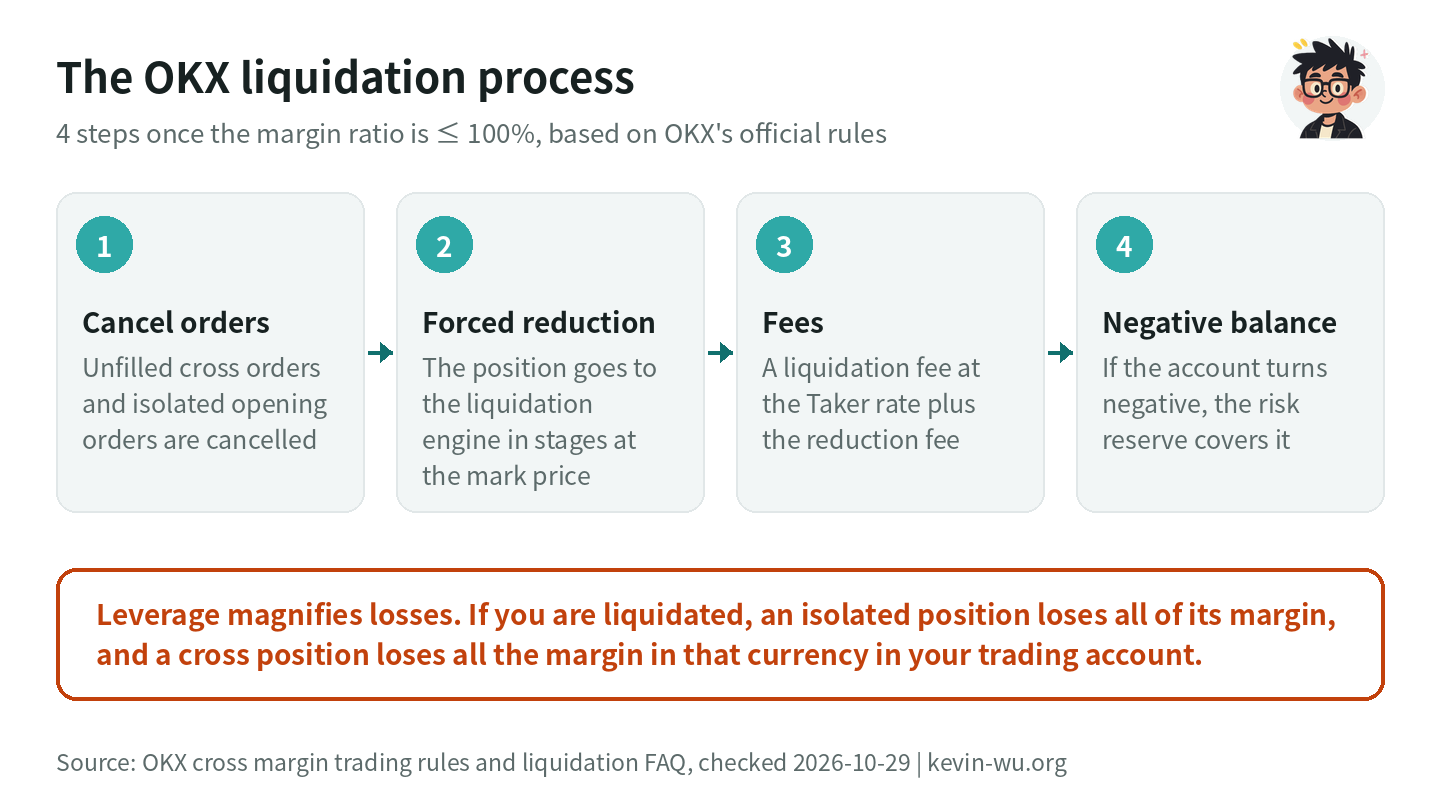
OKX does not close everything at once. According to the cross margin trading rules for spot and futures accounts (updated 2026-08-11), the liquidation FAQ and the introduction to auto-deleveraging (updated 2026-08-11), the sequence is:
- Reduction warning: in cross margin, when the margin ratio of a currency falls below 300%, the system sends a reduction warning. OKX states that 300% is a warning parameter that it may adjust as circumstances require.
- Risk-control order cancellation: when account risk is already elevated but has not reached the pre-reduction level, the system first cancels some open orders that would add to margin usage, to bring the account back to a safe state.
- Pre-reduction cancellation: when the margin ratio is ≤ 100%, all unfilled cross orders in that currency (including algo orders) and isolated opening orders are canceled. In Hedge Mode, isolated TP/SL orders that would open a position are canceled too; those that would close a position are not.
- Forced reduction: if the ratio is still ≤ 100% after the cancellations, the position is handed to the liquidation engine in stages at the mark price at that moment. In cross margin, opposing long and short positions in the same contract are reduced first, then positions that hedge each other, then everything else, one tier at a time, until the account is safe again or everything is closed.
- Fees: according to the liquidation FAQ and the liquidation rules, liquidation incurs a liquidation fee (at the Taker rate) plus the maintenance margin of the tier the reduced contracts fall in (the reduction fee). The latter covers the liquidation engine’s losses from offloading the position, and whatever is left goes into the risk reserve.
- Negative balance coverage: if the account’s assets turn negative after liquidation, the system offsets them with the risk reserve and issues a corresponding negative-balance compensation statement.
- Auto-deleveraging (ADL): when the risk reserve is completely used up, or falls 30% from its peak within 8 hours, the platform no longer places orders to close the position; it goes straight to the top-ranked counterparties and settles at the mark price.
Not everyone will see the “staged reduction” in step 4. OKX Learn’s explanation of position maintenance margin rates (updated 2025-04-24) says only positions at Level 3 or above are partially reduced first; at Level 2 or below, the liquidation engine takes over the position directly at the bankruptcy price. Tier 2 of BTCUSDT ends at 5,000 contracts (50 BTC). Most retail positions fall within that range, so they are usually closed in full. The help-centre liquidation pages do not state this cutoff; what OKX actually does is what counts.
How is the OKX liquidation price calculated?
When the account holds only one USDT-margined position, set the isolated maintenance margin ratio above to 100% and solve for the liquidation price:
- Long liquidation price = (entry price − margin ÷ quantity) ÷ (1 − maintenance margin rate − Taker rate)
- Short liquidation price = (entry price + margin ÷ quantity) ÷ (1 + maintenance margin rate + Taker rate)
Quantity is in BTC, equal to contracts × 0.01. I checked the formula against the example in the OKX help centre: BTCUSDT perpetual, cross, 3x, average entry price 60,996, 50 contracts (0.5 BTC), 5,000 USDT available. With 0.4% and 0.05%, (60,996 − 5,000 ÷ 0.5) ÷ 0.9955 = 51,226.5, matching the 51,226.5 USDT shown by OKX’s calculator.
Worked example: 10x isolated long
The OKX mark price API, read on 2026-10-29, showed the BTCUSDT perpetual at about 80,104; the calculation below rounds this to 80,000. Opening a 10-contract (0.1 BTC) long at 10x isolated:
- Position value 0.1 × 80,000 = 8,000 USDT; at 10x you put up 800 USDT of margin.
- Margin ÷ quantity = 800 ÷ 0.1 = 8,000. The entry price minus that is 72,000, the bankruptcy price at which equity reaches zero.
- 72,000 ÷ (1 − 0.004 − 0.0005) = 72,000 ÷ 0.9955 ≈ 72,325.46. This is the liquidation price, 9.59% below the entry price.
- A short on the same terms: (80,000 + 8,000) ÷ 1.0045 ≈ 87,605.77, 9.51% above the entry price.
The liquidation price and the bankruptcy price are about 325 USDT (0.45%) apart; that gap is the maintenance margin plus the liquidation fee. Now keep the margin fixed at 1,000 USDT and change the leverage:
OKX isolated BTC long: the higher the leverage, the closer liquidation gets
Price drop that triggers liquidation on a long (%); the smaller the number, the riskier; same assumptions as the table below

- 5x19.64
- 10x9.59
- 20x4.57
- 50x1.56
- 100x0.55
| Isolated leverage | Position value | Long liquidation price (distance) | Short liquidation price (distance) | Left in the position when triggered |
|---|---|---|---|---|
| 5x | 5,000 USDT | 64,289.30 (19.64%) | 95,569.94 (19.46%) | 18.08 USDT |
| 10x | 10,000 USDT | 72,325.46 (9.59%) | 87,605.77 (9.51%) | 40.68 USDT |
| 20x | 20,000 USDT | 76,343.55 (4.57%) | 83,623.69 (4.53%) | 85.89 USDT |
| 50x | 50,000 USDT | 78,754.39 (1.56%) | 81,234.44 (1.54%) | 221.50 USDT |
| 100x | 100,000 USDT | 79,558.01 (0.55%) | 80,438.03 (0.55%) | 447.51 USDT |
Assumptions: entry price 80,000, BTCUSDT tier 1 maintenance margin rate 0.4% (OKX API, 2026-10-29), regular-user Taker fee 0.05% (OKX notice on VIP tiers and futures fees, updated 2026-08-11), funding fees not included. “Left in the position when triggered” is the equity I calculated at the liquidation price, which equals the maintenance margin plus the liquidation fee.
The higher the leverage, the more money is still sitting in the position when liquidation is triggered: at 100x it is 447.51 USDT, or 44.75% of the margin. That money is not refunded; the section “How much margin is left after liquidation” below breaks it down.
How is the cross margin liquidation price calculated?
In cross margin, the margin is the available equity in that currency in your trading account, so “margin” in the formula becomes that figure. Take the same 0.1 BTC long at 80,000 with 3,000 USDT in the trading account: the liquidation price is about (80,000 − 30,000) ÷ 0.9955 ≈ 50,226.02, 37.22% below the entry price. The liquidation price is further away, but if you are liquidated, the whole 3,000 USDT is lost with it. Using the same method, the 300% warning price is about 50,684.24, only 0.91% above the liquidation price. With a single tier 1 position, that 0.91% is the same no matter how much margin you hold, so by the time the warning arrives, the price is already very close to liquidation.
With several positions in cross margin, no single formula works. The liquidation FAQ states that when USDT cross margin holds positions in two or more currencies, or holds options positions, the system cannot calculate an estimated cross liquidation price. Also, the OKX trading fee FAQ (updated 2026-09-09) notes that if your available balance cannot cover funding fees, they are deducted from position margin, and the liquidation price moves closer. For a full comparison of the two modes, see cross vs isolated margin; to plug in your own numbers, use the liquidation price calculator.
Where can you see the liquidation price on OKX?
- Estimated liquidation price on the position: after you open a position, the “Est. liquidation price” appears at the lower right of the position card. OKX states that this is only a system estimate; the actual liquidation or reduction price is the mark price at the moment the maintenance margin ratio is ≤ 100%.
- App calculator: on the futures trading page, tap “···” at the top right → “Tools” → “Calculator” → “Liquidation price”, choose the trading pair, cross or isolated, and long or short, then enter the leverage, average entry price, position size and available margin to calculate.
- Web calculator: on the website, go to “Trade” → “Futures” at the top left, then click “Calculator” → “Liquidation price” below the trading page; for isolated you need to fill in “Additional margin”.
- Checking whether the liquidation price was hit: the chart shows the last price by default. On the market page, click “Last price” at the top left and switch to “Mark price”, then compare with the price at the moment of liquidation.
The calculator paths follow “how OKX calculates the futures liquidation price”; the rest follows the liquidation FAQ. For the difference between the two prices, see mark price vs last price.
How can you lower the chance of being liquidated on OKX?
The list below covers only tools OKX itself provides; whether to use them is your decision.
- Take profit / stop loss: when opening a position, tick “TP/SL” on the futures trading page; after opening, in the app tap “Positions” → choose the position → “TP/SL”, or on the web click “Add” under “Positions”. The trigger can be the last, mark or index price. OKX warns that TP/SL orders may fail to place because of price limits, insufficient margin or system issues (OKX futures TP/SL settings, updated 2026-08-26). For setup steps, see how to set stop loss and take profit.
- Adding margin to an isolated position: the OKX futures margin calculation rules state that you can add margin to a specific isolated position. The OKX guide to adding margin (updated 2026-08-05; it uses margin trading as the example and also covers futures cross margin) describes the steps: in the position row, click the “+” next to the margin to add 10%–100% of your trading account funds; the limits for adding and removing are whatever the page shows. In the 10x example above, raising the margin from 800 to 1,200 USDT moves the liquidation price from about 72,325.46 to about 68,307.38, widening the distance to 14.62%, but the loss if liquidated also becomes 1,200 USDT.
- Topping up cross margin: cross has no add-margin button. Transferring funds into the trading account automatically counts toward cross margin, and the margin ratio rises accordingly (same guide).
- Adjusting leverage: OKX lets you change the leverage of an open position. To lower leverage, your trading account must have enough funds to meet the higher margin requirement (futures margin calculation rules).
- Partial close: entering a partial quantity when closing reduces the position; to close it all at once, tap “Market close all” on the position (OKX guide to opening and closing futures positions, updated 2026-08-26).
None of the OKX futures help pages I checked mention an “auto add margin” feature for futures positions, so it is not listed here.
How much margin is left after OKX liquidation, and can you end up owing money?
When an isolated position is fully liquidated, you usually get none of the margin back. The liquidation FAQ states that liquidation incurs two charges: the liquidation fee, based on your current fee tier and calculated on the position value (not the margin), and the reduction fee, which is the maintenance margin of the tier the reduced quantity falls in. Using the 800 USDT, 10x example above:
| Item | Amount (USDT) | Calculation |
|---|---|---|
| Position value when triggered | 7,232.55 | 0.1 × 72,325.46 |
| Equity when triggered | 32.55 | 800 + 0.1 × (72,325.46 − 80,000) |
| Liquidation fee | 3.62 | 7,232.55 × Taker 0.05% |
| Reduction fee | 28.93 | 7,232.55 × tier 1 maintenance margin rate 0.4% |
| Returned to the user | About 0 | 32.55 − 3.62 − 28.93 |
Source: the fee definitions follow the OKX liquidation FAQ and liquidation rules; the figures are my own estimates using the tiers and rates of 2026-10-29, and your OKX statement is what counts. If the liquidation engine closes the position at a better price than the 72,000 bankruptcy price, the surplus goes into the Security Fund, according to Understanding OKX’s Security Fund (updated 2026-08-05), and is not returned to the user.
Can you end up owing money? If the market gaps and the position is closed at a price worse than the bankruptcy price, the account may go negative. The OKX liquidation FAQ states that a negative balance caused by such a loss does not have to be borne by the user and is covered by the risk reserve; the cross margin trading rules also state that the system offsets negative assets with the risk reserve and issues a negative-balance compensation statement. On the other hand, the liquidation rules also state that OKX has full discretion over when to use the Security Fund and does not guarantee that users’ losses will be covered by it. What liquidation affects: in isolated mode only that position’s margin is deducted; in cross mode all the margin in that currency in the trading account is lost. Neither affects assets in your funding account.
How much is in OKX’s insurance fund (Security Fund)?
OKX calls it the Security Fund, and its explainer notes that other exchanges may call it an “insurance fund”; this site’s glossary entry is insurance fund. According to OKX, the fund is set up and wholly owned by OKX and is used to cover the shortfall of “bankrupt positions”. It is funded mainly by the surplus when liquidated positions are closed at better than the bankruptcy price; OKX may also inject its own funds from time to time, but has no obligation to keep it at any particular size. The reserves for each business line are separate, and USDT-margined perpetuals have one pool per underlying, so ETHUSDT and XRPUSDT, for example, cannot be combined. Each day at 16:00 (UTC+8), the negative-balance losses and liquidation inflows of the previous 24 hours are settled.
| Item | Balance on 2026-10-29 | Note |
|---|---|---|
| BTC-USDT perpetual pool | 93,079,002.18 USDT | About 93.079 million USDT |
| ETH-USDT perpetual pool | 64,248,392.31 USDT | About 64.248 million USDT |
| API total field | USD 2,975,682,114.37 | Defined in the API docs as the total Security Fund balance, in USD |
Source: OKX Security Fund API (read on 2026-10-29 at about 20:20 UTC+8); field definitions in the OKX API docs. OKX states that the figures on its page and in the API may not match exactly, and recommends relying on the OKX Security Fund page.
These figures only show the fund’s size. OKX’s explainer lists three important terms: the Security Fund is not an insurance product or a custodial protection fund; it is not guaranteed to be used to compensate any specific user or trade; and users have no beneficial interest in or claim to its assets, with OKX alone deciding whether and how much of it to use.
Who gets hit by ADL (auto-deleveraging)?
ADL starts only when the risk reserve is used up, or falls 30% from its peak within 8 hours. The selected counterparty positions are settled directly at the mark price, with no fee. The ranking uses “leveraged return”: for profitable isolated positions it is the position’s return ÷ the position’s margin ratio, and for cross positions the account margin ratio is used instead. The higher the return and the lower the margin ratio, the higher the position ranks, so the positions reduced are often the ones making money. Next to each position there is a 5-bar indicator; all 5 bars lit means a high rank and higher ADL risk. If your position is reduced, you are notified by email.
What liquidation risks should you know about on OKX?
- You may lose all your margin: OKX’s explainer on cross and isolated margin (updated 2026-08-11) states that a liquidated isolated position loses all of that position’s margin, and in extreme markets a cross account may lose all of a given currency in the account.
- High leverage leaves very little room: for a 100x isolated BTCUSDT long, a 0.55% drop in the mark price triggers liquidation.
- Orders may not fill: OKX’s closing guide warns that in highly volatile markets orders may not fill, and TP/SL orders may also fail to trigger.
- Parameters can change: OKX states that it can adjust the 300% warning parameter, the position tiers and the maintenance margin rates.
OKX’s rules also state that leveraged trading magnifies both potential gains and losses, and that you may lose your entire investment. This article only explains the rules and calculations and is not trading advice.
FAQ
What triggers liquidation on OKX?
An OKX futures position is reduced or liquidated when its maintenance margin ratio is ≤ 100%. The ratio’s denominator is “maintenance margin + liquidation fee”, and the check uses the mark price. In cross margin, a reduction warning is sent first when the margin ratio falls below 300%.
At 10x on OKX, how far does the price have to fall before liquidation?
For a 10x isolated long on the BTCUSDT perpetual, a drop of about 9.59% in the mark price triggers liquidation; for a short, a rise of about 9.51%. This uses the tier 1 maintenance margin rate of 0.4% and a Taker fee of 0.05% (2026-10-29) and leaves out funding fees; if funding is deducted from the margin, the liquidation price moves closer.
What is the OKX liquidation price formula?
For a USDT-margined long, liquidation price = (entry price − margin ÷ quantity) ÷ (1 − maintenance margin rate − Taker rate); for a short = (entry price + margin ÷ quantity) ÷ (1 + maintenance margin rate + Taker rate). The formula only applies when the account holds a single position. Checked against the calculator example in the OKX help centre, the result matches (51,226.5 USDT).
Can you owe money after OKX liquidation?
According to the OKX liquidation FAQ, a negative balance caused by a liquidation shortfall does not have to be borne by the user; the risk reserve covers it. The usual maximum loss is the position’s margin in isolated mode, or all the margin in that currency in the trading account in cross mode, and the funding account is not affected. However, OKX also states that it does not guarantee losses will always be covered by the Security Fund.
How much is the OKX liquidation fee?
Two charges apply on liquidation: the liquidation fee, at the Taker rate of your current tier and calculated on the position value, which is 0.05% for regular users on USDT-margined contracts; and the reduction fee, the maintenance margin of the tier the reduced contracts fall in, which is 0.4% of the position value for BTCUSDT tier 1. Together they roughly equal the equity left in the position when liquidation is triggered.
Does OKX liquidation use the last price or the mark price?
The mark price, not the last price and not the index price. To check, switch the chart from “Last price” to “Mark price” at the top left of the market page.
How much is in OKX’s insurance fund?
The OKX API on 2026-10-29 showed about 93,079,002 USDT in the BTC-USDT perpetual pool and about USD 2.976 billion in the total field. OKX calls it the Security Fund and states that it is not an insurance product and does not guarantee compensation to any specific user.
Why was I liquidated before the estimated liquidation price?
The estimated liquidation price is only a reference; what counts is the mark price when the maintenance margin ratio is ≤ 100%. Funding fees deducted from position margin, losses on other positions in cross margin, or adding to a position so that it moves into a tier with a higher maintenance margin rate can all bring the actual liquidation point forward. An OKX Learn article also recommends using the margin ratio as the real measure of risk.
Enabling OKX futures, placing orders and fees are covered in the OKX futures guide. For holding costs, see what the funding rate is and how it is calculated and how futures fees are calculated. Fees by tier are in OKX trading fees, and how to sign up is in OKX referral code.
Want to see these updates more often in Google Search? Add Kevin Wu as a preferred source on Google