


Updated Rules checked 2026-10-29
Bybit liquidates based on the Mark Price, not the last traded price. In isolated margin mode, liquidation is triggered when the mark price reaches that position’s liquidation price; cross margin and portfolio margin look at the whole account and trigger liquidation when the account Maintenance Margin Rate (MMR) reaches 100%. Once liquidation is triggered, the system first cancels open orders that would increase the position, and a position in the lowest risk limit tier is then closed at the Bankruptcy Price (the price at which the loss equals the entire initial margin).
Bybit has no automatic exchange rebate. This extra rebate is paid by Fee Otter, not by the exchange and not by Kevin Wu; the rate is whatever Fee Otter's page shows (checked 2026-10-22).
Bybit’s official API, read on 2026-10-29, shows a maintenance margin rate of 0.33% for BTCUSDT risk limit tier 1, so an isolated 10x long is liquidated after a price drop of about 9.70%. Bybit charges no liquidation fee on perpetual and expiry contracts, but the position is closed at the bankruptcy price, so the margin still left at the moment of liquidation is not returned. Losses beyond the margin are paid by the Insurance Fund, and Auto-Deleveraging (ADL) starts only when the insurance fund is not enough.
Below are the liquidation process, the liquidation price formula with worked examples, where to find each figure, and Bybit’s official tools for avoiding liquidation, each with its official source. In leveraged trading, an adverse price move can get your position forcibly closed, and you can lose all of your margin.
Key points:
1. Bybit isolated margin is liquidated when the mark price reaches the position’s liquidation price; cross margin and portfolio margin are liquidated when the account maintenance margin rate reaches 100%.
2. In isolated margin, a position in the lowest risk limit tier that still lacks margin after orders that would add to it are cancelled is closed at the bankruptcy price; positions above the lowest tier are first partly closed with an IOC order.
3. On 2026-10-29, BTCUSDT tier 1 covered positions up to 300,000 USDT, with a maximum of 150x and a maintenance margin rate of 0.33%; a 10x isolated long opened at 80,000 USDT has a liquidation price of about 72,238.39 and a bankruptcy price of 72,000.
4. Bybit charges no liquidation fee on perpetual and expiry contracts, but the position is closed at the bankruptcy price, so once liquidation is triggered the margin of that position is lost in full.
5. Bybit’s official API on 2026-10-29 showed a balance of 388,212,733.57 USDT in the shared USDT insurance fund pool that BTCUSDT belongs to; ADL starts only when the insurance fund is not enough.
The information below was checked against the official pages on 2026-10-29 (fact-check date) and is provided for reference.
When does Bybit liquidate a position?
Bybit’s Unified Trading Account (UTA) has three margin modes, each judging liquidation differently; the default is cross margin. The differences between the modes and the conditions for switching are covered in cross vs isolated margin; this section only looks at liquidation:
| Item | Isolated Margin | Cross Margin (default) | Portfolio Margin |
|---|---|---|---|
| When liquidation is triggered | The mark price reaches that position’s liquidation price | The account maintenance margin rate (MMR) reaches 100% | The account maintenance margin rate reaches 100% |
| Liquidation price | Can be calculated when the position is opened and stays the same while the position is unchanged | Moves with account equity, unrealized profit and loss and other positions; Bybit states the figure shown is for reference only | Changes dynamically with the risk of the whole portfolio |
| Money you can lose in a liquidation | Only this position’s margin; other positions are not affected | All assets in the account that can serve as margin | All assets in the account that can serve as margin |
| Auto-Margin Replenishment (AMR) | Supported (USDT Perpetual, USDT Expiry, USDC Perpetual) | Not supported | Not supported |
| MMR Close Order | Not supported | Supported | Bybit’s guide lists cross margin only |
Sources: Bybit FAQ: order execution and liquidation (updated 2026-09-25), Bybit trading rules: liquidation process (updated 2026-10-15), and the guides to Auto-Margin Replenishment and the MMR Close Order, checked on 2026-10-29.
The candlestick chart shows the last traded price by default, so a position can be liquidated even though the chart never reached the liquidation price: the mark price got there first. The difference between the two prices is explained in mark price vs last traded price.
How does Bybit’s liquidation process work? Step by step
Isolated margin: the lowest tier vs tiers above it
According to Bybit’s liquidation process (updated 2026-10-15), how an isolated position is handled after liquidation is triggered depends on which risk limit tier it falls in:
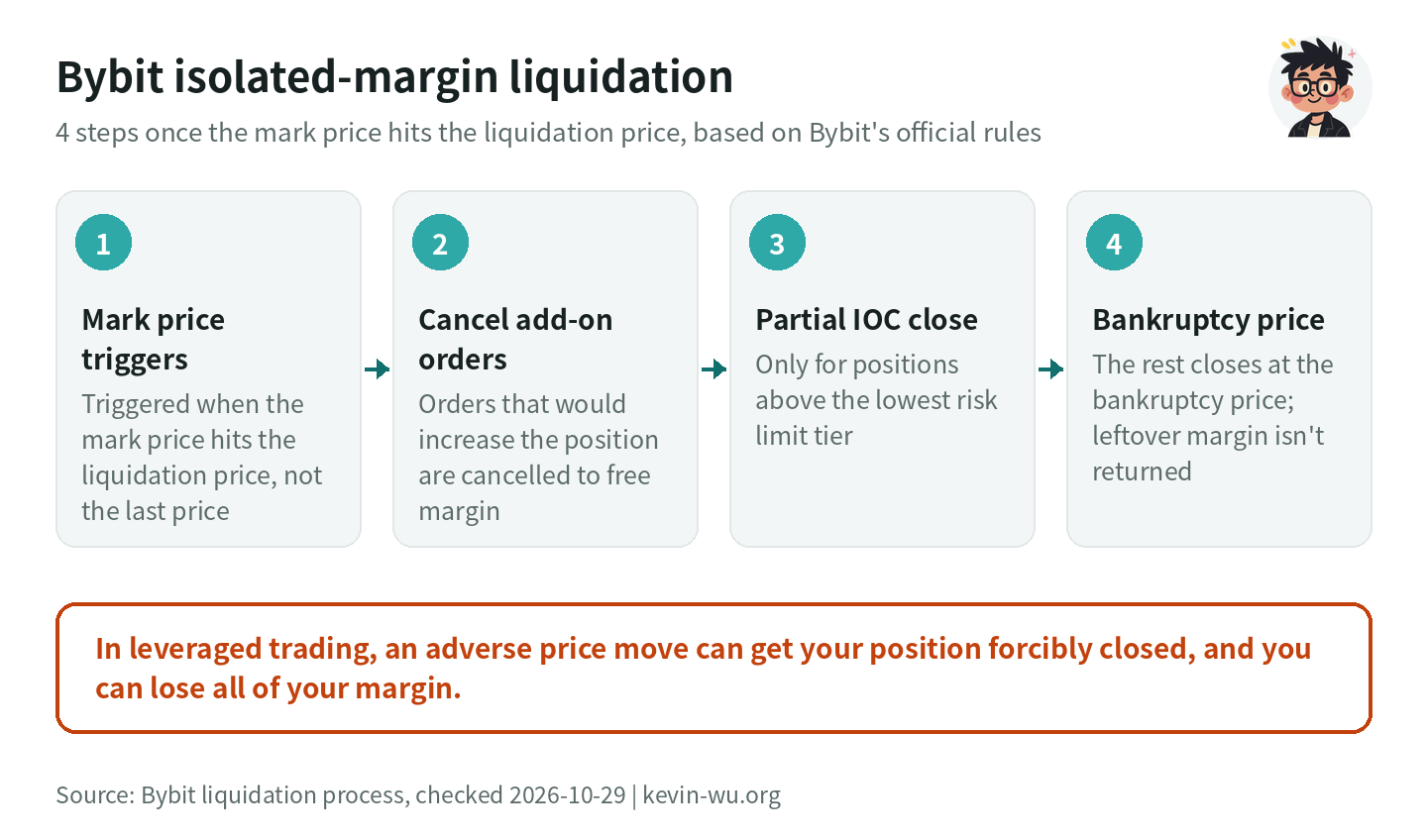
- Lowest tier: all orders that would increase the position are cancelled first to free up margin. If the position still does not meet the maintenance margin requirement, it is liquidated at the bankruptcy price and closed in full.
- Above the lowest tier: orders that would increase the position are again cancelled first. Next, an IOC (Immediate or Cancel) order partly closes the position, for an amount equal to “the difference between the current position value and the limit of the next lower tier.” If that is still not enough, the rest of the position is closed at the bankruptcy price.
For example, BTCUSDT tier 1 has a limit of 300,000 USDT. A 500,000 USDT 10x long has a position value of about 451,749 USDT when liquidation is triggered, so the system first closes about 151,749 USDT with an IOC order. A position within 300,000 USDT skips this partial close.
Cross margin: six steps after the account MMR reaches 100%
Cross margin looks at the whole account. When the account Initial Margin Rate (IMR) reaches 100%, there is no liquidation yet, but restrictions start: you can no longer place new derivatives orders that need extra margin, and options orders are cancelled. If the account has borrowings, Bybit’s trading page guide states that spot assets are force-sold for automatic repayment once the MMR reaches 85%. After the MMR reaches 100%, the system works through these steps in order:
- Cancel derivatives orders that would increase positions (including options buy orders), plus spot margin orders that carry liabilities or haircut losses.
- If the account has liabilities, trigger automatic repayment.
- Cancel all orders.
- Settle fully hedged positions in hedge mode at the mark price to release margin.
- Liquidate unhedged positions: the system calculates how much margin must be released to bring the MMR back below 100%, picks the positions to close following the contract liquidity order, and lowers the risk limit tier at the same time.
- If the MMR is still above 100%, liquidate all options seller positions.
As soon as any step brings the MMR below 100%, the remaining steps stop. Perpetual positions are still liquidated at the bankruptcy price, and the contracts at the top of the liquidity order are BTCUSDT, ETHUSDT and SOLUSDT. If the account MMR reaches 160% or higher, the liquidation engine takes over directly and liquidates the entire position (except bought options). Sources: the liquidation process from the previous section and Bybit’s guide to the futures trading page (updated 2026-06-18).
How do the bankruptcy price, insurance fund and ADL take over?
According to Bybit’s bankruptcy price guide (updated 2026-08-11), the liquidation engine takes over the position at the bankruptcy price. This takeover does not go through the matching engine, so the bankruptcy price does not show up on the candlestick chart. One of three outcomes follows:
- The position fills at a better price than the bankruptcy price: the leftover margin is added to the insurance fund.
- It cannot fill at a better price than the bankruptcy price: the shortfall is paid by the insurance fund.
- The insurance fund is not enough either: the position is passed to the Auto-Deleveraging (ADL) system.
The insurance fund is funded by money Bybit provides and by the margin left over when liquidated positions fill at better than the bankruptcy price. Some trading pairs share one fund pool, while others have isolated pools. When I read Bybit’s insurance fund API on 2026-10-29, the shared USDT pool that holds BTCUSDT and ETHUSDT covered 176 contracts with a balance of 388,212,733.57 USDT (shared pool figures update every 24 hours).
ADL has two triggers (Bybit’s auto-deleveraging guide, updated 2026-04-13): a single trading pair’s insurance fund drawdown within 8 hours reaches that pair’s trigger threshold, or the combined balance of several isolated fund pools is less than or equal to 0. Bybit’s example triggers at a 30% drawdown and stops at 25%. Positions are selected by their ranking on “leveraged return,” with profitable positions first; a position hit by ADL is closed at the bankruptcy price of the position being taken over, and all open orders are cancelled.
How is the Bybit liquidation price calculated?
Bybit publishes this formula for isolated USDT perpetual and expiry contracts (Bybit liquidation process; terms follow the official page):
- Liquidation Price (Long) = [(Entry Price × Position Size) − (Entry Price × Position Size ÷ Leverage) − (Extra Margin Added ÷ (1 − Taker Fee Rate)) − Maintenance Margin Deduction] ÷ [Position Size − (Position Size × Maintenance Margin Rate)]
- Liquidation Price (Short) = [(Entry Price × Position Size) + (Entry Price × Position Size ÷ Leverage) + (Extra Margin Added ÷ (1 + Taker Fee Rate)) + Maintenance Margin Deduction] ÷ [Position Size + (Position Size × Maintenance Margin Rate)]
The maintenance margin rate and the maintenance margin deduction (a quick-calculation amount) depend on the risk limit tier, and the closing fee makes the actual liquidation price differ slightly from the formula result. Bybit’s official example (1 BTC, 40,000 USDT, 50x, 3,000 USDT of added margin, maintenance margin rate 0.5%) gives a liquidation price of 36,380.25 USDT, and plugging the numbers into the formula gives the same result.
Worked example: BTCUSDT isolated at 80,000 USDT, liquidation price at each leverage
At the 2026-10-29 check, the BTCUSDT mark price was about 80,080 USDT (Bybit tickers API), so 80,000 is used as the entry price. The position value is fixed at 10,000 USDT (0.125 BTC), which falls in tier 1, with a maintenance margin rate of 0.33% and a deduction of 0 (Bybit risk limit API), and no margin is added:
Bybit isolated BTC long: the higher the leverage, the closer liquidation gets
Price drop that triggers liquidation on a long (%); the smaller the number, the riskier; same assumptions as the table below

- 5x19.74
- 10x9.70
- 20x4.69
- 50x1.68
- 100x0.67
| Leverage | Margin | Long liquidation price | Long: drop to liquidation | Long bankruptcy price | Short liquidation price | Short: rise to liquidation |
|---|---|---|---|---|---|---|
| 5x | 2,000 USDT | 64,211.90 | 19.74% | 64,000 | 95,684.24 | 19.61% |
| 10x | 1,000 USDT | 72,238.39 | 9.70% | 72,000 | 87,710.56 | 9.64% |
| 20x | 500 USDT | 76,251.63 | 4.69% | 76,000 | 83,723.71 | 4.65% |
| 50x | 200 USDT | 78,659.58 | 1.68% | 78,400 | 81,331.61 | 1.66% |
| 100x | 100 USDT | 79,462.23 | 0.67% | 79,200 | 80,534.24 | 0.67% |
Sources: the formula follows Bybit’s liquidation process, the bankruptcy price follows Bybit’s bankruptcy price guide (isolated USDT contracts: long = Entry Price × (1 − 1 ÷ Leverage)), and the maintenance margin rate comes from Bybit’s risk limit API, read on 2026-10-29. The figures are my own calculations and exclude the closing fee.
Taking the 10x long step by step: the quantity is 0.125 BTC, the numerator is 10,000 − 1,000 = 9,000, the denominator is 0.125 × (1 − 0.0033) = 0.1245875, and 9,000 ÷ 0.1245875 = 72,238.39. For a quick mental estimate, use “1 ÷ leverage − maintenance margin rate”: 10% − 0.33% ≈ 9.7%.
The small gap between the liquidation price and the bankruptcy price is the maintenance margin. When the price reaches 72,238.39, the position has lost (80,000 − 72,238.39) × 0.125 = 970.20 USDT, leaving about 29.80 USDT, which is exactly 72,238.39 × 0.125 × 0.33%. This money is not returned. The maintenance margin shown in the Positions tab also includes the estimated closing fee, which for the 10x long is 0.125 × 80,000 × (1 − 1 ÷ 10) × 0.055% = 4.95 USDT (Bybit maintenance margin guide, updated 2026-04-16; Taker fee rate from Bybit trading fee structure, updated 2026-10-07).
How does the liquidation price change with a bigger position, added margin or funding fees?
| Scenario (BTCUSDT 10x isolated long opened at 80,000) | Calculation | Liquidation price | Drop to liquidation |
|---|---|---|---|
| Base case: 10,000 USDT position | Tier 1, maintenance margin rate 0.33% | 72,238.39 | 9.70% |
| Position increased to 500,000 USDT (6.25 BTC) | Tier 2, maintenance margin rate 0.5%, deduction 510 | 72,279.80 | 9.65% |
| Base case plus 500 USDT added manually | Extra margin 500 ÷ (1 − 0.055%) | 68,222.93 | 14.72% |
| Available balance runs short, 90 USDT of funding fees deducted from the initial margin | 910 USDT of margin left | 72,960.77 | 8.80% |
Sources: maintenance margin rates and deductions from Bybit’s risk limit API, read on 2026-10-29 (BTCUSDT has 35 tiers in total); the rule that funding fees can be deducted from the initial margin from Bybit’s bankruptcy price guide; the figures are my own calculations.
Where the 510 deduction in the second row comes from: 300,000 × (0.5% − 0.33%) = 510. For a 500,000 position, the maintenance margin is 500,000 × 0.5% − 510 = 1,990 USDT, the same as calculating the first 300,000 at 0.33% and the remaining 200,000 at 0.5% (Bybit maintenance margin guide). If you forget the deduction and apply 0.5% directly, you get 72,361.81, slightly closer than the real figure.
The 90 USDT in the fourth row assumes a funding rate of 0.01% every 8 hours, accumulated over 90 settlements in 30 days. Bybit states that when the available balance cannot cover funding fees, they may be deducted from the position’s initial margin; the effective leverage then rises, and both the liquidation price and the bankruptcy price move closer. The funding fee rules are in what the funding rate is and how it is calculated.
How is the cross margin liquidation price calculated?
The cross margin liquidation price moves with account equity, other positions and the available balance, and Bybit states that it is for reference only. Following the method in Bybit’s official examples, a USDT perpetual long that is not yet at a loss has a liquidation price of roughly “Entry Price − (Available Balance + Initial Margin − Maintenance Margin) ÷ Net Position Size”; for a short, change the minus sign to a plus sign. Fees are not included.
Take the same 10x position opened at 80,000 with a 10,000 USDT position value and 3,000 USDT in the account in total: initial margin 1,000, available balance 2,000, maintenance margin 33. The liquidation price is about 80,000 − (2,000 + 1,000 − 33) ÷ 0.125 = 56,264, so the price has to fall about 29.67% before liquidation, much further than the 9.70% for isolated margin. The cost is that a liquidation can take all 3,000 USDT in the account. Bybit’s official example also notes that when another position in the same account racks up bigger losses, the liquidation price of a profitable position moves toward the mark price as well. You can run your own numbers with the liquidation price calculator.
Where can you see the liquidation price on Bybit?
The interface names below follow Bybit’s futures trading page guide (updated 2026-06-18) and its order execution and liquidation FAQ (updated 2026-09-25):
- Liquidation price: in the “Positions” tab below the trading page on the web, or below the order panel in the app, in the estimated liquidation price column. A “–” means the position’s liquidation risk is currently low; for cross margin and portfolio margin, the figure is for reference only.
- Account maintenance margin rate: for cross margin and portfolio margin, check “Maintenance Margin Rate (MMR)” in the asset details on the trading page; liquidation is triggered at 100%. This field does not apply to isolated margin.
- Mark price: shown in the middle of the order book; on the candlestick chart, click the last traded price to switch to the mark price.
- ADL ranking: the ADL priority indicator lights in the “Positions” tab; the more lights, the more likely the position is to be auto-deleveraged.
- Liquidation history (app): “Trade” in the bottom menu → the history icon at the lower right of the order book → “Trade History” → filter the trade type by “Liquidation”.
- Liquidation history (web): “Orders” in the top navigation bar → “Unified Trading Account Orders” → “Derivatives” on the left → “Trade History” → filter the trade type by “Liquidation”.
How can you lower the chance of being liquidated on Bybit?
This list only covers tools and rules that Bybit officially provides. It is not trading advice:
- Leverage and position size: at 10x, a drop of about 9.70% triggers liquidation; at 20x it takes only 4.69%. Once a position goes beyond tier 1, the maintenance margin rate rises too. The risk limit rules are in the Bybit futures trading guide.
- Adding margin manually (isolated): adding 500 USDT to the 10x long moves the liquidation price from 72,238.39 to 68,222.93. The added money also bears the losses.
- Auto-Margin Replenishment (AMR, isolated margin only): once it is on, when the margin nears the liquidation threshold, the system moves funds from the Unified Trading Account’s available balance into the position, topping up to at most 1x leverage, and notifies you when it triggers. It supports USDT Perpetual, USDT Expiry and USDC Perpetual. Bybit states that AMR does not guarantee you will avoid liquidation: once the available balance runs out, the position is still liquidated. On the web, use the “Auto-Margin Replenishment” toggle in the “Positions” tab below the chart on the trading page; in the app, open the “Positions” tab under “Trade”, tap the position, then tap “Margin” to switch it (Bybit Auto-Margin Replenishment, updated 2026-06-29).
- Trigger stop-losses by the mark price: a stop-loss triggered by the last traded price may not fire before liquidation. Bybit’s example is a stop-loss at 12,030 with a liquidation price of 12,000: while the last traded price is still 12,050, the mark price falls to 12,000 first, and the position is liquidated first. A stop-loss triggered by the mark price still fills at the last traded price, so slippage is possible. Setup steps are in how to set take-profit and stop-loss.
- MMR Close Order (cross margin): set an account maintenance margin rate as the trigger, and once it is reached the position is closed in full at market. The trigger has to be between the current account MMR and 90%, and each position can have only one; if the MMR jumps to 100% in an instant, the order may not trigger in time. On the web, click “Add” under “MMR Close” in the “Positions” tab; in the app, tap “Set TP/SL” in the “Positions” tab and switch to the “MMR Close” tab (Bybit MMR Close Order, updated 2026-05-12).
- Keep an available balance for funding fees: when the available balance runs short, funding fees are deducted from the isolated position’s initial margin, and the liquidation price moves closer (see the fourth row of the table above).
How much margin is left after a Bybit liquidation? Can you end up owing money?
For a position in the lowest risk limit tier, a liquidation wipes out that position’s entire margin. Bybit states that it charges no liquidation fee on perpetual and expiry contracts (Bybit fees overview, updated 2026-04-08), but the position is closed at the bankruptcy price, which by definition is the price at which the loss equals the entire initial margin. In the 10x long example above, about 29.80 USDT is left when liquidation triggers, and that money does not come back to your account.
Compare closing the position yourself: if you stop out the same 10x long at 73,000 with a market order, the loss is 875 USDT plus a Taker fee of about 5.02 USDT, and you get back about 119.98 USDT; if you let it run until liquidation, the full 1,000 USDT margin goes to zero. The gap comes from how far the stop price is from the liquidation price, not from fees.
As for owing money: Bybit’s bankruptcy price guide says that when a position cannot fill at a better price than the bankruptcy price, the shortfall is paid by the insurance fund, and if the insurance fund is not enough, the position goes to ADL. Bybit’s guides do not say that users must make up losses beyond their margin, but they also contain no explicit statement such as “users do not bear negative balances.”
How do Bybit’s liquidation rules compare with Binance and OKX?
| Exchange | BTCUSDT tier 1 position limit / max leverage | Tier 1 maintenance margin rate | Drop that liquidates a 10x isolated long (excluding fees) | Extra fee charged on liquidation |
|---|---|---|---|---|
| Bybit | 300,000 USDT / 150x | 0.33% | 9.70% | No liquidation fee on perpetual and expiry contracts |
| Binance | 300,000 USDT / 150x | 0.40% | 9.64% | Liquidation clearance fee, based on the position’s notional value and the applicable rate; not charged when the position goes bankrupt |
| OKX | 1,000 contracts (10 BTC) / 100x | 0.40% | 9.64% | Charged at the user’s Taker fee for their current tier |
Sources: official tier data from Bybit, Binance and OKX, read on 2026-10-29; liquidation fees from Bybit’s fees overview, Binance liquidation rules (updated 2026-01-04) and the OKX trading fee FAQ (updated 2026-09-09). The drop is calculated as 1 − (1 − 1 ÷ leverage) ÷ (1 − maintenance margin rate), excluding fees.
At the same 10x, the liquidation distance at the three exchanges differs by only 0.06 percentage points, far less than the effect of leverage. Bybit charges no liquidation fee, but the lowest tier is closed at the bankruptcy price, so the remaining maintenance margin is lost all the same. A comparison table covering 13 exchanges is in the liquidation price calculator.
What are the risks of liquidation on Bybit?
- Liquidation loses all of your margin: positions in the lowest risk limit tier are closed at the bankruptcy price, and the equity left at the moment of liquidation is not returned. A 10x long is liquidated after a drop of about 9.70%, and at 100x it takes only 0.67%.
- Cross margin can drag in the whole account: liquidation starts once the account MMR reaches 100%, and losses on other positions, or a fall in the value of assets such as BTC used as margin, all push the MMR up.
- The chart can mislead you: liquidation follows the mark price while the candlestick chart shows the last traded price by default, so a position may already be liquidated even if the chart never touched the liquidation price.
- Protection tools are not guaranteed to work: stop-losses fill at the last traded price and may slip; AMR stops once the available balance is used up; an MMR Close Order may not trigger in time if the MMR jumps to 100% in an instant.
- Auto-deleveraging: in extreme markets, if the insurance fund draws down to its trigger threshold, even profitable positions may be partly reduced by the system, at the bankruptcy price of the position being taken over.
- Parameters change: Bybit’s risk limit guide (updated 2026-09-04) states that Bybit regularly assesses market liquidity and may adjust initial margin rates, maintenance margin rates, maximum leverage and position limits. The figures in this article reflect only the check on 2026-10-29.
FAQ
Does Bybit liquidation use the mark price or the last traded price?
Bybit liquidation uses the mark price. In isolated margin, liquidation triggers when the mark price reaches the position’s liquidation price; in cross margin and portfolio margin, it triggers when the account maintenance margin rate reaches 100%. The candlestick chart shows the last traded price by default, so a position may already be liquidated even if the chart never fell to the liquidation price.
How is the Bybit liquidation price calculated?
For an isolated long, liquidation price = (Entry Price × Quantity − Entry Price × Quantity ÷ Leverage − Added Margin ÷ (1 − Taker Fee Rate) − Maintenance Margin Deduction) ÷ [Quantity × (1 − Maintenance Margin Rate)]; for a short, change the minus signs to plus signs. Using the BTCUSDT tier 1 maintenance margin rate of 0.33% on 2026-10-29, a 10x long opened at 80,000 USDT has a liquidation price of about 72,238.39, a drop of about 9.70%. The cross margin liquidation price changes with the account and is for reference only.
Does Bybit charge a fee when you are liquidated?
Bybit charges no liquidation fee on perpetual and expiry contracts. However, the position is closed at the bankruptcy price, the price at which the loss equals the entire initial margin, so the maintenance margin left at the moment of liquidation is not returned; if the position fills at a better price, the difference goes to the insurance fund. Options and spot margin have their own liquidation fees (the fees overview lists 0.2% and 2%).
Can you owe money after a Bybit liquidation?
Bybit’s guides do not say that users must make up losses beyond their margin. The bankruptcy price guide says that when a position cannot fill at a better price than the bankruptcy price, the shortfall is paid by the insurance fund; if the insurance fund is not enough, the position goes to auto-deleveraging (ADL). In isolated margin you can lose at most that position’s margin, while in cross margin you may lose every asset in the account that can serve as margin.
What is Bybit auto-deleveraging (ADL), and could it reach my position?
ADL is the mechanism the system uses when the insurance fund cannot absorb liquidation losses: it forcibly reduces positions on the opposite side, ranked by leveraged return, with profitable, high-leverage positions first. The more ADL lights in the “Positions” tab, the higher your position ranks; Bybit states that lowering leverage lowers the ranking immediately, while a partial close only reduces the exposed quantity and does not lower the ranking.
Why was my position liquidated on Bybit even though I set a stop-loss?
Usually the stop-loss was triggered by the last traded price, while liquidation follows the mark price, so the mark price reached the liquidation price first and the position was liquidated first. Bybit’s FAQ says the mark price is commonly used for stop-losses and helps them trigger before liquidation, but the order still fills at the last traded price and may slip. The stop price also has to be set before the liquidation price.
On Bybit, is cross or isolated margin less likely to be liquidated?
When the account holds other available balance, the cross margin liquidation price is further away. With 3,000 USDT in the account and 1,000 of it used to open a 10x long, cross margin is liquidated only after a drop of about 29.67%, while isolated margin is liquidated after a drop of 9.70%. But a cross margin liquidation can take all 3,000 USDT, while isolated margin loses at most 1,000 USDT. Bybit defaults to cross margin, and the margin mode applies to the whole account.
Opening steps, leverage limits and futures fees are in the Bybit futures trading guide, and holding costs are covered in what the funding rate is and how it is calculated and Bybit trading fees. You can estimate liquidation prices with the liquidation price calculator, and the differences between margin modes are in cross vs isolated margin. Bybit’s rebate method is covered in Bybit fee rebate: get fees back with Fee Otter.
Want to see these updates more often in Google Search? Add Kevin Wu as a preferred source on Google
