


Updated Rules checked 2026-10-29
Which USDT network has the lowest fees? On 2026-10-29 I went through the official withdrawal fees of 7 exchanges, network by network: Binance, OKX, Bybit, Bitget, MEXC, Gate and KuCoin. All 7 support TRC20, but they charge 0.5 to 1.99 USDT for it, with a median of 1.5 USDT, which makes it the most expensive of the common networks. BEP20 costs just 0.01 USDT per withdrawal on Binance, Bitget and MEXC, and the medians for Plasma, Avalanche C-Chain, Aptos and Polygon are all 0.05 USDT or less.
The cheapest network isn’t always usable: the receiving side has to support the same one. OKX doesn’t offer BEP20 for USDT, and KuCoin no longer lists Optimism this time. So in practice, open the receiving side’s deposit page first, see which networks it accepts, and then pick the one with the lowest fee at the sending side.
The withdrawal fee an exchange charges is set by the exchange itself, and it is a separate amount from the gas actually spent on-chain. On the same day I sampled on-chain data: the median gas for one ERC20 USDT transfer on Ethereum was about 0.023 USDT, yet the exchanges charge 0.094 to 5.5 USDT. A TRC20 transfer without staked energy burns 6.4285 or 13.0285 TRX, about 2.13 or 4.32 USDT, which is more than on Ethereum.
Key points:
1. Based on official fees as of 2026-10-29, the median USDT withdrawal fee across the 7 exchanges (the number of exchanges offering each network varies; see the table below) is: Plasma 0.012, Optimism 0.027, Avalanche C-Chain 0.04, Aptos 0.04, Polygon 0.05, BEP20 0.08, Arbitrum One 0.1, TON 0.15, Kaia 0.3, Solana 0.5, ERC20 0.8 and TRC20 1.5 USDT.
2. BEP20 costs 0.01 USDT on Binance, Bitget and MEXC and 1 USDT on KuCoin; OKX doesn’t support BEP20 for USDT.
3. The same network can cost dozens of times more at one exchange than at another: ERC20 ranges from 0.094 USDT at MEXC to 5.5 USDT at KuCoin, and TRC20 from 0.5 at MEXC to 1.99 USDT at KuCoin.
4. ERC20, BEP20, Polygon, Arbitrum One, Optimism, Avalanche C-Chain, Plasma and Kaia all use the same address format starting with 0x, so an address check won’t stop you if you pick the wrong network. Withdrawing over TON from Binance, Gate or KuCoin requires a Memo.
5. Withdrawal fees change: OKX’s ERC20 fee went from 0.55 USDT on 2026-10-12 and 0.43 USDT on 10-22 down to 0.29 USDT on 10-29. Before you confirm a withdrawal, go by the amount shown on the withdrawal page.
The data below was checked against official pages on 2026-10-29 (data check date) and is provided for reference.
Which networks does USDT run on? Address formats and support at a glance
USDT is one stablecoin, but it is issued on many blockchains, and that is what “network” means on an exchange’s withdrawal page (for the terms, see what TRC20, ERC20 and BEP20 are). Tether’s official supported protocols page states that Tether tokens on the different chains are equivalent and interchangeable. The chains it lists with a USD₮ contract include Ethereum, Tron, Solana, TON, Aptos, Avalanche, Kaia, Celo, Near, Tezos, Polkadot AssetHub, Kava and Liquid, while Omni, EOS, Algorand, Kusama and Bitcoin Cash SLP have stopped issuance and redemption.
| Network (common name) | What the address looks like | USD₮ contract on Tether’s supported protocols page? | Exchanges (of 7) offering withdrawals | Memo needed? |
|---|---|---|---|---|
| TRC20 (Tron) | Starts with T, 34 characters in total | Yes | 7 | No |
| ERC20 (Ethereum) | 0x + 40 characters | Yes | 7 | No |
| BEP20 (BNB Smart Chain) | 0x + 40 characters | No (only an XAU₮ contract is listed) | 6 (not OKX) | No |
| Solana | 32 to 44 characters, case-sensitive | Yes | 7 | No |
| TON | Usually starts with UQ or EQ, 48 characters | Yes (Jetton) | 7 | Required at Binance, Gate, KuCoin |
| Polygon | 0x + 40 characters | No; OKX labels it USDT0 | 7 (Binance withdrawals paused that day) | No |
| Arbitrum One | 0x + 40 characters | No; OKX and Bybit label it USDT0 | 7 | No |
| Optimism | 0x + 40 characters | No | 6 (not listed by KuCoin) | No |
| Avalanche C-Chain | 0x + 40 characters | Yes | 7 | No |
| Aptos | 0x followed by 62 to 64 characters | Yes | 7 | No |
| Plasma | 0x + 40 characters | No; OKX and Bybit label it USDT0 | 7 | No |
| Kaia | 0x + 40 characters | Yes | 4 (Binance, Bybit, MEXC, Gate) | No |
Source and date: address formats follow each network’s address rules in the data behind Binance’s deposit and withdrawal fee page; exchange counts and Memo requirements follow the 7 exchanges’ official fee data, checked 2026-10-29. Binance notes that Solana addresses are case-sensitive; Bitget’s data marks TON withdrawals as not needing a Tag. Whether there is a Memo field depends on each exchange’s withdrawal page.
Eight networks in the table use the same 0x address. If you switch from ERC20 to BEP20, Polygon or Arbitrum One, the address doesn’t change by a single character and the exchange’s format check still passes, so most wrong-network mistakes happen among these networks. OKX’s USDT0 FAQ states that USDT0 is backed 1:1 by USDT held by Tether, that the USDT0 networks OKX supports are X Layer, Arbitrum One, Optimism, Polygon, Unichain, Berachain, Plasma and Monad, and that the contract addresses have not changed. Before you send, check that the network name and contract address on the receiving side’s deposit page match the ones you picked.
How much is the USDT withdrawal fee on each network? 7 exchanges compared
The table below has one row per network and lists the 7 exchanges’ USDT withdrawal fees as of 2026-10-29, in USDT. Each is a fixed fee per withdrawal, regardless of the amount. “—” means the exchange doesn’t offer USDT withdrawals on that network. The median is the middle value after sorting the fees of the exchanges that offer the network; with an even number of exchanges, it is the average of the middle two.
| Network | Binance | OKX | Bybit | Bitget | MEXC | Gate | KuCoin | Median |
|---|---|---|---|---|---|---|---|---|
| TRC20 | 1.5 | 1.5 | 1.3 | 1.5 | 0.5 | 1.5 | 1.99 | 1.5 |
| ERC20 | 0.6 | 0.29 | 0.8 | 2 | 0.094 | 1 | 5.5 | 0.8 |
| BEP20 | 0.01 | — | 0.15 | 0.01 | 0.01 | 0.5 | 1 | 0.08 |
| Solana | 0.3 | 0.28 | 0.5 | 0.5 | 0.18 | 0.5 | 1.5 | 0.5 |
| TON | 0.3 | 0.015 | 0.15 | 0.15 | 0.017 | 0.3 | 0.5 | 0.15 |
| Polygon | 0.03 (withdrawals paused) | 0.0097 | 0.07 | 0.07 | 0.0065 | 0.05 | 0.8 | 0.05 |
| Arbitrum One | 0.3 | 0.0034 | 0.1 | 0.1 | 0.05 | 0.05 | 1 | 0.1 |
| Optimism | 0.04 | 0.013 | 1 | 0.014 | 0.0078 | 0.05 | — | 0.027 |
| Avalanche C-Chain | 0.04 | 0.017 | 0.1 | 0.04 | 0.000074 | 0.05 | 1 | 0.04 |
| Aptos | 0.1 | 0.00069 | 0.002 | 0.03 | 0.1 | 0.04 | 0.5 | 0.04 |
| Plasma | 0.012 | 0.0000058 | 0 | 0.012 | 0 | 0.05 | 0.4 | 0.012 |
| Kaia | 0.02 | — | 0.1 | — | 1 | 0.5 | — | 0.3 |
Source and date: Binance deposit and withdrawal fee page, OKX withdrawal fee page, Bybit deposit and withdrawal status page, Bitget official coin API, MEXC fee overview, Gate fee page, KuCoin official currency API, checked 2026-10-29. For the exchanges whose fee pages load through JavaScript, I read the public data that the official page itself requests. That day, Binance showed Polygon withdrawals as paused while the hot wallet was being replenished; OKX also has a separate Optimism (USDT0) network, with the same 0.013 USDT fee.
Besides the fee, check the minimum withdrawal, which is where small transfers often get stuck. Here are the 5 most common networks (in USDT):
| Network | Binance | OKX | Bybit | Bitget | MEXC | Gate | KuCoin |
|---|---|---|---|---|---|---|---|
| TRC20 | 5 | 10 | 2.6 | 5 | 2 | 10 | 4 |
| ERC20 | 3 | 2 | 6 | 5 | 8 | 1 | 30 |
| BEP20 | 2 | — | 10 | 5 | 0.2 | 1 | 10 |
| Solana | 5 | 2 | 10 | 5 | 10 | 1 | 3 |
| TON | 3 | 2 | 1 | 5 | 8 | 1 | 1 |
Source and date: same as the table above, checked 2026-10-29. KuCoin requires at least 30 USDT for an ERC20 withdrawal, and OKX and Gate require at least 10 USDT on TRC20. If you only want to send 5 USDT to test an address, pick a network with a low enough minimum.
Which network is cheapest for sending USDT? It depends on where you send from
Ranking the medians from the table, the cheapest is Plasma (0.012 USDT), followed by Optimism (0.027; not offered by KuCoin), Avalanche C-Chain and Aptos (0.04 each) and Polygon (0.05); the most expensive are TRC20 (1.5) and ERC20 (0.8). But the gap between exchanges on the same network is often bigger than the gap between networks, so “which network is cheapest” depends on which exchange you send from:
- From Binance or Bitget: BEP20 at 0.01 USDT is the lowest of the common networks, with Plasma at 0.012 USDT next. Binance’s fee data even carries a note on the TRC20 network: “USDT withdrawals on BSC now have the lowest fees”.
- From OKX: there is no BEP20. The lowest networks in the table are Plasma (0.0000058), Aptos (0.00069) and Arbitrum One (0.0034); the common ones cost 0.015 on TON, 0.28 on Solana and 0.29 USDT on ERC20.
- From Bybit: Plasma at 0 and Aptos at 0.002 USDT are the lowest in the table; BEP20 costs 0.15 USDT, with a 10 USDT minimum withdrawal.
- From MEXC: Plasma 0, Avalanche C-Chain 0.000074, Polygon 0.0065 and BEP20 0.01 USDT; its TRC20 fee of 0.5 USDT is the lowest TRC20 fee of the 7.
- From Gate: Aptos at 0.04 USDT is the lowest, and Polygon, Arbitrum One, Optimism, Avalanche C-Chain and Plasma all cost 0.05 USDT; BEP20, by contrast, costs 0.5 USDT.
- From KuCoin: the lowest in the table is Plasma at 0.4 USDT, then TON and Aptos at 0.5 USDT each; ERC20 at 5.5 USDT is the highest fee in the whole table.
Median USDT withdrawal fee at 7 exchanges (USDT)
Flat fee per withdrawal; the number of exchanges offering each network varies. The gap between exchanges on the same network is often bigger than the gap between networks

- Plasma0.012
- Optimism0.027
- Avalanche C-Chain0.04
- Aptos0.04
- Polygon0.05
- BEP200.08
- Arbitrum One0.1
- TON0.15
- Kaia0.3
- Solana0.5
- ERC200.8
- TRC201.5
The advantage of TRC20 and ERC20 is that almost every platform accepts them, while less common networks may not be accepted. Fees and supported networks broken down by exchange are in USDT withdrawal fees compared.
A fixed fee adds up the more often you transfer. Say you send twice a month, 24 times a year:
| Exchange and network | Fee per withdrawal (USDT) | Total for 24 a year (USDT) |
|---|---|---|
| Binance via TRC20 | 1.5 | 36 |
| Binance via Solana | 0.3 | 7.2 |
| Binance via BEP20 | 0.01 | 0.24 |
| KuCoin via ERC20 | 5.5 | 132 |
| OKX via ERC20 | 0.29 | 6.96 |
| MEXC via TRC20 | 0.5 | 12 |
How it’s calculated: the official withdrawal fees from the table above as of 2026-10-29 × 24, without any later fee changes. On Binance alone, switching from TRC20 to BEP20 saves 35.76 USDT over 24 withdrawals a year.
Withdrawal fee vs on-chain gas: why is TRC20 more expensive?
When you withdraw from an exchange, you pay the exchange’s withdrawal fee: in USDT, a fixed amount per withdrawal, deducted straight from your account. Binance’s withdrawal fee explainer states that this fee is not paid to Binance but to the miners or validators who process the transaction, and that it changes with factors such as network congestion, without prior notice. Gas, on the other hand, is the fee the blockchain itself charges the sending address, paid in that chain’s native coin:
- Ethereum: the fee is “gas units used × (base fee + priority fee)”, paid in ETH, and the base fee is burned (ethereum.org on gas).
- Tron: a TRC20 transfer calls a smart contract and consumes bandwidth and Energy. There is no free Energy allowance; if the account has no staked or delegated Energy, TRX is burned at 100 sun per unit of Energy. Each activated account gets 600 free bandwidth per day, and beyond that TRX is burned at 1,000 sun per unit (TRON resource model, TRON on paying for resources).
- Solana: the base fee is 5,000 lamports per signature, and an optional priority fee can be added (Solana fee structure). On 2026-10-29 I queried a single-signature message through the Solana mainnet RPC, and the fee it returned was also 5,000 lamports.
On 2026-10-29 I sampled real USDT transfers on the chains below and converted the costs to USDT at the prices at that moment:
| Chain | Sample result | Per transfer, approx. (USDT) | Withdrawal fee at the 7 exchanges (USDT) |
|---|---|---|---|
| TRC20 | Of 98 USDT transfers, 67 used 64,285 Energy and 29 used 130,285 Energy; paying entirely by burning takes 6.4285 or 13.0285 TRX | About 2.13 or 4.32 | 0.5 to 1.99 |
| ERC20 | 159 successful transfers, median gas used 46,097, median effective gas price 0.24 gwei, about 0.0000099 ETH | About 0.023 (highest single transfer about 0.74) | 0.094 to 5.5 |
| BEP20 | 25 successful transfers, median gas used 34,503, median gas price 0.0715 gwei, about 0.000003 BNB | About 0.002 | 0.01 to 1 |
| Solana | Base fee 5,000 lamports = 0.000005 SOL (excluding priority fee) | About 0.0005 | 0.18 to 1.5 |
Source and date: Tron block 87,534,432, 3 consecutive Ethereum blocks from block 26,298,371, and 3 consecutive BNB Smart Chain blocks from block 130,472,629, around 12:23 (UTC) on 2026-10-29. Prices were converted with Binance spot prices at that moment: ETH 2,323.58, TRX 0.3316, BNB 740.4 and SOL 100.38 USDT. Gas changes every minute; this is a snapshot of one point in time.
At the time of the sample, Ethereum gas was low: the median USDT transfer cost only about 0.02 USDT, so “ERC20 is expensive” doesn’t hold at every hour of the day. Exchange ERC20 withdrawal fees, though, ranged from 0.094 to 5.5 USDT, and that gap comes from each exchange’s own pricing. TRC20 actually had the highest on-chain cost, but only 9 of the 98 transfers in that block burned TRX to pay for Energy; the rest used staked or delegated Energy. Since withdrawal fees on the same network vary so much between exchanges, sending from a different exchange can often save you most of the fee.
Your own wallet differs from an exchange in one more way: to send USDT from your own wallet, you need that chain’s native coin to pay gas. TRC20 needs TRX, ERC20 needs ETH, BEP20 needs BNB and Solana needs SOL; with only USDT in the wallet, you can’t send it. An exchange withdrawal only deducts USDT. For wallet setup, see the crypto wallet guide.
How long do USDT transfers take on each network? Confirmations required by exchanges
Arrival time depends on two things: how often the chain produces a block, and how many confirmations the receiving exchange waits for before crediting. Tron usually schedules a block-production slot every 3 seconds (TRON block docs), and each Ethereum slot is 12 seconds (ethereum.org on proof-of-stake). Each exchange sets its own confirmation count, and on the same network the numbers can differ widely (what confirmations are):
| Network | Binance deposit confirmations | Bybit deposit / unlock confirmations | KuCoin confirmations |
|---|---|---|---|
| TRC20 | 1 | 20 / 20 | 3 |
| ERC20 | 6 | 6 / 64 | 64 (credited early after 12 confirmations) |
| BEP20 | 1 | 60 / 60 | 60 (credited early after 15 confirmations) |
| Solana | 1 | 200 / 200 | 200 |
| TON | 1 | 1 / 1 | 1 |
| Polygon | 200 | 60 / 150 | 300 (credited early after 200 confirmations) |
| Arbitrum One | 120 | 120 / 3,360 | 1,900 (credited early after 120 confirmations) |
| Avalanche C-Chain | 12 | 30 / 120 | 32 |
| Aptos | 1 | 1 / 1 | 1 |
| Plasma | 1 | 10 / 10 | 20 |
Source and date: data from Binance’s deposit and withdrawal fee page, Bybit’s deposit and withdrawal status page and KuCoin’s official currency API, checked 2026-10-29. Bybit’s API documentation states that once the deposit confirmation count is reached you can trade, and only after the safe confirmation count is reached are the funds fully unlocked and available to withdraw.
Doing the math: TRC20 to Bybit takes 20 confirmations, about 20 × 3 seconds = 1 minute. ERC20 to Binance takes 6 confirmations, about 6 × 12 seconds = 72 seconds, while ERC20 to Bybit needs 64 confirmations before you can withdraw, about 13 minutes. These are the fastest theoretical times; review at the sending side, network congestion and wallet maintenance all add more. For how withdrawals and deposits actually work at each exchange, see the Binance deposit and withdrawal guide, the OKX deposit and withdrawal guide and the Bybit deposit and withdrawal guide.
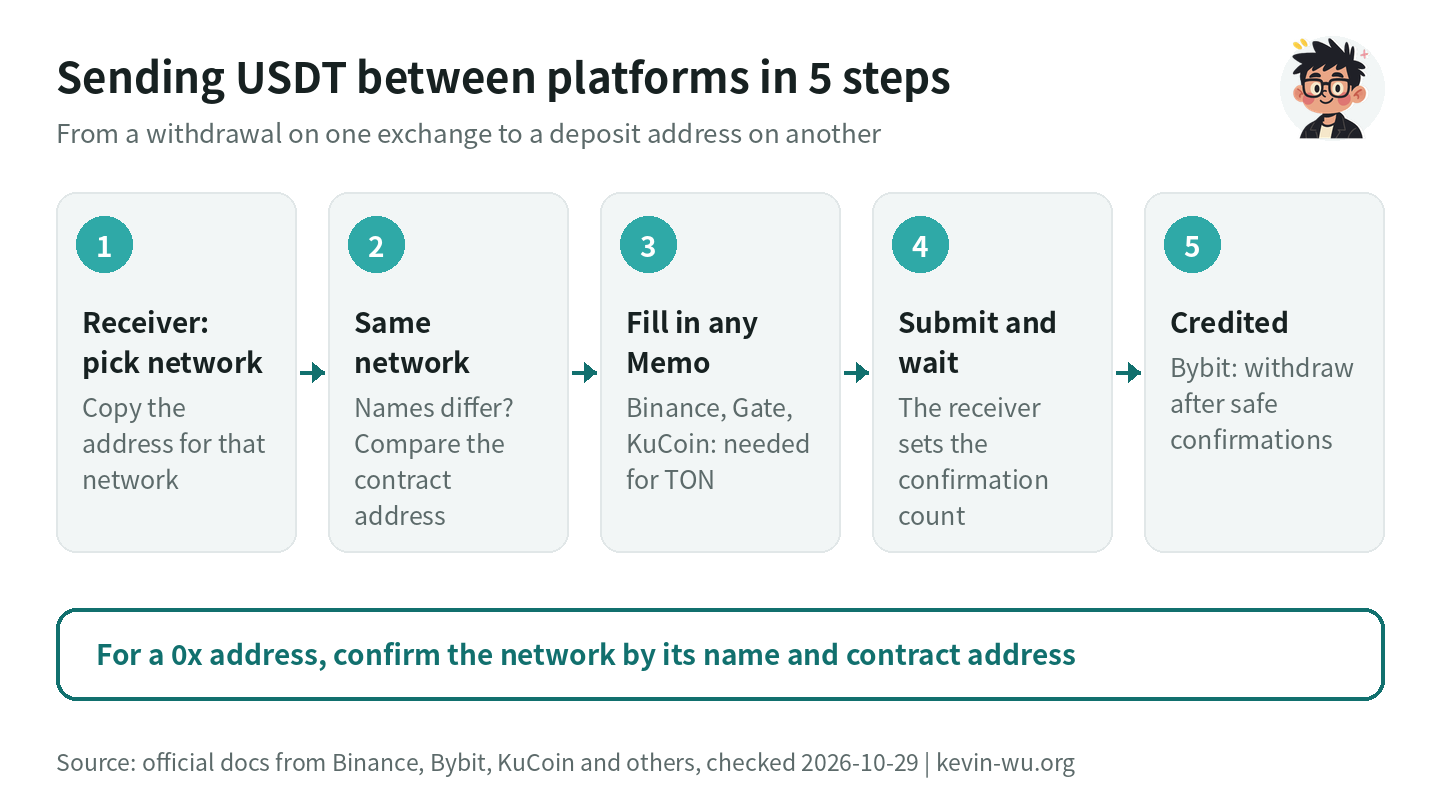
How to avoid picking the wrong network: checks before sending USDT
Binance’s withdrawal explainer is blunt: you must choose a network compatible with the withdrawal address, choosing the wrong network may result in funds being lost and unrecoverable, and you shouldn’t simply pick the cheapest option (Binance withdrawal fee explainer). Before a transfer, check in this order:
- Open the receiving side’s deposit page first, choose the network, then copy the address. The same account may have different deposit addresses on different networks, so copy it again whenever you switch networks.
- Look at how the address starts: T means TRC20, UQ / EQ means TON, and 0x could be any of the 8 networks in the table above. In that case only the network name and contract address can tell you which.
- The network name must match on both sides. OKX and Bybit label Arbitrum One, Plasma and others as USDT0, and other exchanges may not; when the names differ, compare the contract address.
- For TON, check whether a Memo is needed (what a Memo / Tag is). Binance, Gate and KuCoin all require one for USDT on TON; if the receiving side’s deposit page gives a Memo, you must always fill it in.
- Check the minimum amounts: the sending side has a minimum withdrawal and the receiving side has a minimum deposit. A transfer below the minimum deposit may not be credited.
- Check the network status: on 2026-10-29, Binance’s Polygon withdrawals were paused, and one of KuCoin’s TON networks was open for deposits only. Pauses are often lifted within a few days; go by the page at the time.
If you have already sent to the wrong network, whether it can be fixed depends on what went wrong and whether the receiving platform offers recovery; each exchange’s recovery fees and processing times are in sent USDT on the wrong network: what to do. For how much you can withdraw per day and per transaction, see exchange withdrawal limits compared.
How often do USDT withdrawal fees change? Two weeks of our records
Our USDT withdrawal fee comparison was checked once on 2026-10-12 and partly rechecked on 10-22. Checking again on 10-29, several networks had changed at the same 7 exchanges:
| Exchange and network | 2026-10-12 | 2026-10-22 | 2026-10-29 |
|---|---|---|---|
| OKX ERC20 | 0.55 | 0.43 | 0.29 |
| OKX Aptos | 0.0012 | 0.0023 | 0.00069 |
| OKX TON | 0.037 | 0.016 | 0.015 |
| Binance ERC20 | 0.5 | 0.6 | 0.6 |
| Binance Polygon | 0.07 | 0.03 | 0.03 (withdrawals paused) |
| Binance BEP20 minimum withdrawal | 5 | 5 | 2 |
| Gate Avalanche C-Chain | 0.1 | 0.1 | 0.05 |
| Bitget minimum withdrawal (all networks) | 10 | 5 | 5 |
Source and date: the 2026-10-12 and 10-22 figures are the ones we recorded at the time from official data; the 10-29 figures follow this article’s sources. Amounts in USDT. OKX’s ERC20 fee fell from 0.55 to 0.29 USDT in two weeks, while Aptos first rose and then fell. According to our records, the main fees at Bybit, MEXC and KuCoin did not change over this period, and the Optimism network KuCoin used to list is no longer in its USDT network list.
So every figure in any article, this one included, is only a snapshot from the day it was checked. Before sending a large amount, the most reliable check is the withdrawal page itself: see how much is actually deducted and how much arrives.
FAQ
Which USDT network has the lowest fees?
It depends on which exchange you send from; no single network is cheapest everywhere. Based on checks on 2026-10-29, Plasma has the lowest median across the 7 exchanges at 0.012 USDT, followed by Optimism at 0.027 USDT (not offered by KuCoin) and Avalanche C-Chain and Aptos at 0.04 USDT. Binance, Bitget and MEXC charge only 0.01 USDT on BEP20, while OKX has no BEP20. Before you choose, confirm the receiving side supports the same network.
How much is the USDT TRC20 withdrawal fee?
Based on checks on 2026-10-29, the 7 exchanges charge 0.5 to 1.99 USDT: MEXC 0.5, Bybit 1.3, Binance, OKX, Bitget and Gate 1.5, and KuCoin 1.99 USDT. All 7 support TRC20, but its median of 1.5 USDT makes it the most expensive of the common networks.
Is sending USDT over ERC20 still expensive?
On-chain gas isn’t necessarily expensive, but the withdrawal fees exchanges charge vary a lot. In a 2026-10-29 sample, the median gas for one USDT transfer on Ethereum was about 0.023 USDT; on the same day, exchange ERC20 withdrawal fees ranged from 0.094 at MEXC and 0.29 at OKX up to 5.5 USDT at KuCoin.
BEP20 and ERC20 addresses look the same. Can I send between them?
The address format is the same, but both sides must use the same network. BEP20 and ERC20 addresses are both 0x plus 40 characters, so an address check can’t stop you from choosing the wrong network; Binance states that choosing the wrong network may result in funds being lost and unrecoverable. If it happens, see what to do after sending to the wrong network.
Do I need TRX or ETH to send USDT from a wallet?
Yes when sending from your own wallet, no when withdrawing from an exchange. When a wallet sends USDT, gas is paid in that chain’s native coin: TRX for TRC20 (TRX is burned when you have no staked Energy), ETH for ERC20 and SOL for Solana. An exchange withdrawal deducts the fee in USDT directly from your account.
Do I need a Memo to send USDT on TON?
If the receiving side gives you a Memo, you must fill it in. Binance, Gate and KuCoin all mark USDT withdrawals on TON as requiring a Memo; Bitget marks it as not needed. A missing Memo usually means filing a separate recovery request, and fees vary by exchange.
Is USDT0 the same as USDT?
OKX’s explainer states that USDT0 is backed 1:1 by USDT held by Tether, but you should still compare contract addresses before a transfer. OKX labels networks such as Arbitrum One, Polygon and Plasma as USDT0, and other exchanges may not use this label on the same network, so when the names differ between the two sides, check the contract address.
Which network gets USDT there fastest?
TON and Aptos need just 1 confirmation at Binance, Bybit and KuCoin, and TRC20 also needs only 1 at Binance. The exchange decides the confirmation count: for the same TRC20, Bybit requires 20 (about 1 minute), and Arbitrum One at Bybit needs 3,360 confirmations before withdrawals unlock. The actual time also includes review at the sending side.
Each exchange’s trading fees and referral codes are collected in crypto exchange referral codes; for how USDT and USDC differ, see USDT vs USDC; and terms such as deposit, withdrawal and crypto transfer are explained in crypto deposit, withdrawal and transfer terms explained.
Want to see these updates more often in Google Search? Add Kevin Wu as a preferred source on Google