


Updated Rules checked 2026-10-17
How to open futures on XT.COM: log in, go to “Futures” → “USDT-M Futures” → “Perpetual”, and the first time, accept the “XT Futures User Service Agreement” to open your futures account. Then transfer USDT from your spot account to your futures account, choose cross or isolated margin and your leverage, and you can place an order. The official XT futures tutorials I found don’t mention any quiz or questionnaire. In XT’s official help pages, identity verification (KYC) is “recommended”, not a requirement for opening futures.
KEVINWUOn cost, regular users (VIP 0) pay futures fees of 0.02% maker and 0.06% taker, calculated on position value and charged once when you open and once when you close. Perpetual contracts also carry a funding fee, which on most trading pairs settles every 4 hours or every 8 hours. Leverage depends on the trading pair: crypto contracts go up to 150x, but only three pairs (BTC, ETH and XAUT) reach that level, and the most common cap is 20x.
Leverage magnifies both gains and losses. If the price moves against you, your position may be liquidated and you lose all the margin you put in. Below I go through account setup, margin modes, fees, liquidation prices and take-profit/stop-loss in that order, with an official XT source for each.
Key points
XT’s official help states that “cross margin mode is XT’s default margin mode”. When I read XT’s official futures API on 2026-10-17, all 719 actively trading USDT-M perpetual contracts had cross as their initial margin mode, and BTCUSDT’s initial leverage was 20x.
XT’s VIP 0 futures fees are 0.02% maker and 0.06% taker. With 1,000 USDT of margin at 10x, opening and closing as a taker costs 12 USDT in total fees.
The official API on the same day showed that 397 of the 719 USDT-M perpetual contracts settle funding every 4 hours, more than the 321 that settle every 8 hours.
XT publishes its isolated-margin liquidation formula: long liquidation price = (average entry price × quantity × contract size + maintenance margin − position margin) ÷ (quantity × contract size). For BTC at 10x with a 0.40% maintenance margin rate, a move of about 9.6% against you triggers liquidation.
XT doesn’t let you switch between cross and isolated while you hold a position or have unfilled orders: you must cancel the orders and close the position first.
The information below was checked against official pages on 2026-10-17 (the fact-check date) and is provided for reference.
If you don’t have an XT account yet, sign up with the referral code KEVINWU, and XT pays Futures 60%, Spot 35% of your trading fees back to your spot account the day after you trade (T+1); futures are included. This rate syncs with the exchange every day, and every change is recorded in the rebate rate report.
How do you open a futures account on XT.COM?
Check three things before you start. First, how activation works: the “XT Futures User Service Agreement” (updated 2026-10-04) that you accept when opening a futures account ends with: “I have read and agree to the XT futures service agreement, and agree to use XT’s futures business. I am aware of the risk and confirm the trade.” The official tutorials include no quiz or questionnaire. Second, identity verification: XT’s “How to complete identity verification?” (updated 2026-09-18) describes KYC as “recommended”, and completing it raises your withdrawal limit; the steps are in the XT identity verification guide. Third, where you live: section 3.3.4 of the XT user agreement bars people in the United States, Canada, mainland China, Cuba, North Korea, Singapore, Sudan, Venezuela and the Crimea region from using the service. For a comparison across exchanges, see exchange restricted countries.
Steps on the website
- Log in to XT and click “Assets” → “Futures Account” at the top. You’ll see your USDT-M and coin-M futures assets.
- Click “Transfer”, choose USDT, enter the amount and confirm. XT states that transfers take effect immediately and that internal transfers on XT are free. You can also click “Deposit” on the futures account page and choose “Futures Account” to deposit straight into it (XT: transferring and viewing futures account funds, updated 2026-10-12).
- Click “Futures” → “USDT-M Futures” → “Perpetual” at the top of the home page to open the trading page, then search for a trading pair in the top left, for example BTCUSDT.
- Click “Cross/Isolated” in the top right to choose the margin mode, then click the leverage currently shown, adjust it with the slider and press “Confirm”.
- Choose “Open”, pick an order type (limit, market or trigger order), enter the price and quantity, and click “Buy/Long” or “Sell/Short”.
- Filled positions appear under “Positions”, and unfilled orders under “Open Orders”.
Steps in the app
- Tap “Futures” at the bottom, tap the two-way arrow icon, and choose BTCUSDT under “USDT-M Futures”.
- Choose “Cross/Isolated” and your leverage.
- Pick an order type (limit or another option), enter the price and quantity, and tap “Buy/Long” or “Sell/Short”.
- To estimate profit and loss or the liquidation price, tap “…” in the top right of the futures page to open the “Futures Calculator”.
These steps are based on XT’s “How to open a position” (updated 2026-08-19), the XT USDT-M perpetual futures tutorial and the XT futures calculator guide. The official help pages don’t say where to transfer funds in the app. The order quantity unit can be set to “USDT (cost value)” or “USDT (notional value)”: the first is your margin, the second is the position value, so check which one is selected before you type.
Cross vs isolated margin: what’s the difference, and which should you use?
| Item | Isolated | Cross (XT default) |
|---|---|---|
| How margin is allocated | Position margin is kept separate from your account balance | Your entire available balance in the same coin supports the position |
| Maximum loss on liquidation | That position’s margin | All assets in that coin (for example, a USDT contract can wipe out your whole USDT balance) |
| When margin runs low | You can add margin manually | The system automatically tops it up from your available balance to the initial margin requirement |
| Liquidation price | Depends only on this position’s margin | Moves with the PnL of other positions and your available balance |
| Can you switch while holding a position? | No. You must cancel all open orders on that trading pair and close the position first | |
Definitions are from XT: the difference between cross and isolated margin (updated 2026-06-08) and the XT position margin guide. XT’s official cross-margin example says that after a BTCUSDT position is liquidated, “he will lose his entire USDT balance, but his BTC balance will not be affected”.
XT defaults to cross margin, and this is the point beginners most often miss. On 2026-10-17 I read the XT official futures contract API: for all 719 actively trading USDT-M perpetual contracts, the initial margin mode field was cross. The initial leverage field was 10x for 389 of them, 5x for 177 and 20x for 138, and both BTCUSDT and ETHUSDT were at 20x. What your own screen shows is what counts, but if you move all your USDT into the futures account and place an order without changing the settings, every USDT you hold is carrying that position’s risk.
Numbers make this clearer. Say your futures account holds 2,000 USDT and you use 1,000 USDT of it to open a 10x BTC long. With isolated margin, even if you’re liquidated, your loss is capped at that 1,000 USDT and the other 1,000 USDT is untouched. With cross margin, the system automatically uses the other 1,000 USDT to top up your margin, so the liquidation price sits further from your entry, but if liquidation does happen, you could lose all 2,000 USDT. Which one to choose depends on how much money you’re willing to put at risk on this position.
What to watch for in hedge mode
The XT position mode guide (updated 2026-06-12) says that “XT perpetual futures support hedge mode”: you can hold a long and a short on the same trading pair at the same time, and each side’s leverage can be set separately, for example 25x on a BTCUSDT long and 50x on the short. In this mode you select “Open” to open a position and “Close” to close one. The official help pages don’t explain how to switch to one-way mode; only the futures trial bonus rules mention that while you hold a trial bonus, “only one-way mode is supported”.
There are three ways to close: place an opposite order in the order panel, click “Close” under “Positions”, or use “Close All” and take-profit/stop-loss. XT’s “How to close a position” specifically warns that when you close from the order panel, the quantity must not exceed your position. If it does, the fill opens a new position in the opposite direction, turning a long into a short.
How do you set leverage, and what’s the maximum?
XT sets leverage separately for each trading pair. Before opening a position, click the current multiplier in the “Long” or “Short” column to adjust it (XT: adjusting futures leverage). I grouped the 719 USDT-M perpetual contracts I read from the XT official leverage bracket API on 2026-10-17 by maximum leverage:
| Max leverage | Number of pairs | Examples |
|---|---|---|
| 500x | 3 | XAUUSDT, XAGUSDT, DJ30USDT (precious metal and index contracts) |
| 150x | 3 | BTCUSDT, ETHUSDT, XAUTUSDT |
| 100x | 7 | SOLUSDT, XRPUSDT, LTCUSDT and 4 commodity contracts |
| 75x | 170 | — |
| 40–50x | 141 | — |
| 21–25x | 71 | — |
| 20x | 227 | — |
| 15x | 14 | — |
| 3–10x | 83 | — |
Crypto contracts top out at 150x, available on only 3 trading pairs, and the most common cap (227 pairs) is 20x. The same contract data shows a minimum order value of 5 USDT on 498 pairs and 10 USDT on 217. For BTCUSDT it’s 10 USDT, and each contract is 0.0001 BTC.
The bigger the position, the lower the leverage you can use. The XT leverage bracket guide states that “the larger the position, the higher the margin level required”. Here are the first 5 brackets I read from the XT official BTCUSDT leverage bracket API on 2026-10-17:
| Bracket | Position value (USDT) | Max leverage | Maintenance margin rate | Maintenance amount deduction (USDT) |
|---|---|---|---|---|
| 1 | 0–300,000 | 150x | 0.40% | 0 |
| 2 | 300,000–1,000,000 | 125x | 0.42% | 60 |
| 3 | 1,000,000–2,000,000 | 100x | 0.50% | 860 |
| 4 | 2,000,000–5,000,000 | 75x | 0.67% | 4,260 |
| 5 | 5,000,000–10,000,000 | 50x | 1.00% | 20,760 |
Altcoin thresholds are much lower. On the same day, SOLUSDT’s first bracket only went up to 100,000 USDT, with a 100x maximum and a 0.50% maintenance margin rate; XRPUSDT’s first bracket only went up to 40,000 USDT. Brackets change: the example table in the help center’s “Maintenance margin calculation” article already differs from the current API data, so go by the leverage settings screen before you order.
You can also change leverage after opening. When you raise it, the position margin stays the same and you have to reduce the excess margin manually. When you lower it and the initial margin falls short, the difference is taken from your available balance; if the balance isn’t enough, you can’t make the change (XT position margin guide).
How are XT futures fees calculated?
The XT futures fee rate guide (updated 2026-10-10) gives the formula “fee = number of contracts filled × contract size × average fill price × fee rate”, where the first three terms multiplied together are the position value. Opening and closing are both 0.02% maker and 0.06% taker, and USDT-M futures charge in USDT. The XT VIP fee tier announcement also lists 0.02%/0.06% as the VIP 0 futures rate. Another XT article, “USDT-M Futures” (updated 2026-05-28), still says 0.04% maker; here I go by the newer fee rate guide and VIP announcement, and you can check the actual charges in your trade history.
Example assumptions: 1,000 USDT of margin at 10x, a position value of 10,000 USDT, a funding rate of +0.01% per interval (XT’s own official example also uses 0.01%; when I read the XT official funding rate API on 2026-10-17, BTCUSDT’s current rate was 0.005077%, settled every 8 hours), and a 3-day hold.
| Item | Formula | Amount (USDT) |
|---|---|---|
| Opening fee (taker) | 10,000 × 0.06% | 6 |
| Closing fee (taker) | 10,000 × 0.06% | 6 |
| Maker on both open and close | 10,000 × 0.02% × 2 | 4 |
| Funding, settled every 8 hours, 3 days | 10,000 × 0.01% × 9 times | 9 |
| Funding, settled every 4 hours, 3 days | 10,000 × 0.01% × 18 times | 18 |
| Taker in and out + 8-hour contract | 12 + 9 | 21 (2.1% of margin) |
| Taker in and out + 4-hour contract | 12 + 18 | 30 (3.0% of margin) |
Funding is the cost people underestimate most. The XT funding fee calculation guide gives the formula “funding fee = position value × funding rate”, with position value based on the mark price. When the rate is positive, longs pay shorts; when it’s negative, the reverse. Users pay each other, and XT takes nothing. The standard interval is every 8 hours, settled at 00:00, 08:00 and 16:00 (UTC), which is 08:00, 16:00 and 24:00 Taiwan time, and you only pay or receive it if you hold a position at the moment of settlement.
Even so, more contracts settle every 4 hours. On 2026-10-17 I read the official funding rate data for each of the 719 USDT-M perpetual contracts: 397 settle every 4 hours, 321 every 8 hours and 1 every hour. Major coins such as BTC, ETH, SOL, XRP, DOGE and BNB are all on 8 hours. The futures page shows the rate “per interval”, so a 4-hour contract charges or pays it 6 times a day. An extreme example was ERAUSDT, the only 1-hour contract that day: its current rate was −0.309469%, so shorts paid about 0.31% of position value every hour, roughly 30.95 USDT an hour on a 10,000 USDT short. XT also changes the interval of individual contracts, for example STRCUSDT went from every 1 hour back to every 8 hours on 2026-10-15.
Compared with the VIP 0 futures rates of a few large exchanges, XT’s taker fee matches Bitget at 0.06%:
| Exchange | Futures maker | Futures taker | 10,000 USDT taker in and out | Rebate channel on this site |
|---|---|---|---|---|
| XT.COM | 0.02% | 0.06% | 12 USDT | Automatic fee rebate from the exchange, Futures 60%, Spot 35%; see XT referral code |
| Bitget | 0.02% | 0.06% | 12 USDT | Automatic fee rebate from the exchange, 20%; see Bitget referral code |
| Bybit | 0.02% | 0.055% | 11 USDT | Fee Otter, see Bybit fee rebate |
| Binance | 0.02% | 0.05% | 10 USDT | Automatic fee rebate from the exchange, 20%; see Binance referral code |
| OKX | 0.02% | 0.05% | 10 USDT | Automatic fee rebate from the exchange, 20%; see OKX referral code |
Sources: XT futures fee rates, Bitget trading fee FAQ, Bybit trading fee structure, Binance fee page, OKX fee page. For how to get started on other exchanges, see the Binance futures guide, OKX futures guide, Bybit futures guide and Bitget futures guide. XT’s VIP 1 threshold is low: 200,000 USDT of futures volume in 30 days gets you there, and the futures rate drops to 0.018%/0.054%.
How does the referral code rebate apply to futures?
The XT referral rebate overview says that every time an invitee generates a real trading fee, a proportional rebate is paid. The XT referral rebate guide states that rebates are paid to the spot account on T+1 and can be found under “Spot Account” → “Funding Records” → “Distribution”, where Futures Cashback is the fee the invitee saved on futures. You won’t get the rebate in these cases:
- Opening and closing within 60 seconds: the XT partner risk control rules (updated 2026-10-15) state that the rebate is cancelled for any single order held for less than 60 seconds, and more than 8 such orders in a day may trigger risk controls.
- Frequent short-term trading: if trades opened and closed within 3 minutes make up more than 60% of your volume, or trades within 5 minutes more than 75%, the platform has the right to deduct the rebate.
- Fees covered by futures vouchers: the part paid with a voucher doesn’t count toward the rebate (XT futures voucher rules).
- Funding fees: these are paid between longs and shorts, not fees collected by XT, so they don’t generate a rebate.
| Monthly volume | Fees (0.06%) | Auto rebate (60%) | Net fees |
|---|---|---|---|
| 20,000 USDT | 12 USDT | 7.2 USDT | 4.8 USDT |
| 300,000 USDT | 180 USDT | 108 USDT | 72 USDT |
| 1,000,000 USDT | 600 USDT | 360 USDT | 240 USDT |
Example at a futures fee rate of 0.06% and the current 60% automatic rebate (rate updated 2026-10-23). Your exchange statement prevails.
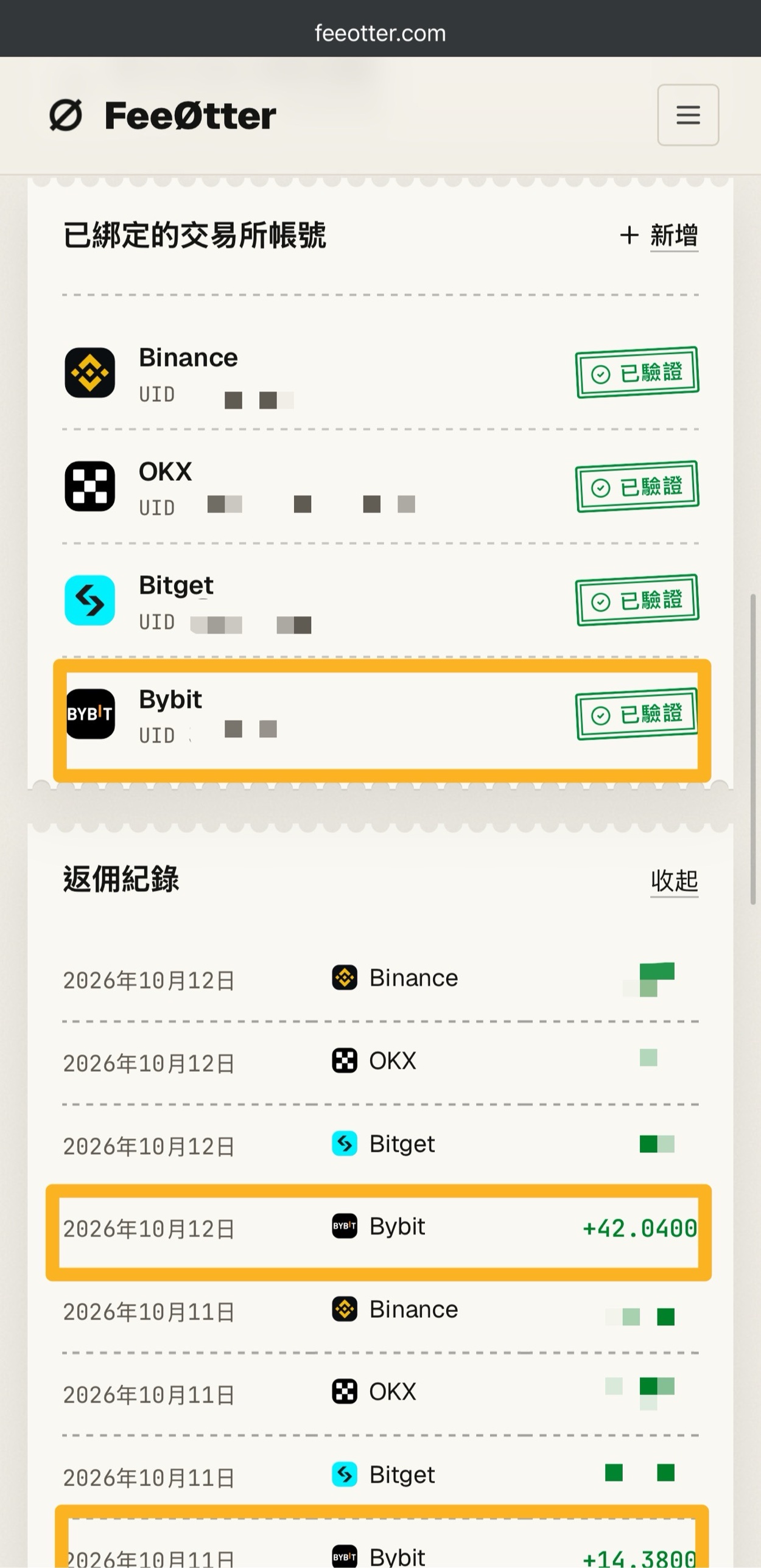
The first row, 20,000 USDT, is the trading volume of opening and closing the 10,000 USDT position in the example. The referral code has to be entered at sign-up, and I couldn’t find any official process for adding or changing it later; if you’ve already registered, see the XT referral code rebind guide. Bybit has no automatic fee rebate from the exchange on this site; its rebate channel is Fee Otter. The extra rebate is paid by Fee Otter, not by the exchange and not by Kevin Wu; the money is credited to your Fee Otter account, and the rate is whatever Fee Otter’s page shows at the time. For the steps, see Bybit fee rebate.
How is the liquidation price calculated?
XT uses the mark price to trigger liquidation: when the mark price hits the liquidation price, the position is closed at the bankruptcy price (the price at which your margin reaches 0). The XT liquidation price guide (updated 2026-07-01) publishes the isolated-margin formula:
- Long liquidation price = (average entry price × quantity × contract size + maintenance margin − position margin) ÷ (quantity × contract size), rounded up.
- Short liquidation price = (average entry price × quantity × contract size − maintenance margin + position margin) ÷ (quantity × contract size), rounded down.
- Position margin = position value ÷ leverage; maintenance margin = position value × maintenance margin rate − maintenance amount deduction.
The table below applies this formula to a BTC entry price of 60,000 USDT, 1,000 USDT of margin, and BTCUSDT’s first-bracket maintenance margin rate of 0.40% with a deduction of 0 (at 150x the position is 150,000 USDT, still in bracket 1). The price is only an assumption to keep the math simple:
| Leverage | Position value | Long liquidation price | Drop that triggers liquidation | Short liquidation price | Rise that triggers liquidation |
|---|---|---|---|---|---|
| 2x | 2,000 | 30,240 | 49.6% | 89,760 | 49.6% |
| 5x | 5,000 | 48,240 | 19.6% | 71,760 | 19.6% |
| 10x | 10,000 | 54,240 | 9.6% | 65,760 | 9.6% |
| 20x | 20,000 | 57,240 | 4.6% | 62,760 | 4.6% |
| 50x | 50,000 | 59,040 | 1.6% | 60,960 | 1.6% |
| 100x | 100,000 | 59,640 | 0.6% | 60,360 | 0.6% |
| 150x | 150,000 | 59,840 | 0.27% | 60,160 | 0.27% |
For a quick mental estimate, use “1 ÷ leverage − maintenance margin rate”: at 10x that’s 10% − 0.40% = 9.6%, and at 150x only 0.667% − 0.40% ≈ 0.27% is left. XT’s formula doesn’t include the closing fee, so go by the liquidation price shown in your positions panel. If your available balance can’t cover a funding fee, it is deducted from the position margin: in XT’s official example, a 50x long paid 200 USDT in funding and its liquidation price moved from 19,700 to 19,900. To run your own numbers, use the liquidation price calculator.
What happens once it triggers: according to XT’s liquidation process (updated 2026-10-15), the system first cancels all unfilled orders on that contract, then partially liquidates the position bracket by bracket; if that still isn’t enough, the liquidation engine takes over the position at the bankruptcy price. Whether you get any remaining margin back is described differently in two XT articles. “Liquidation process” says that when “the loss is less than the margin”, the remaining margin is returned, while the XT insurance fund guide (updated 2026-08-31) says liquidations are always settled at the bankruptcy price, and when the fill is better than the bankruptcy price, the remaining margin goes into the insurance fund. If the insurance fund can’t cover losses beyond the margin, auto-deleveraging (ADL) is triggered: counterparties’ profitable positions are forcibly reduced, ranked by profit ratio and leverage (XT auto-deleveraging guide).
How do you set take-profit and stop-loss?
Tick “TP/SL” in the order panel to set them together with your order. If the position is already open, find the contract under “Positions” and click “Add” (XT: how to set take-profit and stop-loss, updated 2026-08-07). The rules:
- Trigger price: you can choose mark price, index price or last price. The XT take-profit/stop-loss FAQ (updated 2026-10-06) states that the default is the last traded price, but liquidation is triggered by the mark price, so the mark price may trigger liquidation before the last price reaches your stop-loss.
- Two modes: “Partial position” covers a fixed quantity, and you can set several; “Entire position” follows the position size, only one can be set, and it closes at market once triggered.
- Execution: market by default, or you can switch to limit. Market orders may slip; limit orders may not fill or may fill only partly. XT suggests setting a limit sell price slightly below the trigger price, for example a trigger of 3,200 and an order price of 3,198.
- They can fail: violent price moves, a position larger than the maximum single market order, or insufficient margin at trigger time can all make the order fail. If the position is liquidated, all its take-profit and stop-loss orders are cancelled along with it.
- Reset after adding to a position: adding changes your average entry price, but the trigger prices are fixed when you create them and don’t adjust automatically.
Your stop-loss must sit before the liquidation price. For example, the 10x long in the table above liquidates at 54,240, so set the stop-loss above that with some room to spare. XT also offers a paid “Guaranteed Stop Loss”. The XT guaranteed stop-loss announcement (updated 2026-10-11) states that once triggered it fills at your set stop price with no slippage, and you’re charged only when it actually triggers and fills. The fee = stop-loss fill quantity × stop-loss fill price × that pair’s guaranteed stop-loss rate, and the first supported pairs are BTCUSDT, ETHUSDT, SOLUSDT, XRPUSDT and DOGEUSDT. In the official contract API, BTCUSDT’s guaranteed stop-loss rate field is 0.05%; at that rate, stopping out 1 BTC at 79,000 USDT costs 39.5 USDT, but the actual rate is whatever the order page shows. Separately, XT’s futures order types include GTX (maker only), which is cancelled if it can’t be placed as a maker order, so you’re sure to pay the 0.02% maker rate.
The most common beginner mistakes
- Thinking fees are based on margin: fees are based on position value. With 1,000 USDT at 20x, taker in and out costs 20,000 × 0.06% × 2 = 24 USDT, which is 2.4% of your margin gone before the price even moves.
- Ordering without changing the defaults: XT defaults to cross margin, and BTCUSDT’s initial leverage is 20x. If you move all your funds into the futures account and order straight away, a liquidation could wipe out all your USDT.
- Wanting isolated only after opening: you can’t switch while you have a position or open orders; you have to cancel the orders and close the position first.
- Entering too large a close quantity: when you close from the order panel and the quantity exceeds your position, the fill flips you into a new position in the opposite direction.
- Ignoring how often funding settles: more than half (397) of USDT-M perpetual contracts settle every 4 hours, so the same rate is paid 6 times a day.
- Relying only on the futures calculator: the XT futures calculator guide states that results are for reference only and may differ because of fees, funding rates and other factors.
- Expecting rebates on ultra-short trades: orders opened and closed within 60 seconds get no rebate, and frequent short-term trading may also lead to deducted rebates or risk controls.
What are the risks of XT.COM futures?
Futures are not a principal-protected product. Each of the risks below is stated on an official XT page:
- You can lose all your margin to liquidation: the risk warning in the XT futures trading beginner’s guide says “violent price fluctuations may cause your entire margin balance to be forcibly liquidated”; a cross-margin liquidation loses all your assets in that coin.
- Liquidation is irreversible: XT states that liquidation “is an irreversible process, and traders cannot control when it is executed or at what price”.
- Auto-deleveraging: if the insurance fund is drained too quickly, profitable, high-leverage counterparty positions may be reduced by the system; XT also warns that coin-M futures are more likely to face ADL than USDT-M futures.
- Take-profit and stop-loss fills aren’t guaranteed: a regular stop-loss may fail or fill at a different price in extreme markets.
- Service may be suspended: the futures user service agreement states that XT reserves the right to suspend or terminate the futures service at any time.
- Rules change: leverage brackets, maintenance margin rates and funding intervals are all adjusted by announcement. For example, between 2026-09-01 and 10-17, the funding rate section of the XT help center had 39 announcements changing the settlement interval of individual contracts.
- Regional restrictions: the user agreement states that if you hide or misstate where you live, XT can close your account and close the positions in it.
Weigh the risk of the exchange itself as well. XT’s proof of reserves and the 2024 incident of abnormal outflows from its platform wallet are covered in the XT review, exchange proof of reserves comparison and exchange safety record.
FAQ
Do you need a quiz or KYC to open XT futures?
No quiz. XT’s official futures tutorials don’t mention a quiz or questionnaire; to activate futures you accept the “XT Futures User Service Agreement”. For KYC, XT officially says it’s “recommended”. If your account screen asks for anything extra, go by the screen.
What’s the minimum amount for XT futures?
The official contract data on 2026-10-17 shows that most USDT-M perpetual contracts have a minimum order value of 5 USDT or 10 USDT; for BTCUSDT it’s 10 USDT, at 0.0001 BTC per contract. That’s the floor on position value, so at 10x about 1 USDT of margin is enough for the smallest BTCUSDT order.
What are XT’s futures fees?
VIP 0 futures fees are 0.02% maker and 0.06% taker, charged on position value once when you open and once when you close. 200,000 USDT of futures volume in 30 days moves you up to VIP 1, where the rates drop to 0.018%/0.054%. The full VIP table and XT platform token discounts are in XT fees.
What’s XT’s maximum leverage?
Crypto contracts go up to 150x, and in the official API on 2026-10-17 only BTCUSDT, ETHUSDT and XAUTUSDT reached it; gold, silver and Dow Jones index contracts go up to 500x. The most common cap (227 pairs) is 20x, and larger positions get lower leverage: once a BTCUSDT position exceeds 300,000 USDT, it drops to 125x.
Is cross or isolated margin better on XT?
Neither is better in absolute terms. Isolated limits your loss to that position’s margin, but the liquidation price is closer; cross puts the liquidation price further away, but a liquidation can cost you all your assets in that coin. XT defaults to cross, so to use isolated you have to switch before opening.
How often is XT’s funding rate charged?
The standard is every 8 hours, settled at 08:00, 16:00 and 24:00 Taiwan time, but in the official data on 2026-10-17, 397 of the 719 USDT-M perpetual contracts settled every 4 hours and 1 every hour, while major coins were mostly on 8 hours. If you close before settlement, you don’t pay it. For how it works and a comparison across exchanges, see what is the funding rate.
Can you get your money back after an XT liquidation?
Don’t expect to. XT’s “Liquidation process” says the remaining margin is returned, but its “Insurance fund” article says the remaining margin goes into the insurance fund; the two articles don’t agree.
Do XT futures trades get a rebate?
Yes. Accounts registered with a referral code that carries a rebate also get rebates on futures fees, paid to the spot account on T+1 and shown as Futures Cashback under “Funding Records” → “Distribution”. Orders opened and closed within 60 seconds, fees covered by vouchers, and funding fees don’t generate a rebate. For all the cases where rebates are cancelled, see can rebates be cancelled; for how to check your binding status, see how to check whether your referral code is bound.
The full method for fees and funding is in how futures fees are calculated, you can run your own position through the perpetual futures cost calculator, and the difference between placing and taking orders is in maker vs taker fees. XT’s fees, identity verification and overall review are in XT fees, the XT identity verification guide and the XT review. For the referral code and how to sign up, see XT referral code; codes for every exchange are collected in crypto exchange referral codes.