


Updated Rules checked 2026-10-17
You need only two things to trade futures on Bybit: your account has completed identity verification at any level, and you are not in a region on Bybit’s service restriction list. Bybit’s official futures starter guide does not mention any quiz you must pass first. Transfer USDT from your Funding Account to your Unified Trading Account (UTA), open the USDT perpetual trading page, and you can place an order. The defaults are cross margin, 10x leverage and one-way mode.
Bybit has no automatic exchange rebate. This extra rebate is paid by Fee Otter, not by the exchange and not by Kevin Wu; the rate is whatever Fee Otter's page shows (checked 2026-10-22).
Regular users (VIP 0) pay futures fees of 0.02% Maker and 0.055% Taker, charged on position value, not on margin. Open 10x with 1,000 USDT of margin and your position is 10,000 USDT, so opening and closing at market costs 11 USDT in total. BTCUSDT goes up to 150x, but more than 70% of Bybit’s USDT perpetual contracts are capped at 25x or lower. Leverage can get your position forcibly liquidated, and you lose all your margin.
Signing up on Bybit with a referral code gives you no automatic fee rebate from the exchange. To get part of your futures fees back, you need a rebate site such as Fee Otter. This guide goes through setup, margin modes, leverage, fees, liquidation, and take-profit and stop-loss orders, in that order.
Key points: Bybit perpetual futures fees at VIP 0 are 0.02% Maker and 0.055% Taker, calculated on position value; 1,000 USDT of margin at 10x costs 11 USDT to open and close at market. Bybit defaults to cross margin, 10x leverage and one-way mode, and the margin mode applies to the whole account; you cannot set it separately for each trading pair. Read from Bybit’s official API on 2026-10-17: BTCUSDT goes up to 150x, its first risk limit tier is 300,000 USDT with a 0.33% maintenance margin rate, and 610 of 798 USDT perpetual contracts are capped at 25x or lower. An isolated 10x long hits its liquidation price after a drop of about 9.70%. Bybit charges no liquidation fee on perpetual contracts, but positions in the lowest risk tier are closed at the bankruptcy price, and the remaining margin is not returned. Bybit has no trading fee rebate for invitees; the extra rebate from a rebate site is paid by Fee Otter, not by the exchange and not by Kevin Wu.
The information below was checked against official pages on 2026-10-17 (data check date) and is provided for reference.
How do you start trading futures on Bybit?
Check two conditions first. The first is identity verification: Bybit’s table of verification level permissions states that you can trade perpetual, expiry and options contracts once you complete any level (individual Standard, Advanced or Business verification), and that unverified accounts can neither trade futures nor deposit (Bybit benefits of different KYC levels, updated 2026-10-06). For the verification steps, see the Bybit identity verification guide.
The second is your region: Bybit’s service restricted countries (updated 2026-10-16) lists the United States, mainland China, Hong Kong, Singapore, Canada and other regions, and does not list Taiwan. To compare the restricted regions of each exchange, see exchange restricted countries.
How to open a futures trade in the app
- Transfer funds: deposits and withdrawals go through the Funding Account, while trading happens in the Unified Trading Account (UTA). On the app home screen, tap “Assets” at the bottom right, tap the coin you want to move (for example USDT), then tap “Transfer”. Choose the Funding Account as the source and the Unified Trading Account as the destination, enter the amount and confirm. Bonuses, margin in use and deposits under risk review cannot be transferred (How to transfer assets on Bybit, updated 2026-08-11).
- Open the futures trading page and pick a trading pair: for example, the BTCUSDT perpetual contract.
- Set the margin mode: tap the “⋯” icon, choose “Isolated Margin”, “Cross Margin” or “Portfolio Margin”, and tap “Switch Margin Mode”.
- Set the position mode: tap “⋯” → “Trading Preferences”, choose “One-Way Mode” or “Hedge Mode”, and confirm. Before switching, you must close all positions and cancel all open orders.
- Set the leverage: tap the “Leverage” drop-down in the order panel and choose a preset multiple or “Custom”. The highest multiple you can choose depends on your risk limit tier.
- Choose the order type and enter the price and quantity: limit, market or conditional order. You can order by quantity or by value; “order by cost” is available only in hedge mode on USDT perpetual contracts.
- Set take profit and stop loss (optional): tick TP/SL before you place the order, and the system places them automatically once the order fills.
- Order settings (optional): the time in force defaults to GTC, and you can also choose IOC or FOK. Limit orders can be set to “Post-Only” (Maker only), and in one-way mode you can tick “Reduce-Only” or “Close On Trigger”.
- Tap “Long” or “Short” to submit. Filled orders cannot be canceled; unfilled orders can be amended or canceled in the orders tab.
Steps 2 to 9 follow Bybit’s getting started with futures trading (updated 2026-08-05), with interface labels based on the official Traditional Chinese page.
How to open a futures trade on the website
- Log in to the Bybit website, go to the assets page, click “Transfer” and move USDT from the Funding Account to the Unified Trading Account.
- Open the futures trading page from the top menu, then choose USDT perpetual and a trading pair.
- In the order panel on the right, use “Margin Mode & Leverage” to set the margin mode and multiple; you can also switch the margin mode under Asset Details.
- Choose a limit, market or conditional order, enter the price and quantity, tick TP/SL if you want it, then click Long or Short.
- After placing the order, check it in the “Positions” and “Current Orders” tabs at the bottom of the trading page. Bybit recommends turning on the order confirmation window to reduce mistaken clicks.
The section names on the website follow Bybit’s guide to the perpetual and expiry contract trading page (updated 2026-06-18). The website steps in the official starter guide are screenshots only, so go by the menu names you actually see on screen.
The minimum order is very low: read from the Bybit instruments info API on 2026-10-17, the BTCUSDT minimum order quantity is 0.001 BTC and the minimum notional value is 5 USDT.
Cross vs isolated margin: what’s the difference and which should you choose?
Bybit’s Unified Trading Account has three margin modes. The mode you choose applies to the whole account, so you cannot run BTCUSDT in isolated mode and ETHUSDT in cross mode.
| Item | Isolated margin | Cross margin (default) | Portfolio margin |
|---|---|---|---|
| Liquidation trigger | The mark price reaches that position’s liquidation price | The account maintenance margin rate reaches 100% | The account maintenance margin rate reaches 100% |
| Assets usable as margin | Single asset: only the settlement coin; USDT contracts use only USDT | Multiple assets: collateral-eligible assets in the account, valued in USD | Multiple assets, same as cross |
| Can unrealized profit open new positions? | No | Yes | Yes |
| Spot margin trading and borrowing | Not supported | Supported | Supported |
| Hedge mode | Supported; long and short can use different leverage | Supported; long and short must use the same leverage | One-way mode only |
| Auto-add margin | Supported | Not supported | Not supported |
Source: Bybit’s differences between the margin modes under the Unified Trading Account (updated 2026-08-04).
The difference is how far a loss can reach. In isolated mode, one position can lose at most the margin assigned to it; its liquidation price is fixed to that position, and the rest of the money in your account is unaffected. In cross mode, the USDT in your account, and even collateral-eligible assets such as BTC, all count as margin, so a single position is less likely to be liquidated. But if the market keeps moving against you, the equity of the entire account is used to absorb that loss, and when liquidation is triggered it hits the whole account. If you want to fix the maximum loss of each trade in advance, isolated mode is easier to control; if you hold several positions at once and want their profits and losses to offset each other, cross mode uses less margin.
Switching has conditions. To move from cross or portfolio margin to isolated, the account cannot have options orders or positions, spot margin orders or borrowings, and your assets must be enough to cover isolated mode’s higher margin. To move to cross or portfolio margin, the initial margin rate after the switch cannot exceed 100%, and switching to portfolio margin also requires that you have no hedge mode orders or positions.
Position mode is a separate setting. In one-way mode, you can hold only one direction per trading pair, and an order in the opposite direction closes your existing position. In hedge mode, you can hold a long and a short at the same time, and orders are split into “Open” and “Close”. At present only USDT perpetual contracts support hedge mode (Bybit’s guide to the trading page).
How do you set leverage, and what is the maximum?
You set leverage in the order panel. The default is 10x, and the step size listed in the instruments info API is 0.01x. The cap is not fixed; it depends on the trading pair and the risk limit tier. The larger your position (plus open orders in the same direction), the higher the tier, the lower the maximum leverage you can use, and the higher the maintenance margin rate. Bybit adjusts the tier automatically based on your positions and open orders, and returns you to the lowest tier when you have neither (Bybit risk limit, updated 2026-09-04).
| BTCUSDT risk limit tier | Position value cap | Max leverage | Initial margin rate | Maintenance margin rate |
|---|---|---|---|---|
| Tier 1 | 300,000 USDT | 150x | 0.66% | 0.33% |
| Tier 2 | 2,000,000 USDT | 100x | 1% | 0.50% |
| Tier 3 | 2,600,000 USDT | 90x | 1.11% | 0.56% |
| Tier 4 | 3,200,000 USDT | 80x | 1.25% | 0.63% |
Data from the Bybit risk limit API (read on 2026-10-17); BTCUSDT has 35 tiers in total. The example in the official explanation matches: with leverage set to 90x, the cap on positions plus open orders is 2.6 million; to go bigger, you have to lower the leverage to 80x yourself, and the cap becomes 3.2 million. Bybit also states that it may adjust margin rates, maximum leverage and position caps based on market liquidity.
150x is the cap on only a few trading pairs. On the same day I read all 798 USDT perpetual contracts trading on Bybit, and the maximum leverage breaks down like this:
| Max leverage | Contracts | Share | Examples |
|---|---|---|---|
| 150x | 5 | 0.6% | BTCUSDT, ETHUSDT, XAUUSDT |
| 100x | 23 | 2.9% | SOLUSDT, XRPUSDT |
| 50–75x | 160 | 20.1% | DOGEUSDT (75x) |
| 25x | 417 | 52.3% | — |
| 5–20x | 193 | 24.2% | — |
Source: Bybit instruments info API (read on 2026-10-17; counts only USDT-settled perpetual contracts with trading status). Leverage decides how much margin you put up for the same position, and also how far the price can move against you before liquidation: the higher the multiple, the closer the liquidation price is to your entry price. With leveraged trading, an adverse price move may get your position forcibly liquidated, and you lose all your margin. Changing the leverage also changes the initial margin you tie up and your liquidation price.
How are Bybit futures fees calculated?
The formula is “fee = trade value × fee rate”, charged once when you open and once when you close. At VIP 0, USDT perpetual, USDC perpetual and inverse contracts are all 0.02% Maker and 0.055% Taker (Bybit trading fee structure, updated 2026-09-02). Bybit states that rates may differ by region and that the “My Fee Rates” page of your own account prevails. If you turn on paying fees with MNT, USDT perpetual fees get 10% off and Taker becomes 0.0495%, but this does not apply to inverse contracts, copy trading, API or liquidation orders. For the full rates and VIP thresholds, see Bybit trading fees; for the difference between Maker and Taker, see Maker vs Taker fees.
Worked example: 1,000 USDT of margin at 10x, held for 7 days
| Item | Calculation | Amount |
|---|---|---|
| Position value | 1,000 × 10 | 10,000 USDT |
| Opening fee (market, Taker) | 10,000 × 0.055% | 5.5 USDT |
| Closing fee (market, closed at the same price) | 10,000 × 0.055% | 5.5 USDT |
| Funding fee (assuming 0.01% every 8 hours, 3 times a day) | 10,000 × 0.01% × 3 × 7 | 21 USDT |
| Total | 5.5 + 5.5 + 21 | 32 USDT (3.2% of margin) |
| Open and close with limit orders (Maker) | 10,000 × 0.02% × 2 + 21 | 25 USDT |
| With MNT fee deduction (market) | 11 × 0.9 + 21 | 30.9 USDT |
For this trade to make money, the price has to move at least 32 ÷ 10,000 = 0.32% in your favor. The funding fee is not paid to Bybit: when the rate is positive, longs pay shorts; when it is negative, shorts pay longs; and if you fully close before the settlement time, you neither pay nor receive it (Bybit funding fee calculation, updated 2026-05-12). 0.01% is the baseline interest rate per 8-hour period in Bybit’s formula; the actual rate changes every period, and when I read the API on 2026-10-17, BTCUSDT was at 0.0050%.
The settlement frequency also depends on the trading pair. In the same day’s API data, of 798 USDT perpetual contracts, 416 settle every 8 hours, 380 every 4 hours and 2 every hour; BTCUSDT settles every 8 hours, with a funding rate cap and floor of ±0.333%. When the rate hits the cap or floor, Bybit switches to hourly settlement (Bybit introduction to funding rate). Before holding a position, check the countdown next to the funding rate on the trading page. For details, see what the funding rate is and how it’s calculated.
Why can’t exactly 1,000 USDT open a 10,000 USDT position?
Because when you place an order, Bybit reserves the “order cost”, which is more than the margin. According to Bybit’s order cost explanation (updated 2026-06-28), order cost = initial margin + opening fee + estimated closing fee, and the closing fee is estimated using the bankruptcy price and the non-VIP Taker rate. For a 10x long with a 10,000 USDT position: initial margin 1,000, opening fee 5.5, estimated closing fee 10,000 × (1 − 1/10) × 0.055% = 4.95, for a total of 1,010.45 USDT. With only 1,000 USDT in the account, the most you can open at 10x is roughly a 9,896 USDT position.
How Bybit futures compare with other exchanges
| Exchange | VIP 0 Maker / Taker | BTCUSDT max leverage | Tier 1 position cap / maintenance margin rate | Extra fee on liquidation | Automatic fee rebate from the exchange with this site’s referral code |
|---|---|---|---|---|---|
| Bybit | 0.02% / 0.055% | 150x | 300,000 USDT / 0.33% | No liquidation fee on perpetual and expiry contracts | None (rebate site: Fee Otter) |
| Binance | 0.02% / 0.05% | 150x | 300,000 USDT / 0.40% | Liquidation clearance fee, based on notional value and each contract’s rate | 20% |
| OKX | 0.02% / 0.05% | 100x | 1,000 contracts (10 BTC) / 0.40% | Charged at the Taker rate of your current tier | 20% |
| Bitget | 0.02% / 0.06% | 150x | 200,000 USDT / 0.40% | Not stated officially | 20% |
Sources: fees from the official fee pages of Bybit, Binance, OKX and Bitget; leverage and maintenance margin rates from official data of Bybit, Binance, OKX and Bitget, read on 2026-10-17; liquidation fees from the Bybit fees overview, Binance liquidation rules and OKX trading fee FAQ. Looking only at official rates, Bybit’s Taker fee is 0.005 percentage points higher than Binance’s and OKX’s. BTCUSDT’s tier 1 maintenance margin rate of 0.33% is the lowest of the four, so at the same leverage the liquidation price sits slightly farther away. For the futures guides of the other three, see the Binance futures guide, the OKX futures guide and the Bitget futures guide.
How much of your Bybit futures fees can you get back?
The exchange itself gives nothing back. Bybit’s referral program FAQ (updated 2026-10-10) lists the invitee benefits as a welcome gift and trading task rewards, with no trading fee rebate. Rebate sites work through Bybit’s affiliate program, where the commission base is “trading fees − market maker rebates − bonuses/coupons”, and the rebate site then passes part of that commission on to you (Bybit affiliate program FAQ, updated 2026-09-19). So only trading fees you actually pay generate a rebate; funding fees do not.
The Fee Otter rebate page lists Bybit at 40% (as of 2026-10-17). All of it is Fee Otter’s extra rebate, paid by Fee Otter, not by the exchange and not by Kevin Wu; go by the rate on Fee Otter’s page. Applied to the example above, you get 4.4 USDT back from the 11 USDT of opening and closing fees, so the 7-day total cost falls from 32 USDT to 27.6 USDT, while the 21 USDT funding fee stays the same. This money is credited to your Fee Otter account and has to be withdrawn separately, and there is also the risk that a third party changes its rate or shuts down.
Below is a screenshot of my own Fee Otter dashboard, showing the actual Bybit rebate credits:
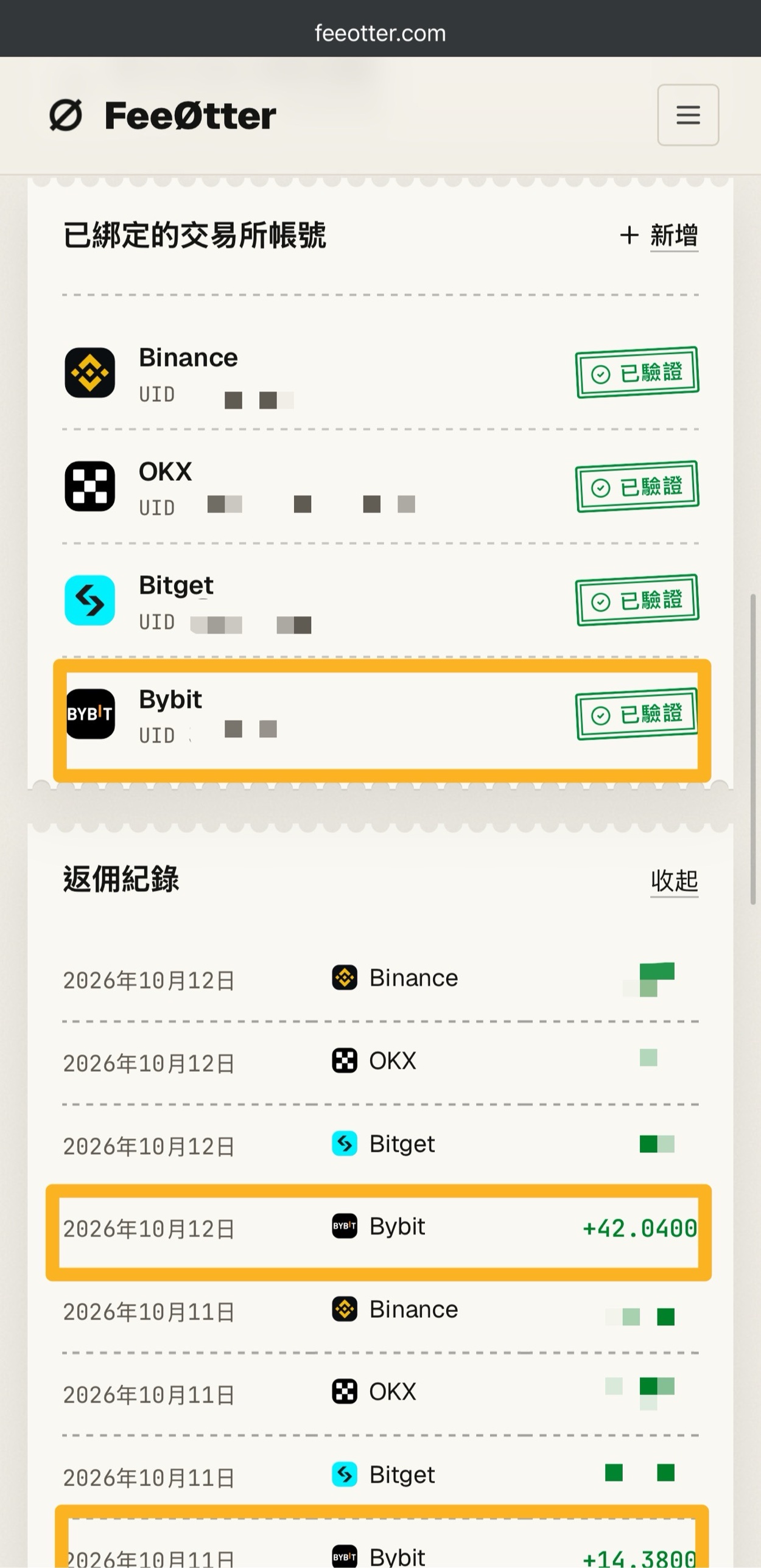
Whether turning on MNT fee deduction affects the rebate is not stated officially. The affiliate program FAQ says that users who receive other discounts or promotions “may not contribute” to the affiliate’s commission, so if this matters to you, ask Fee Otter first. For sign-up, UID binding and withdrawal steps, see how to get a Bybit fee rebate (Fee Otter); for the rules on adding a code to an existing account, see Bybit referral code rebind.
How is the liquidation price calculated?
Liquidation uses the mark price, not the last traded price. In isolated mode, it is triggered when the mark price reaches that position’s liquidation price; cross and portfolio margin look at the whole account and trigger when the account maintenance margin rate reaches 100% (Bybit order execution and liquidation FAQ, updated 2026-09-25). Bybit’s formula for an isolated long is:
Liquidation price (long) = [entry price × quantity − entry price × quantity ÷ leverage − extra margin added ÷ (1 − Taker fee rate) − maintenance margin deduction] ÷ [quantity − quantity × maintenance margin rate]
For a short, swap the minus signs for plus signs and change the denominator to “quantity + quantity × maintenance margin rate” (Bybit liquidation process, updated 2026-10-15). Bybit also notes that the closing fee makes the actual liquidation price differ slightly. Using a BTCUSDT entry price of 80,000 USDT (a round number for easy math), a 10,000 USDT position (0.125 BTC), the tier 1 maintenance margin rate of 0.33% and no extra margin added:
| Leverage | Margin | Long liquidation price | Price drop that triggers liquidation |
|---|---|---|---|
| 5x | 2,000 USDT | 64,211.90 | 19.74% |
| 10x | 1,000 USDT | 72,238.39 | 9.70% |
| 20x | 500 USDT | 76,251.63 | 4.69% |
| 50x | 200 USDT | 78,659.58 | 1.68% |
| 100x | 100 USDT | 79,462.23 | 0.67% |
For a quick mental estimate, use “1 ÷ leverage − maintenance margin rate”: at 10x that is 10% − 0.33% ≈ 9.7%. A 10x short has a liquidation price of 87,710.56 and is liquidated after a 9.64% rise. In cross mode, the liquidation price depends on the other assets in the account and the profit or loss of other positions, so you cannot work it out from a single position. To try your own numbers, use the liquidation price calculator.
Once triggered, there are two ways it is handled (same liquidation process article):
- Lowest risk limit tier: open orders that would increase the position are canceled first; if margin is still insufficient, the position is closed at the bankruptcy price. The bankruptcy price is the price at which the loss exactly equals the full initial margin, so a 10x long triggered at 72,238.39 still has about 29.8 USDT of equity left, and you do not get that back either.
- Above the lowest tier: after orders are canceled, part of the position is first closed with an IOC order to bring it down to the next tier; only if that is still not enough is the rest closed at the bankruptcy price.
Bybit states that it charges no liquidation fee on perpetual and expiry contracts (Bybit fees overview, updated 2026-04-08). Losses beyond a position’s margin are covered by the insurance fund, which is funded by Bybit’s contributions and the leftover margin of liquidated positions. When the insurance fund draws down to its trigger level, auto-deleveraging (ADL) kicks in, ranking positions by leveraged return, and profitable positions are reduced first (Bybit auto-deleveraging, updated 2026-04-13).
How do you set take profit and stop loss?
You can set them at two points. When placing an order, tick TP/SL; in advanced mode you can apply it to the “entire position” or to “this order” only. Once you have a position, set it in the “Positions” tab, where you can choose the entire position or a partial position (a specified quantity, with multiple sets allowed). Unfilled orders cannot carry multiple TP/SL sets; only open positions can (Bybit introduction to take profit and stop loss, updated 2026-10-08).
| Setting | Options | Default |
|---|---|---|
| Trigger price type | Last traded price, index price, mark price (take profit and stop loss can be set separately) | Last traded price |
| Trigger method | By return (ROI %), by price change (%), by profit/loss amount | ROI % when placing an order |
| Execution after trigger | Market, limit, limit with slippage tolerance, best bid/ask | — |
| After one side triggers | The other side is canceled automatically | — |
Bybit spells out two details. First, a limit TP/SL is not guaranteed to fill after it triggers; it depends on whether the limit price can be matched. Second, liquidation uses the mark price, so a stop loss triggered by the last traded price may not trigger in time before liquidation. The official FAQ says the mark price is commonly used for stop losses because it helps them trigger before liquidation, but execution still happens at the last traded price, so slippage is still possible (Bybit order execution and liquidation FAQ). Your stop loss also has to sit before the liquidation price: for the 10x long above, the liquidation price is 72,238.39, so the stop loss must be higher than that.
Common beginner mistakes
- Thinking fees are based on margin: fees are charged on position value, so 1,000 USDT at 10x is charged on 10,000 USDT. At 50x, opening and closing once at market costs 5.5% of your margin.
- Leaving the money in the Funding Account: you have to transfer it to the Unified Trading Account before it can be used as margin.
- Not noticing that cross margin is the default: in cross mode, every collateral-eligible asset in the account counts as margin, so when one trade loses, the whole account is affected.
- Using the last traded price for a stop loss set too close to the liquidation price: Bybit warns that this kind of stop loss may not trigger in time before liquidation.
- Holding positions without checking the funding rate: 48% of USDT perpetual contracts settle every 4 hours, so the same rate is paid 6 times a day. In the example above, holding for 7 days costs 21 USDT in funding, more than the 11 USDT of opening and closing fees.
- Not noticing the leverage cap changed as the position grew: once a position exceeds the cap of its risk limit tier, Bybit blocks new orders that add to it, and the maintenance margin rate rises, moving the liquidation price closer.
- Trying to switch between one-way and hedge mode with open positions: you must close all positions and cancel all open orders before you can switch.
What are the risks of Bybit futures?
- Liquidation loses all your margin: a 10x long is liquidated after a drop of about 9.7%, and at 100x it takes only 0.67%. In the lowest risk tier, positions are closed at the bankruptcy price, and the equity left at the trigger is not returned.
- Cross margin drags in the whole account: liquidation is triggered when the account maintenance margin rate reaches 100%, and a drop in the price of assets used as margin, such as BTC, also pushes the maintenance margin rate up.
- A stop loss is not guaranteed to fill at your set price: market execution has slippage, and limit execution may not fill.
- Auto-deleveraging: in extreme markets, when the insurance fund is not enough, even profitable positions may be partly reduced by the system.
- Platform risk: disputes are handled under Bybit’s platform terms. For the exchange’s security record, see the Bybit review and exchange security records.
- The rebate site is a third party: Fee Otter’s rebates are credited to its own account, and its rates and rules may change.
FAQ
How do I start trading futures on Bybit?
Complete identity verification at any level, transfer USDT from the Funding Account to the Unified Trading Account, and open the USDT perpetual trading page to place an order. The official starter guide does not mention a quiz, and the 2026-10-16 version of the service restriction list does not include Taiwan.
What are Bybit’s futures fees?
At VIP 0, 0.02% Maker and 0.055% Taker, calculated on position value and charged once when opening and once when closing (Bybit trading fee structure, updated 2026-09-02). With 1,000 USDT of margin at 10x, opening and closing at market costs 11 USDT in total, or 4 USDT with limit orders both ways; with MNT fee deduction on, USDT perpetual fees get 10% off.
What is Bybit’s maximum futures leverage?
BTCUSDT and ETHUSDT go up to 150x, but only in the first risk limit tier (BTCUSDT positions up to 300,000 USDT). Read from the Bybit API on 2026-10-17, 417 of 798 USDT perpetual contracts are capped at 25x, and only 5 allow 150x. The larger the position, the lower the leverage you can use.
Is cross or isolated margin better on Bybit?
Neither is better in absolute terms; the difference is how far a loss can reach. In isolated mode, a single trade can lose at most the margin assigned to it. Cross mode uses all collateral-eligible assets in the account as margin, so liquidation is less likely, but when it happens it affects the whole account. Bybit defaults to cross margin.
Does Bybit charge a fee when you are liquidated?
No. Bybit states that it charges no liquidation fee on perpetual and expiry contracts. But positions in the lowest risk limit tier are closed at the bankruptcy price, so the maintenance margin left when liquidation is triggered is not returned either, which in practice means losing all your margin.
How often is the Bybit funding rate charged?
It depends on the trading pair; BTCUSDT settles every 8 hours. Official API data from 2026-10-17 shows that 52% of USDT perpetual contracts settle every 8 hours and 48% every 4 hours, and when the rate hits its cap or floor, settlement switches to hourly. If you fully close before the settlement time, you neither pay nor receive it.
Does a Bybit referral code give a futures fee rebate?
Not from the exchange itself; Bybit’s referral program gives invitees a welcome gift and task rewards. To get futures fees back, you need a rebate site. For example, the Fee Otter rebate page lists Bybit at 40% (2026-10-17), paid by Fee Otter, not by the exchange and not by Kevin Wu; go by the rate on Fee Otter’s page.
Should a stop loss use the last traded price or the mark price?
Bybit defaults to the last traded price. The official FAQ says the mark price is commonly used for stop losses because liquidation also uses the mark price, so the stop is more likely to trigger before liquidation. After triggering, both execute at the last traded price, so slippage is possible.
For how futures costs are calculated, see how futures fees are calculated and what the funding rate is, or try the perpetual futures cost calculator and the liquidation price calculator. Bybit’s rate details are in Bybit trading fees, verification before you open an account is in the Bybit identity verification guide, and the rebate method is in Bybit fee rebate: get fees back with Fee Otter. For comparisons with other exchanges, see Binance vs Bybit, OKX vs Bybit and Bybit vs Bitget; referral codes for every exchange are collected in the crypto exchange referral codes hub.
