


Updated Rules checked 2026-10-17
How to start trading futures on WEEX: log in, transfer USDT from your spot account to your futures account, click “Futures” on the website and choose USDT-M Futures, then pick a trading pair, a margin mode and leverage, and you can place an order to go long or short. The official WEEX futures tutorials I found do not say you have to pass a quiz or fill in a questionnaire first. On identity verification (KYC), WEEX states that it will proactively ask users to complete verification depending on their user level.
kevinwuOn cost, regular users (VIP 0) pay futures fees of 0.02% Maker and 0.08% Taker, calculated on position value, not on margin. That Taker rate is the highest among the 13 exchanges this site compares. Perpetual futures also carry a funding fee: BTC and ETH settle every 8 hours, but most crypto contracts settle every 4 hours. Maximum leverage is 400x, available only on BTC and ETH, and the most common cap is 50x.
Leverage magnifies both profits and losses. If the price moves against you, your position may be forcibly liquidated and you lose all the margin you put in. Every point below comes with an official WEEX source.
Key points
WEEX’s VIP 0 futures fees are 0.02% Maker and 0.08% Taker. Opening a 10x position with 1,000 USDT of margin and opening and closing it with Taker orders costs 16 USDT in total fees.
When I read WEEX’s official API on 2026-10-17, only BTC and ETH offered the maximum 400x leverage among 564 crypto USDT-M perpetual contracts, and 173 trading pairs were capped at 50x.
The official API on the same day showed that 440 of the 564 crypto perpetual contracts settle funding every 4 hours, so the same rate is paid 6 times a day.
WEEX’s old futures were shut down at the end of October 2024. The current Futures Pro lets several trading pairs share margin, so older online tutorials that transfer funds into a separate account per trading pair no longer apply.
WEEX’s liquidation process goes in order: cancel orders, offset hedged long and short positions, reduce the position tier by tier, and only then liquidate whatever position remains. Any positive assets left in the account after liquidation go into the risk reserve.
The information below was checked against official pages on 2026-10-17 (data check date) and is provided for reference.
If you don’t have a WEEX account yet, sign up with the referral code kevinwu and WEEX automatically refunds Futures 60%, Spot 35% of your trading fees, calculated on the fees you actually pay. This rate syncs with the exchange every day, and every change is recorded in the rebate rate report.
How do I enable futures trading on WEEX?
Check three things before you start. The first is identity verification: WEEX’s KYC rules state that it will proactively ask users to complete verification depending on their user level. For VIP 0 users, the 24-hour withdrawal limit is 10,000 USDT at KYC1 and 1,000,000 USDT at KYC2 (WEEX VIP privileges guide); the steps are in the WEEX identity verification guide. The second is where you live: WEEX’s Terms of Use list the regions it does not serve, including the United States, Canada, South Korea, mainland China, Hong Kong and Singapore, and Article 2.1 of the WEEX futures trading user agreement also states that WEEX may decide whether to offer futures trading based on the user’s country or region. Restrictions compared across exchanges are in exchange restricted countries. The third is a quiz: the official futures tutorials I found have no such step. If your account shows an extra confirmation, follow what the screen asks for.
Steps on the website
- Log in to WEEX. On the futures page, click the transfer icon next to “Available” and move USDT from your “Spot account” to your “Futures account”. WEEX states that transfers between the spot and futures accounts are free (WEEX futures fund transfer FAQ).
- Click “Futures” in the navigation bar and choose “USDT-M Futures”.
- Pick a trading pair at the top left of the page, such as BTC/USDT.
- Set the leverage in the order panel and choose cross or isolated next to it. The official tutorial says the default leverage is usually 10x or 20x, so check it once before you submit an order.
- Choose an order type (market, limit, trigger or trailing stop), enter the price and quantity, and click “Open long” or “Open short”.
- Once the order fills, the “Positions” section at the bottom of the page shows your entry price, mark price, unrealized PnL, estimated liquidation price and margin. To close, you can use a market close (flash close) or a limit close.
Steps in the app
- Tap “Assets” at the bottom, tap “Transfer” below the total asset value, move funds from your spot account to your futures account, enter the amount and confirm.
- Tap “Futures” to open the futures trading page and choose a contract category and trading pair. In the app you can also swipe up or down to switch trading pairs.
- Choose the account mode (cross or isolated), the order type and the leverage, in that order.
- Enter the price and quantity, choose a direction (open long or open short) and submit.
- Once the position is open, find the “TP/SL” button for that position in the positions section to set take-profit and stop-loss.
The website steps follow WEEX’s guide to trading futures with market, limit, trigger and trailing stop orders, and the app steps follow WEEX’s sign-up, deposit and trading walkthrough and the position TP/SL launch announcement, checked on 2026-10-17.
Some older tutorials online tell you to choose a “BTC/USDT futures account” when you transfer. That was how the old futures worked. The WEEX announcement on retiring the old futures states that opening positions on the old futures was blocked from 2024-10-15, remaining positions were closed at 15:00 (UTC+8) on October 31, and the web entry closed on November 1. Its replacement, Futures Pro, lets several trading pairs share margin, so you no longer need to move funds back and forth between trading pairs (WEEX Futures Pro public beta announcement). If you want to practice first, use demo futures: newly registered users get 50,000 USDT of demo funds on each of the BTC and ETH contracts, can claim another 5,000 USDT when the balance drops below 5,000 USDT, and cannot claim again for 72 hours after claiming (WEEX demo trading guide).
Cross vs isolated margin: what is the difference, and which should you use?
| Item | Isolated | Cross |
|---|---|---|
| How margin is allocated | Each position gets its own margin, kept separate from other positions | All available funds in the futures account count as available margin |
| Maximum loss on liquidation | That position’s margin | You may lose all your futures funds |
| Liquidation price | Depends only on this position’s margin, so it is closer | Liquidation happens only when losses exceed the account balance, so it is farther away |
| When one position takes a big loss | Other funds in the futures account are not affected | Other positions’ liquidation risk rises too |
| Adjusting margin | You can add or remove margin manually, or turn on auto margin top-up | Supported automatically by the account balance |
Definitions follow WEEX’s isolated margin guide and cross margin guide (both updated 2025-09-11). WEEX says cross margin gives you “more room to absorb losses when you call the direction wrong”, but once losses exceed the limit, it “may deduct all your futures funds”. Its isolated margin example: with 1,000 USDT in your futures account and a 10x position opened with 100 USDT of margin, even if you are liquidated, your loss is only that 100 USDT.
Isolated margin also has “auto margin top-up”: when the mark price nears the estimated liquidation price, the system moves available funds from the futures account into that position. The WEEX auto margin top-up guide (updated 2026-01-08) warns that this feature can lower the chance of liquidation, but in extreme cases it may lose all the available funds in your futures account, which makes it work much like cross margin. Once the position is fully closed, the feature resets and has to be turned on again for your next position.
Does WEEX have one-way mode?
WEEX’s official guide states that both cross and isolated margin support hedge mode, so you can hold a long and a short on the same contract at the same time (WEEX hedge mode guide). I found no official guide in the help center on switching to one-way mode, so before you go short, check whether you mean to “close the long” or “open a separate short”. If you want to flip your position directly, you can use “one-click reverse”: the system first closes the position at market, then opens the same quantity in the opposite direction at market. WEEX states that a reverse is not guaranteed to succeed (WEEX one-click reverse guide).
How do you set leverage, and what is the maximum?
WEEX raised the maximum leverage on BTC and ETH contracts to 400x on 2025-02-21 (WEEX BTC and ETH leverage increase announcement), and from 2025-03-18 began trialing up to 300x on XRP, SOL and ADA (WEEX 300x trial announcement). On 2026-10-17 I read the official WEEX contract information API: there were 1,040 USDT perpetual contracts, of which 564 were crypto and 476 were stock, index, precious metal, forex and other contracts that the API classifies as TradFi. Here are the crypto contracts grouped by maximum leverage:
| Maximum leverage | Number of trading pairs | Examples |
|---|---|---|
| 400x | 2 | BTCUSDT, ETHUSDT |
| 300x | 3 | SOLUSDT, XRPUSDT, ADAUSDT |
| 200x | 79 | DOGEUSDT, BNBUSDT and others |
| 100–125x | 153 | — |
| 75x | 63 | — |
| 50x | 173 | — |
| 40x or less | 91 | 66 of them at 20x |
In other words, 400x applies to only 2 trading pairs, and the most common cap is 50x. Among TradFi contracts, gold (XAUTUSDT) and silver (XAGUSDT) also go up to 400x, but 310 of the 476 are capped at 20x. Stock and index contracts may pause trading when the underlying market is closed or a circuit breaker is triggered, and prices may move quickly when trading resumes (WEEX guide to market closures and circuit breakers).
The larger the position, the lower the leverage you can use. WEEX uses tiered maintenance margin rates: the larger the position, the higher the minimum maintenance margin rate and the lower the maximum leverage you can choose. In isolated mode, tiers are calculated separately for each direction; in cross mode, long and short contracts are combined (WEEX position tier guide). The official guide pages do not list the numbers for each tier; you have to click “…” on the futures trading page and check “Position tiers” (WEEX maintenance margin rate guide). WEEX’s leverage change announcements all note that existing positions are not affected, but its futures trading risk disclosure also states that the platform monitors high-leverage positions and may forcibly reduce or liquidate them when necessary.
How are futures fees calculated?
The formula in WEEX’s spot and futures fee calculation guide (updated 2026-01-08) is: fee = entry price × contract size × number of contracts × Maker or Taker rate. It is charged only when an opening, closing or reduction trade fills, not when you cancel, and it is deducted from the position margin. VIP 0 is 0.02% Maker and 0.08% Taker. The official API on 2026-10-17 showed that of 564 crypto contracts, 437 are on the standard rate, 71 have a Maker rate of 0.03%, 36 have 0.05%, 19 charge 0.08% for both Maker and Taker (so limit orders are no cheaper there), and USDCUSDT is 0.04%/0.16%. Before you place an order, check the rate shown on the trading page.
Assumptions for the example: 1,000 USDT of margin at 10x, a position value of 10,000 USDT, a funding rate of +0.01% per settlement, and a 3-day holding period.
| Item | Calculation | Amount (USDT) |
|---|---|---|
| Opening fee (Taker) | 10,000 × 0.08% | 8 |
| Closing fee (Taker) | 10,000 × 0.08% | 8 |
| Maker on both opening and closing | 10,000 × 0.02% × 2 | 4 |
| Maker to open, Taker to close (for example, a triggered stop-loss) | 2 + 8 | 10 |
| Funding, settled every 8 hours, 3 days | 10,000 × 0.01% × 9 times | 9 |
| Funding, settled every 4 hours, 3 days | 10,000 × 0.01% × 18 times | 18 |
| Taker in and out + 8-hour contract | 16 + 9 | 25 (2.5% of margin) |
| Taker in and out + 4-hour contract | 16 + 18 | 34 (3.4% of margin) |
Funding is the cost people underestimate most. WEEX states that it “does not collect any funding fees; funding fees are exchanged between users”. When the rate is positive, longs pay shorts, and when it is negative, shorts pay longs. You pay or receive funding only if you hold a position at the settlement time, and the amount is deducted from the position margin (WEEX futures funding fee guide). The futures trading user agreement says “most contracts” settle every 8 hours (UTC 00:00, 08:00 and 16:00, which is 08:00, 16:00 and 00:00 Taiwan time), and some contracts settle every 4 hours. But when I read the official WEEX funding rate API on 2026-10-17, 440 of 564 crypto contracts settled every 4 hours, 121 every 8 hours and 3 every hour; BTC, ETH, SOL, XRP and DOGE are on 8 hours. The contracts where 8 hours is the majority are the TradFi ones (431 of 476).
Here is what real data shows: the official WEEX API shows that in the 30 days up to 08:00 (UTC) on 2026-10-17, BTCUSDT settled 90 times with a total rate of 0.3049%; 18 of those were negative, and the highest single rate was 0.01%. A 10,000 USDT long held for the full 30 days would have paid about 30.49 USDT in funding, close to twice the 16 USDT Taker fee for getting in and out; a short over the same period would have received that amount.
Compared with the VIP 0 futures rates of a few large exchanges, WEEX’s Maker rate is the same as everyone else’s and its Taker rate is the highest, so the gap is most noticeable if you often use market orders:
| Exchange | Futures Maker | Futures Taker | 10,000 USDT Taker in and out | Rebate channel |
|---|---|---|---|---|
| WEEX | 0.02% | 0.08% | 16 USDT | Automatic fee rebate from the exchange; see WEEX referral code |
| Bitget | 0.02% | 0.06% | 12 USDT | Automatic fee rebate from the exchange; see Bitget referral code |
| Bybit | 0.02% | 0.055% | 11 USDT | Fee Otter; see Bybit fee rebate |
| Binance | 0.02% | 0.05% | 10 USDT | Automatic fee rebate from the exchange; see Binance referral code |
| OKX | 0.02% | 0.05% | 10 USDT | Automatic fee rebate from the exchange; see OKX referral code |
Sources: WEEX VIP privileges guide, Bitget fee page, Bybit trading fee structure, Binance fee page, OKX fee page. WEEX’s Taker rate is 4 times its Maker rate, so how you place orders has the biggest effect on your total cost. If you tick “Maker only” on a limit order, any order that would fill immediately is cancelled automatically, which guarantees you pay the Maker rate (WEEX Maker-only guide). VIP levels and the full 13-exchange comparison are in WEEX fees and lowest-fee crypto exchanges.
How does the referral code rebate apply to futures?
Section 5.1 of the WEEX partner program terms (updated 2026-01-08) states that commission is calculated on the trading fees the invited user actually pays, after deducting fee discounts, bonuses, subsidies and other costs; WEEX sets its rebate rates for futures and spot separately. The WEEX commission FAQ adds that fees covered by futures trial funds or vouchers have no real value and generate no commission, and that data may take about 1 hour to update after a trade. Funding fees are paid between longs and shorts and are not fees WEEX collects, so they do not generate rebates either. How often rebates are paid is not stated officially.
| Monthly volume | Fees (0.08%) | Auto rebate (60%) | Net fees |
|---|---|---|---|
| 20,000 USDT | 16 USDT | 9.6 USDT | 6.4 USDT |
| 300,000 USDT | 240 USDT | 144 USDT | 96 USDT |
| 1,000,000 USDT | 800 USDT | 480 USDT | 320 USDT |
Example at a futures fee rate of 0.08% and the current 60% automatic rebate (rate updated 2026-10-24). Your exchange statement prevails.
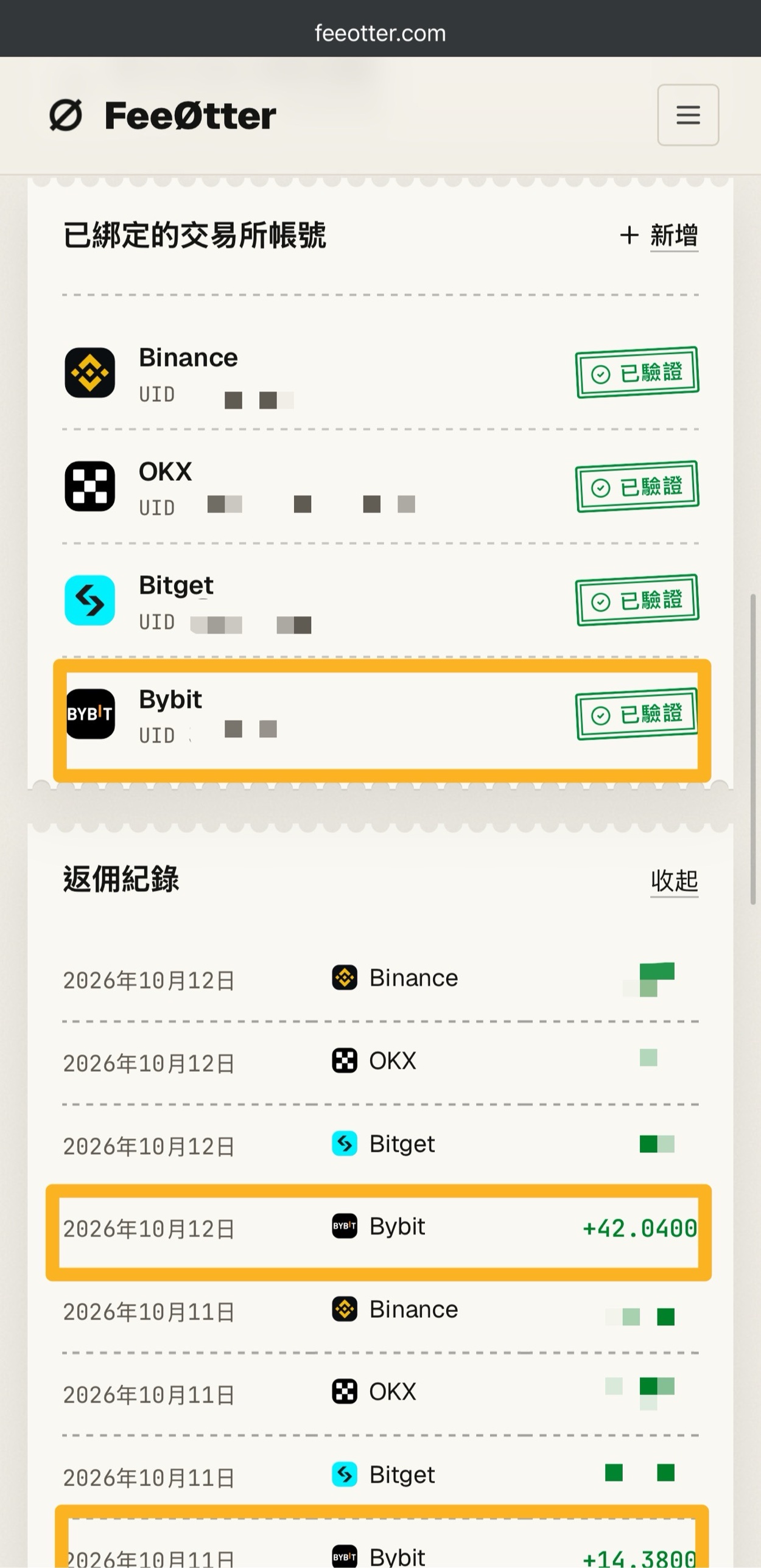
The first amount above, 20,000 USDT, is the trade volume from opening and closing the 10,000 USDT position in the example. Keep WEEX’s abnormal trading policy in mind: opening and closing quickly within 5 minutes, self-trading, or using multiple accounts to churn fees can lead to rebates being deducted depending on the severity. With a yellow card, the rebate is returned 14 days after you make up normal trading volume; with a red or black card, it is not returned. Bybit has no automatic fee rebate from the exchange on this site; its rebate channel is Fee Otter. The extra rebate is paid by Fee Otter, not by the exchange and not by Kevin Wu; the money goes to your Fee Otter account, and the rate is whatever Fee Otter’s page shows at the time. For the steps, see Bybit fee rebate.
How is the liquidation price calculated?
WEEX uses the mark price to decide liquidation. Mark price = spot index price + moving average of the basis, which is meant to prevent unnecessary liquidations caused by abnormal trades (WEEX mark price guide). The WEEX liquidation price guide says: margin ratio = maintenance margin ÷ margin balance, and when it reaches or exceeds 100%, open orders may be cancelled and the position may be partly or fully closed. The official formula for an isolated long is:
Estimated liquidation price = (number of contracts × contract size × entry price − margin) ÷ [number of contracts × contract size × (1 − minimum maintenance margin rate − fee rate)]
The formula comes from WEEX’s forced liquidation and calculation method. The maintenance margin rate depends on your position tier, and the official guide pages do not list the numbers, so the table below leaves it out and uses only the 0.08% Taker rate to work out the largest price move against you. The real liquidation point is a little closer:
| Leverage | Position on 1,000 USDT of margin | Taker opening fee as share of margin | Maximum drop for a long (before maintenance margin rate) | Maximum rise for a short (before maintenance margin rate) |
|---|---|---|---|---|
| 2x | 2,000 | 0.16% | 49.96% | 49.88% |
| 5x | 5,000 | 0.4% | 19.94% | 19.90% |
| 10x | 10,000 | 0.8% | 9.93% | 9.91% |
| 20x | 20,000 | 1.6% | 4.92% | 4.92% |
| 50x | 50,000 | 4% | 1.92% | 1.92% |
| 100x | 100,000 | 8% | 0.92% | 0.92% |
| 200x | 200,000 | 16% | 0.42% | 0.42% |
| 400x | 400,000 | 32% | 0.17% | 0.17% |
At 400x, the Taker opening fee alone is 320 USDT, or 32% of your margin, and a move of less than 0.17% against you is enough to liquidate the position, before the maintenance margin rate is even taken into account. WEEX’s own guide gives examples too: at 20x, a 5% move may trigger liquidation, and at 50x, even 2% can be very dangerous. Funding is deducted from margin, so the longer you hold, the closer the liquidation price gets; in cross mode, losses on other positions also pull the liquidation price closer. To plug in your own numbers, use the liquidation price calculator or the official calculator under “…” at the top right of the futures page.
What happens once liquidation is triggered: according to the WEEX forced liquidation process (updated 2025-07-02), the system first cancels orders (in isolated mode only the orders for that trading pair and direction, in cross mode all of them), then offsets hedged long and short positions, then reduces the position in stages, dropping 2 tiers at a time, and only then sends whatever position remains to the market as a flash order. Other actions are blocked while this is in progress. If the account’s remaining assets after liquidation are positive, they go into the risk reserve; if negative, the risk reserve absorbs them (WEEX risk reserve guide). When the insurance fund is not enough, auto-deleveraging (ADL) is triggered: positions are ranked by “profit percentage × effective leverage”, and the counterparties with the highest profit and leverage are forcibly closed (WEEX auto-deleveraging guide).
How do you set take-profit and stop-loss?
WEEX offers two ways. Position TP/SL applies to the whole position, and once the price is hit, the system closes the entire position at market. In the app, tap “TP/SL” for that position in the positions section; on the website, click “TP/SL” in the details column of the positions section. Enter the prices and confirm, and the order appears under “Conditional orders” (WEEX position TP/SL announcement). The other way is TP/SL for a specified quantity. The rules in WEEX’s take-profit and stop-loss guide (updated 2026-01-08) are summarized below:
- Closing only: TP/SL orders are tied to a position, so you cannot set one without a position. To set conditions for opening a position in advance, use a plan order (trigger order) instead.
- Maximum number: you can set up to 20, and the quantity cannot exceed the number of contracts available to close in the position.
- How they trigger: when the last price reaches the set price, an order is placed at the best available price. Plan orders, by contrast, can trigger on either the last price or the mark price (WEEX plan order guide).
- They can fail: in sharp market moves, the fill price may differ from the trigger price, and the order may not fill or may fill only partly. Adjusting margin manually changes the estimated liquidation price and can also cause TP/SL orders to fail.
- Automatic cancellation: after auto-deleveraging, automatic position reduction, liquidation or a manual close of the whole position, the related TP/SL orders are cancelled with the note “Cancelled due to position change”.
Your stop-loss has to sit before the estimated liquidation price, or the position will be liquidated first. The newer tutorial also covers trailing stops: you can set an activation price (leave it blank to start trailing immediately) and then enter a callback percentage. As the price moves in your favor, the trigger price moves with it, and when the price reverses by the set amount, the order triggers. WEEX also warns that in choppy markets, trailing stops may trigger frequently.
The most common beginner mistakes
- Thinking fees are charged on margin: fees are charged on position value. With 1,000 USDT at 20x, one Taker entry and exit costs 20,000 × 0.08% × 2 = 32 USDT, so 3.2% of your margin is gone before the price has even moved.
- Assuming a limit order is always Maker: WEEX’s newer tutorial states that once a limit order’s price is reached, it is submitted at the market price at that moment, so there may be slippage; a limit order that fills immediately is also charged as Taker. To make sure you pay 0.02%, tick “Maker only”.
- Ignoring how often funding settles: 78% of crypto perpetual contracts settle every 4 hours, so the same rate is paid 6 times a day.
- Following old tutorials that transfer per trading pair: the old futures were shut down in 2024, and the current futures account lets several trading pairs share margin.
- Moving funds out before using up trial funds: the WEEX trial fund guide states that any transfer, transfer out or withdrawal from the account holding the trial funds voids the unused trial funds, and fees paid with trial funds earn no rebate.
What are the risks of WEEX futures?
Futures are not a principal-protected product. All of the risks below are stated on official WEEX pages:
- You may lose all your principal, or even more: Articles 2.2 and 2.3 of the futures trading user agreement state that users may lose all their invested principal in a short time, that losses may exceed the amount initially deposited, and that WEEX reserves the right to recover any negative balance in a futures account.
- The liquidation price is only a reference: the agreement’s definitions state that the liquidation price shown by the platform is for reference only and is not legally binding on WEEX; a liquidation fee is charged based on the liquidated amount.
- Rules change: WEEX can adjust leverage, margin requirements and trading pairs, and changes to margin requirements can apply to existing positions (Articles 3.3 and 5.7 of the agreement).
- Auto-deleveraging: when the risk protection fund cannot cover losses, profitable positions on the other side may be forcibly closed.
- TP/SL orders are not guaranteed to fill: in sharp market moves they may not fill or may fill only partly, and WEEX states that it is not liable for losses caused by market volatility.
The WEEX futures trading risk disclosure says derivatives trading is “only suitable for professional investment institutions or highly experienced investors”, and that the exchange does not guarantee profits. Consider the risks of the exchange itself as well: WEEX’s proof of reserves page showed no figures when I checked, and the 1,000 BTC protection fund is WEEX’s own claim. These points are covered in the WEEX review, the exchange proof of reserves comparison and the exchange safety record.
FAQ
Do I need to pass a quiz or complete KYC to enable WEEX futures?
The official WEEX futures tutorials I found do not mention a quiz; the steps are to transfer USDT to your futures account and then place an order. On KYC, WEEX states that it will proactively ask users to complete verification depending on their user level, and that it may decide whether to offer futures based on the user’s region. If the screen asks you to verify, follow what it says.
What is the minimum to trade WEEX futures?
The official API on 2026-10-17 showed a minimum order quantity of 0.0001 BTC for BTCUSDT. At that day’s mark price of 81,571.5 USDT, that is a position value of about 8.16 USDT. This is a floor on position value, not on margin: at 10x, about 0.82 USDT of margin is enough for the smallest order, but fees and the distance to liquidation are still calculated on the position.
What are WEEX’s futures fees?
VIP 0 futures fees are 0.02% Maker and 0.08% Taker, charged on position value once on opening and once on closing. 127 trading pairs have a higher Maker rate (0.03%–0.08%). With a 5-day asset balance of 10,000 USDT you can move up to VIP 1, where the Taker rate drops to 0.075%; the full VIP table is in WEEX fees.
What is WEEX’s maximum leverage?
The maximum is 400x, but in the official API on 2026-10-17, only BTCUSDT and ETHUSDT among crypto contracts could go up to 400x, and the most common cap was 50x (173 trading pairs). The larger the position, the lower the maximum leverage available; go by the position tiers on the futures page for the actual cap.
How often is the WEEX funding rate charged?
It depends on the trading pair. BTC and ETH settle every 8 hours, at 08:00, 16:00 and 00:00 Taiwan time; in the official API on 2026-10-17, 440 of 564 crypto contracts settled every 4 hours. If you hold no position at settlement, you don’t pay. How it works, compared across exchanges, is in what the funding rate is.
Can I get my money back after being liquidated on WEEX?
Generally, no. WEEX states that any positive assets left in the account after liquidation go into the risk reserve. Its liquidation process guide says the maximum loss is the total margin of the liquidated position, but the futures trading user agreement also reserves the right to recover a negative balance from the user.
Do WEEX futures trades earn a rebate?
Yes. For an account registered with a referral code that carries a rebate, futures fees earn a rebate calculated on the amount actually paid, with separate rates for futures and spot; fees covered by trial funds or vouchers, and funding fees, generate no rebate. WEEX states that the referral relationship cannot be changed after sign-up. If you have already registered, see how to rebind a WEEX referral code, and for how to check your binding status, see how to check whether your referral code is bound.
The full calculation of trading fees and funding is in how futures fees are calculated, and you can run your own position through the perpetual futures cost calculator. WEEX’s fees, identity verification and overall review are covered in WEEX fees, the WEEX identity verification guide and the WEEX review; for how to get started on other exchanges, see the Bitget futures guide, Binance futures guide, OKX futures guide and XT futures guide. The referral code and how to sign up are in WEEX referral code, and every exchange’s referral code is collected in the crypto exchange referral codes roundup.