


Updated Rules checked 2026-10-29
Binance uses the Mark Price to decide when to liquidate: once your margin balance (wallet balance + unrealized PNL) falls below the maintenance margin, which means the margin ratio (maintenance margin ÷ margin balance) reaches 100%, the position is liquidated. The system first cancels open orders, then uses IOC orders to try to close only part of the position. Whatever cannot be closed becomes a bankrupt position, which the futures Insurance Fund takes over at the bankruptcy price. Auto-Deleveraging (ADL) comes in only when the fund is not enough.
For an isolated USDⓈ-M long, the liquidation price simplifies to “(entry price − margin ÷ size) ÷ (1 − maintenance margin rate)”. With BTCUSDT opened at 80,000 USDT, 1,000 USDT of margin, 10x leverage and the tier 1 maintenance margin rate of 0.40%, the liquidation price is 72,289.16, so a 9.64% drop gets the position liquidated.
Leverage magnifies losses. When the price moves against you, the position may be forcibly liquidated and you may lose your entire margin. Every process, formula and rate below cites an official Binance source.
Key points:
1. Binance’s futures liquidation protocol states that a position is liquidated when the margin ratio (maintenance margin ÷ margin balance) reaches 100%, and Binance recommends keeping it below 80%. The liquidation price and unrealized PNL are both calculated from the Mark Price.
2. The liquidation sequence is: cancel open orders, reduce the position partially with IOC orders, hand the remaining bankrupt position to the Insurance Fund at the bankruptcy price, and start Auto-Deleveraging (ADL) when the fund cannot absorb it.
3. Binance’s official API, read on 2026-10-29, shows 522 USDT perpetual contracts trading: 12 of them, including BTCUSDT and ETHUSDT, have a liquidation clearance fee rate of 1.25%, 301 have 1.5%, 180 have 2% and 29 have 2.5%.
4. For BTCUSDT positions up to 300,000 USDT, the 0.40% maintenance margin rate is lower than the 1.25% liquidation clearance fee rate. Binance states that such small positions go bankrupt as soon as they enter liquidation, and the margin is usually lost entirely.
5. The Insurance Fund is not an insurance product and does not compensate traders for losses. On 2026-10-29 the fund that covers BTCUSDT held about 796 million USDT and 500 million USDC.
The data below was checked against official pages on 2026-10-29 (data check date) and is provided for reference.
When does Binance liquidate a position?
Under Binance’s futures liquidation protocol (English version updated 2026-01-04), liquidation happens when “Collateral = Initial Collateral + Realized PNL + Unrealized PNL < Maintenance Margin”. Mapped to the numbers you see on screen:
- Margin balance = wallet balance + unrealized PNL. Wallet balance = net transfers in + realized PNL + net funding fees − trading fees, so the trading fees and funding fees you have paid both reduce your margin balance (Binance futures wallet balance explained, updated 2026-02-27).
- Maintenance margin = position notional value × maintenance margin rate − maintenance amount. The rate is tiered by position value and has nothing to do with the leverage you pick; the larger the position, the higher the rate (Leverage and margin of USDⓈ-M futures, updated 2026-04-28).
- Margin ratio = maintenance margin ÷ margin balance. Liquidation happens at 100%, and Binance recommends keeping it below 80%.
The trigger is the Mark Price, not the last traded price. The Mark Price is built from funding data and a basket of prices from several spot exchanges. The liquidation protocol gives this example: a short’s calculated liquidation price is 17,006 USDT, but the Mark Price jumps from 17,000 to 17,100 within one second, so the liquidation happens at 17,100. For how the two prices differ, see Mark Price vs last price.
The table below shows BTCUSDT’s first 5 tiers as read on 2026-10-29. The last column is the actual rate at each tier’s upper limit after subtracting the maintenance amount, which I calculated from the official numbers:
| Tier | Position value (USDT) | Max leverage | Maintenance margin rate | Maintenance amount (USDT) | Effective maintenance margin rate at the tier cap |
|---|---|---|---|---|---|
| 1 | 0–300,000 | 150x | 0.40% | 0 | 0.40% |
| 2 | 300,000–800,000 | 100x | 0.50% | 300 | About 0.46% |
| 3 | 800,000–3,000,000 | 75x | 0.65% | 1,500 | 0.60% |
| 4 | 3,000,000–12,000,000 | 50x | 1.00% | 12,000 | 0.90% |
| 5 | 12,000,000–70,000,000 | 25x | 2.00% | 132,000 | About 1.81% |
Source and date: tier data from Binance’s leverage and margin page, read on 2026-10-29 (BTCUSDT tiers last updated 2025-08-19). Binance states that it may change a tier’s maintenance margin rate by less than 0.5% without a separate announcement, so check the page before you place an order. For the first 30 days after a futures account is opened, every trading pair is capped at 20x.
How does the Binance liquidation process work, step by step?
Binance calls this process “smart liquidation”. Based on the liquidation protocol and Binance’s ADL explainer (updated 2026-01-21), the order is:
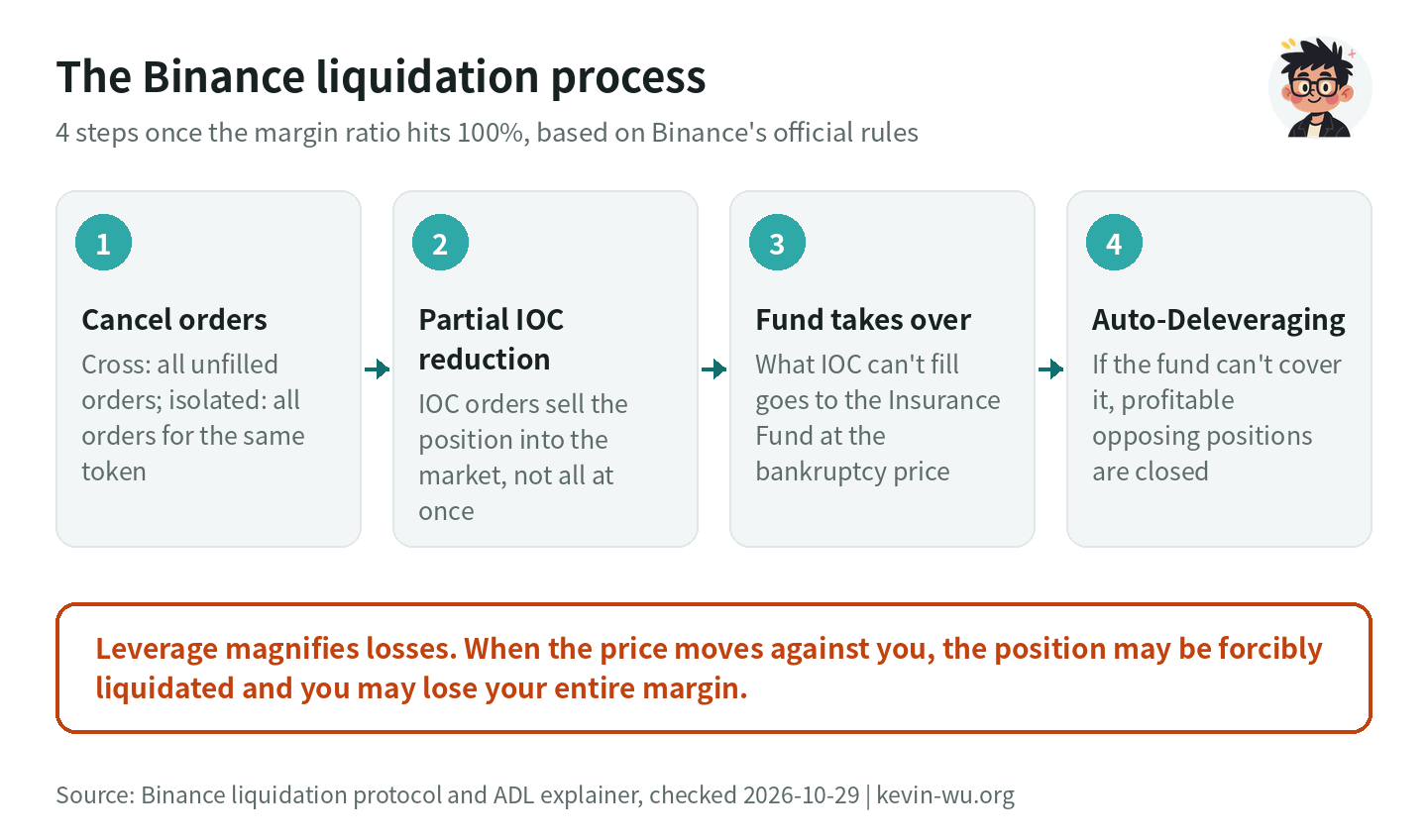
- Alerts: Binance makes reasonable efforts (but has no obligation) to send margin call alerts and liquidation alerts by email and in-app message, and does not guarantee they arrive in time. When the two are too close together, only the liquidation alert is sent.
- Order cancellation: in Cross Margin mode all unfilled orders are cancelled; in Isolated Margin mode all orders for the same token are cancelled.
- Partial reduction: the system first sends large Immediate or Cancel (IOC) orders to sell the position into the market, to avoid closing it all at once. Liquidation stops as soon as the remaining assets, after realized losses and the liquidation clearance fee, are at least equal to the maintenance margin.
- Bankrupt position: any part the IOC orders do not fill, or any part whose balance after liquidation is below 0, becomes a bankrupt position, which the Insurance Fund takes over at the bankruptcy price as far as it can. The bankruptcy price is the price at which the margin balance is exactly zero, and it can be worse than the liquidation price.
- Liquidation clearance fee: if the position is not a bankrupt position after liquidation, part of the assets used to maintain it is paid to Binance as the liquidation clearance fee, shown in the trade history as “Liquidation Clearance”.
- Auto-Deleveraging: when the Insurance Fund cannot cover the loss, or the bankrupt position exceeds the fund’s maximum takeover capacity, the matching engine closes the bankrupt position directly against profitable positions on the other side. This is ADL.
How much is the liquidation clearance fee?
Liquidation clearance fee = position notional value × that contract’s liquidation clearance fee rate, and the rate is listed on the trading rules page. On 2026-10-29 I read Binance’s official futures exchange information API and grouped the 522 USDT perpetual contracts trading at the time by rate:
| Liquidation clearance fee rate | Contracts | Examples | Fee per 10,000 USDT of notional value |
|---|---|---|---|
| 1.25% | 12 | BTCUSDT, ETHUSDT, BNBUSDT, XRPUSDT, ADAUSDT, LINKUSDT and others | 125 USDT |
| 1.5% | 301 | SOLUSDT and others | 150 USDT |
| 2% | 180 | — | 200 USDT |
| 2.5% | 29 | — | 250 USDT |
Source and date: the liquidationFee field in Binance’s official futures exchange information API, read on 2026-10-29; the rate is explained on Binance’s futures trading rules page. For comparison, closing a position yourself with a market order costs the Taker fee, 0.05% at VIP 0 (Binance futures trading fees, updated 2026-05-01). BTCUSDT’s liquidation clearance fee rate is 25 times that.
Read this table together with the tier table. The liquidation protocol states that a small position’s effective maintenance margin may be lower than the liquidation clearance fee rate, and such a position goes bankrupt once it enters liquidation, whatever the final fill price. BTCUSDT’s effective maintenance margin rate only rises above 1.25% at a position value of about 17.6 million USDT (132,000 ÷ (2% − 1.25%)). So when an ordinary trader’s BTC position is liquidated, the margin left is not enough to pay the clearance fee, and the whole amount effectively goes to zero.
How much is in Binance’s Insurance Fund?
Binance’s introduction to the futures Insurance Fund (English version updated 2026-01-04) states that it is not an insurance product and does not make up for traders’ losses; its only use is to cover the gap between the bankruptcy price and the price at which the liquidation order fills. Its money comes from liquidation clearance fees (all or part of them, as Binance decides), gains from taking over bankrupt positions, and assets Binance adds when the fund falls below its minimum size.
There is more than one fund. On 2026-10-29 I read Binance’s official Insurance Fund balance API (data time 2026-10-29 00:00 UTC): the 522 USDT perpetual contracts are spread across 120 funds.
- BTCUSDT, ETHUSDT, BNBUSDT, the BTC and ETH USDT delivery contracts and others share one fund, holding about 796,015,986 USDT plus 499,980,384 USDC.
- The USDT perpetual contracts of ADA, BCH, DOT, ETC, LINK, LTC, TRX, XLM, XMR and XRP share one fund, holding about 65,469,826 USDT.
- The funds behind the other contracts are much smaller: 479 of the 522 contracts belong to a fund with less than 5 million USDT, and the smallest fund holds about 586,163 USDT.
Each fund has a maximum takeover capacity equal to its balance times an undisclosed multiplier. Binance’s example is a balance of USD 1 million with a 3x multiplier, which can take over at most USD 3 million of bankrupt positions; anything beyond that goes to ADL instead.
Who gets hit by Auto-Deleveraging (ADL)?
ADL hits profitable positions on the other side. The ranking formula in Binance’s ADL explainer is: PNL percentage = unrealized profit ÷ abs(position notional value), and effective leverage = abs(position notional value) ÷ (wallet balance + unrealized profit); when the PNL percentage is ≥ 0, ranking = PNL percentage × effective leverage. The more profit and the higher the leverage, the sooner a position is deleveraged. A position closed by ADL is closed at the liquidation order’s bankruptcy price with no trading fee, and each position shows an ADL likelihood indicator. Binance also states that COIN-M futures share smaller funds and are more likely to run into ADL than USDⓈ-M futures.
How is the Binance liquidation price calculated?
The full formula in Binance’s USDⓈ-M liquidation price explainer (updated 2026-01-02), using One-way Mode as the example, can be written as:
Liquidation price = (WB − TMM1 + UPNL1 + cumB − Side × Position × EP) ÷ (Position × MMR − Side × Position)
WB is the wallet balance (the cross wallet balance in Cross Margin, that position’s isolated wallet balance in Isolated Margin); TMM1 and UPNL1 are the maintenance margin and unrealized PNL of your other contracts; cumB is the maintenance amount; Side is 1 for a long and −1 for a short; Position is the size, EP the entry price and MMR the maintenance margin rate. The Hedge Mode version is on the official page. In Isolated Margin, TMM and UPNL are 0, and at tier 1 (maintenance amount 0), leaving out trading fees and funding fees, it simplifies to:
- Long liquidation price = (entry price − margin ÷ size) ÷ (1 − maintenance margin rate)
- Short liquidation price = (entry price + margin ÷ size) ÷ (1 + maintenance margin rate)
I plugged the ETHUSDT cross margin example from the official page into the full formula and got 1,153.26, and 26,316.89 for BTCUSDT; both match Binance’s answers.
Example: a 10x isolated long opened at 80,000 USDT
Assume a BTC entry price of 80,000 USDT (the BTCUSDT Mark Price was about 80,082 on 2026-10-29), 1,000 USDT of margin, 10x, Isolated Margin, One-way Mode:
- Position value = 1,000 × 10 = 10,000 USDT, which is in tier 1 with a maintenance margin rate of 0.40%; size = 10,000 ÷ 80,000 = 0.125 BTC.
- Margin ÷ size = 1,000 ÷ 0.125 = 8,000. 80,000 − 8,000 = 72,000 is the bankruptcy price: at that price the margin is exactly used up.
- Liquidation price = 72,000 ÷ (1 − 0.004) = 72,289.16, which is 9.64% from the entry price.
- Check: at 72,289.16 the loss is (80,000 − 72,289.16) × 0.125 = 963.86 USDT, leaving a margin balance of about 36.15 USDT. The position is now worth 9,036.15 USDT, and 0.40% maintenance margin on that is also about 36.15 USDT, so the margin ratio is exactly 100%.
- At 1.25%, the liquidation clearance fee is 9,036.15 × 1.25% ≈ 112.95 USDT, more than the 36.15 USDT left. So this position is a bankrupt position the moment it enters liquidation: the Insurance Fund takes it over at 72,000, and the full 1,000 USDT of margin goes to zero.
A short with the same inputs: liquidation price = (80,000 + 8,000) ÷ 1.004 = 87,649.40, so a 9.56% rise gets it liquidated, and the bankruptcy price is 88,000. Changing only the leverage and keeping everything else the same:
Binance isolated BTC long: the higher the leverage, the closer liquidation gets
Price drop that triggers liquidation on a long (%); the smaller the number, the riskier; same assumptions as the table below

- 2x49.80
- 5x19.68
- 10x9.64
- 20x4.62
- 50x1.61
- 100x0.60
- 150x0.27
| Leverage | Position value (USDT) | Long liquidation price | Drop that triggers liquidation | Long bankruptcy price | Short liquidation price | Rise that triggers liquidation |
|---|---|---|---|---|---|---|
| 2x | 2,000 | 40,160.64 | 49.80% | 40,000 | 119,521.91 | 49.40% |
| 5x | 5,000 | 64,257.03 | 19.68% | 64,000 | 95,617.53 | 19.52% |
| 10x | 10,000 | 72,289.16 | 9.64% | 72,000 | 87,649.40 | 9.56% |
| 20x | 20,000 | 76,305.22 | 4.62% | 76,000 | 83,665.34 | 4.58% |
| 50x | 50,000 | 78,714.86 | 1.61% | 78,400 | 81,274.90 | 1.59% |
| 100x | 100,000 | 79,518.07 | 0.60% | 79,200 | 80,478.09 | 0.60% |
| 150x | 150,000 | 79,785.81 | 0.27% | 79,466.67 | 80,212.48 | 0.27% |
Source and date: calculated with Binance’s official formula and BTCUSDT’s tier 1 maintenance margin rate of 0.40% on 2026-10-29; entry price 80,000, margin 1,000 USDT, Isolated Margin, trading fees and funding fees not included. For a quick mental estimate, use “1 ÷ leverage − maintenance margin rate”: at 10x that is about 10% − 0.4% ≈ 9.6%, and at 150x only about 0.27% is left.
How do you use the maintenance amount when a position moves into a higher tier?
Now take 10,000 USDT of margin at 50x: the position is worth 500,000 USDT (6.25 BTC) and falls in tier 2, with a maintenance margin rate of 0.50% and a maintenance amount of 300. Plugged into the full formula: (10,000 + 300 − 500,000) ÷ (6.25 × 0.005 − 6.25) = 78,745.73. If you leave out the maintenance amount and just use 0.50%, you get 78,793.97, a liquidation price about 48 USDT too close. Binance reminds you to check that the position value at the liquidation price (here about 492,161 USDT) is still in the same tier; if it is not, recalculate with that tier’s numbers.
How does the liquidation price work in Cross Margin?
In Cross Margin, WB becomes the whole cross wallet balance, minus the maintenance margin of your other cross positions and plus their unrealized PNL, so the liquidation price moves with the PNL of your other positions. For the same 10x long, with 2,000 USDT in the futures wallet and no other positions, the cross liquidation price is 64,257.03, so it takes a 19.68% drop to be liquidated, the same as a 5x isolated position. The cost is that the full 2,000 USDT may be lost on liquidation. Binance uses Cross Margin by default (switching between cross and isolated margin); for the trade-offs between the two modes, see cross vs isolated margin.
None of the above includes trading fees or funding fees. Both are deducted from the wallet balance, so the real liquidation price will be a little closer. To run your own numbers, use the liquidation price calculator. It adds a closing fee, so its result is slightly closer than Binance’s formula and on the conservative side (57,257.66 for 60,000 USDT at 20x with a 0.05% closing fee rate, against 57,228.92 with Binance’s formula).
Where can you see your liquidation price and margin ratio on Binance?
- App positions: log in to the Binance App → [Futures]. Positions use the “Detailed” display mode by default, which shows margin, Mark Price, liquidation price, risk and ROI; the “Simple” mode also shows the liquidation price. You can switch via […] → [Preferences] → [Position Display Mode] on the futures page (Binance App futures display modes).
- “Risk” in the App: account risk ratio = account maintenance margin ÷ total account equity. Binance states that when the risk ratio reaches 100%, all positions are liquidated.
- Estimate before you trade: in the order panel on the right side of the web futures trading page, click the [Calculator] icon, choose [Liquidation Price], pick long or short, enter the entry price and size, drag the leverage slider, then click [Calculate] (Binance futures calculator guide).
- Web positions: the [Positions] tab below the trading page lists your open positions, and isolated margin is adjusted here too. Binance does not officially list the column names one by one, so go by what the screen shows.
- After liquidation: the liquidation records tab shows the actual liquidation price; each contract’s Insurance Fund balance is under [Data] → [Futures Data] → [Insurance Fund History].
How can you lower the chance of being liquidated on Binance?
The list below only includes methods Binance itself mentions, mainly from Binance’s guide to reducing liquidation risk (updated 2026-03-03):
- Watch the margin ratio: Binance recommends keeping it below 80%. As it gets close, add margin or reduce the position.
- Add margin: for an isolated position, click the [Edit] icon in the [Positions] tab, enter the amount to add and click [Confirm] (adjusting margin, updated 2026-03-04); in Cross Margin, transfer more funds into the futures wallet. Adding 500 USDT to the 10x isolated long above moves its liquidation price from 72,289.16 to 68,273.09 and widens the distance to 14.66%, but the added money is also exposed to the loss.
- Set a stop-loss: Binance recommends using stop-loss orders to exit losing positions early, but advises against setting the stop trigger price too close to the estimated liquidation price, or the position may be liquidated before the stop-loss executes (Binance stop-loss and take-profit orders, updated 2026-02-27). If you close the same 10x long yourself with a market stop at 74,000, the loss is 750 USDT plus about 4.63 USDT in Taker fees, and about 245 USDT is left; if you wait until it is liquidated, the margin goes to zero. For setup steps, see how to set stop-loss and take-profit.
- Don’t add to a losing position: Binance’s example is a 20x long opened with a 500 USDT wallet balance when BTC was at USD 50,000, with a liquidation price of USD 25,100.40; after adding to the position at USD 45,000, the liquidation price rises to USD 35,857.67.
- Lower your leverage: maintenance margin does not depend on leverage, so the distance to liquidation is mainly set by leverage. From the table above, 10x leaves about 9.6% and 20x only about 4.6%.
How much margin is left after liquidation? Can you end up owing Binance money?
Usually very little. At the moment of liquidation, the position holds only the maintenance margin, and the liquidation clearance fee still has to come out of it. As calculated above, a BTCUSDT position in tier 1 does not have enough left to pay the 1.25% clearance fee, so it becomes a bankrupt position straight away and the margin is lost entirely. Only when the position is large enough for its effective maintenance margin to exceed the clearance fee rate might some money remain in the account after the IOC partial reduction.
As for negative balances, the liquidation protocol states that when an account goes negative because of a bankrupt position, Binance covers it with the Insurance Fund, processed automatically every 10 minutes, on these conditions: Multi-Assets Mode is not enabled, the USDⓈ-M or COIN-M account with the negative balance has no open positions left, and you have not transferred in funds yourself after liquidation to cover the loss. If you don’t meet them, you need to contact customer support.
What risks of Binance liquidation should you know first?
- You may lose all of your margin: the risk warning in Binance’s futures beginner’s guide (updated 2026-04-13) states that in extreme price swings, your entire margin balance may be liquidated.
- The fill can be worse than the liquidation price: the Mark Price may jump past the liquidation price, and the fund may take over the position directly at the bankruptcy price.
- Cross Margin links your positions: on liquidation, the balance of the same asset in the futures wallet may all be lost.
- Profitable positions can be closed too: ADL starts when the fund is insufficient.
- Alerts are not guaranteed to arrive: margin call and liquidation alerts are sent on a best-effort basis only.
- The rules change: maintenance margin rates, liquidation clearance fee rates and fund allocation can all be adjusted, so go by the official pages and the order screen before you trade.
FAQ
Does Binance liquidate on the Mark Price or the last price?
Binance liquidates on the Mark Price. The liquidation protocol states that the liquidation price and unrealized PNL are both calculated from the Mark Price, and liquidation is always triggered once the Mark Price touches the liquidation price; the last price is only used to calculate realized PNL.
At what margin ratio does Binance liquidate?
Binance liquidates when the margin ratio reaches 100%, and recommends keeping it below 80%. Margin ratio = maintenance margin ÷ margin balance, where the margin balance is the wallet balance plus unrealized PNL.
How far does the price have to fall to liquidate a 10x or 20x position on Binance?
Using BTCUSDT’s tier 1 maintenance margin rate of 0.40%, an isolated 10x long is liquidated after a drop of about 9.64%, 20x after about 4.62% and 100x after about 0.60%. This excludes trading fees and funding fees; the longer you hold and the more funding you pay, the shorter the distance.
What is Binance’s liquidation fee?
On liquidation Binance charges a liquidation clearance fee, calculated as the position’s notional value times the fee rate. The official API on 2026-10-29 shows 1.25% for BTCUSDT and ETHUSDT, and 1.25%, 1.5%, 2% or 2.5% for other USDT perpetual contracts. If the position is already a bankrupt position after liquidation, this fee is not charged on top, but by then the margin has already gone to zero.
Can you owe Binance money after a liquidation?
Usually you don’t have to cover it yourself, but Binance’s wording comes with conditions. When an account ends up with a negative balance because of a bankrupt position, Binance uses the Insurance Fund every 10 minutes to automatically cover accounts that qualify: Multi-Assets Mode is not enabled, the account has no open positions left, and you have not transferred in funds yourself after liquidation to cover the loss. If you don’t qualify, you need to contact customer support.
Will Binance’s Insurance Fund pay back my liquidation loss?
No. Binance states that the Insurance Fund is not an insurance product and traders do not get any losses back from it; it only covers the gap between the bankruptcy price and the liquidation fill price, so the profitable side receives its full profit.
Why does my liquidation price on Binance keep changing?
The liquidation price is calculated from your account balance, so it changes whenever the balance changes. Trading fees and funding fees are deducted from the wallet balance, in Cross Margin the PNL and maintenance margin of your other positions are also part of the formula, and when a position moves into the next tier, the maintenance margin rate goes up as well.
Opening Binance futures, fees and stop-loss/take-profit are covered in the Binance futures guide; for how funding fees affect your holding cost, see what is the funding rate; the liquidation price calculator compares liquidation rules and maintenance margin rates across 13 exchanges. For Binance’s spot and futures fee rates, see Binance fees, and for how to sign up, see Binance referral code.
Want to see these updates more often in Google Search? Add Kevin Wu as a preferred source on Google