


Updated Rules checked 2026-10-21
Choosing between Bybit and Gate comes down to what you trade and how you want to get fees back. If you trade lesser-known coins, want the exchange itself to refund your rebate, or keep 10,000 to 100,000 USD in your account, choose Gate; if you care about platform size, will pay fees with MNT, or only thought of a referral code after signing up, choose Bybit. For regular users (VIP 0) on USDT perpetual futures, Bybit charges Maker 0.02% and Taker 0.055%, and Gate charges 0.02% / 0.05%; spot is 0.1% / 0.1% on both.
The biggest difference is how you get a rebate. Sign up to Gate with a referral code and the exchange refunds the rebate straight to your account; Bybit doesn’t refund fees to invitees, so you need a rebate site such as Fee Otter to get fees back, and the money is paid by a third party. The Fee Otter rebate page lists 40% for Bybit (checked 2026-10-21), which brings futures Taker down to about 0.033%; Gate’s referral rebate has to be 34% or higher to beat that. Gate lists far more products: 2,032 spot base coins against Bybit’s 390, and 591 crypto USDT perpetual contracts against Bybit’s 521.
On security, Bybit lost 401,346 ETH (about 1.5 billion USD) in a hack on 2025-02-21; withdrawals kept running and the gap was filled in about 72 hours. We found no major public incident of Gate’s platform wallets being hacked, but on 2025-04-23 Gate suspended futures trading for an emergency upgrade of its futures system. The difference in size is clear: in the latest proof-of-reserves snapshots, users hold 56,131 BTC on Bybit, about 2.7 times Gate’s 21,156 BTC. Neither exchange lists Taiwan among its restricted regions, and neither offers a direct way to deposit New Taiwan dollars (TWD).
Sign up to Gate with the referral code KEVINXYZ and, after each trade is completed, Gate automatically refunds 20% of the fee to your spot account, on both spot and futures.
Key points:
1. VIP 0 futures: Bybit 0.02% / 0.055%, Gate 0.02% / 0.05%; spot is 0.1% / 0.1% on both. With platform-token fee payment turned on, Bybit futures Taker drops to 0.0495% and spot to 0.075%, while Gate’s GT discount applies only to spot (0.09%).
2. Bybit has no automatic exchange rebate. The Fee Otter rebate page lists 40% for Bybit (checked 2026-10-21), paid by Fee Otter; Gate’s referral rebate is refunded by the exchange straight to your spot account.
3. Fixing a missing referral code: on Bybit you can add a partner’s affiliate code within 14 days of sign-up; we found no official way on Gate to add or change one later, so enter it when you sign up.
4. Maximum BTC leverage: Bybit 150x, Gate 200x; Bybit’s 114 Innovation Zone contracts charge 0.11% Taker.
5. Bybit lost about 1.5 billion USD in ETH in a hack on 2025-02-21, and withdrawals kept running; we found no hack of Gate’s platform wallets, and its latest reserves snapshot is from 2026-10-18.
The data below was checked against official pages on 2026-10-21 (data check date) and is provided for reference.
Bybit vs Gate: what’s the difference?
| Item | Bybit | Gate |
|---|---|---|
| Spot Maker / Taker (VIP 0) | 0.1% / 0.1% (crypto pairs) | 0.1% / 0.1% |
| USDT perpetual futures Maker / Taker (VIP 0) | 0.02% / 0.055% (Innovation Zone 0.04% / 0.11%) | 0.02% / 0.05% |
| Platform-token fee discount | MNT: 25% off spot (0.075%), 10% off futures (Taker 0.0495%); not for copy trading, bots or API | GT: 10% off spot (0.09%), not for futures |
| VIP by account assets | 100,000 USD in assets gets you VIP 1 (futures Taker 0.04%); 250,000 USD gets you VIP 2 (0.0375%) | 10,000 USD in assets gets you VIP 3 (futures Taker 0.048%); 40,000 USD VIP 5 (0.045%); 100,000 USD VIP 6 (0.042%) |
| Referral code rebate | No automatic exchange rebate; Fee Otter rebate | 20% |
| Adding a referral code after sign-up | Main accounts with no referrer can add a partner’s affiliate code within 14 days of sign-up (a regular user’s referral code can’t be added) | No official way to add one found |
| Changing referrer | No change request; accounts registered after 2025-09-01 with under 1 USD in trading volume for 180 consecutive days can be reassigned | No official way to change found; each user can register through only one invitation mode |
| Identity verification requirement | Standard individual verification is required before using any product or service | All users must complete identity verification, before both deposits and withdrawals |
| Unverified accounts | Can’t deposit or trade; withdrawals up to 20,000 USDT a day and 100,000 USDT a month | Can’t deposit or withdraw |
| Restricted regions | Taiwan not included; the list includes the US, mainland China, Hong Kong, Singapore and Canada, and Japan keeps only Convert and withdrawals | Taiwan not included; the longest list among the 13 exchanges this site compares, including Japan, Hong Kong, Singapore, Malaysia, South Korea, Vietnam, Indonesia, the Philippines and Thailand |
| TWD deposit options | No TWD bank deposits; the P2P TWD market had 0 USDT buy and sell ads (checked 2026-10-13) | No TWD bank deposits; C2C has a USDT/TWD market, which showed “No ads available” when checked on 2026-10-17 |
| Spot base coins | 390 (527 trading pairs) | 2,032 (2,181 trading pairs) |
| Crypto USDT perpetual contracts | 521, with up to 150x on BTC and ETH; plus 277 stock, ETF, commodity and forex contracts | 591, with up to 200x on BTC and ETH; plus 443 stock, index, metal, forex and commodity contracts |
| Crypto contracts with 4-hour funding settlement | 376 (of 521) | 397 (of 591) |
| Copy trading / grid | Classic copy trading (USDT perpetuals), TradFi copy trading; spot and futures grid, DCA, Martingale, combo strategies | Futures copy trading; spot grid, futures grid, infinite grid, Martingale, DCA |
| Copy trading profit share | Classic copy trading: 10% to 15% depending on the lead trader’s level, withheld daily and settled every Monday | Set by the lead trader within their level’s limit, up to 30% for expert level; calculated every 7 days and paid out daily |
| Cheapest USDT withdrawal networks and fees | Plasma 0 USDT (minimum 2), Aptos 0.002; BEP20 0.15, ERC20 0.8, TRC20 1.3 (2026-10-12) | Aptos 0.04 USDT (minimum 1); Plasma 0.05, BEP20 0.5, ERC20 1, TRC20 1.5 |
| Proof of reserves (latest snapshot) | 2026-09-23, round 40: BTC 104%, ETH 103%, USDT 110% (verified by Hacken) | 2026-10-18: BTC 121.60%, ETH 123.78%, USDT 111.68%, total reserve ratio 118% |
| Major security incidents | 401,346 ETH (about 1.5 billion USD) stolen on 2025-02-21; withdrawals kept running and the gap was filled in about 72 hours | No major public incident of platform wallets being hacked found; futures suspended on 2025-04-23 for an emergency system upgrade, with compensation promised |
Sources and dates: Bybit’s rates, Innovation Zone rates and VIP thresholds were read from Bybit’s trading fee structure on 2026-10-21, and the MNT discount comes from Bybit’s FAQ on paying trading fees with MNT; Gate’s spot rates and VIP thresholds were read from the Gate fee page and the Gate VIP page on 2026-10-21, and its futures rates by level come from the same page on 2026-10-11. Coin counts, contract counts, leverage and funding intervals were counted on 2026-10-21 from both exchanges’ official public APIs (Bybit futures specs, Bybit spot specs, Gate USDT perpetual contracts, Gate spot trading pairs), covering only items currently trading and excluding pre-market contracts; they change as items are listed and delisted. Bybit’s Innovation Zone contract count is the number marked innovation in the futures specs API. Bybit’s USDT withdrawal fees were read from the Bybit deposit and withdrawal status page on 2026-10-12, and Gate’s from the deposit and withdrawal data on the Gate fee page on 2026-10-21. Sources for the other rows are given in the matching sections below.
How much do Bybit and Gate fees differ?
Suppose someone trades 200,000 USDT of USDT perpetual futures and 20,000 USDT of spot each month, all at the official VIP 0 rates:
| Monthly fees (USDT) | Bybit | Bybit (MNT discount on) | Gate | Gate (GT deduction on) |
|---|---|---|---|---|
| Futures 200,000, all Taker | 110 | 99 | 100 | 100 |
| Spot 20,000, all Taker | 20 | 15 | 20 | 18 |
| Total (all Taker) | 130 | 114 | 120 | 118 |
| Total (all switched to Maker) | 60 | 51 | 60 | 58 |
The calculation uses both exchanges’ official VIP 0 rates (checked 2026-10-21): futures cost 200,000 × 0.055% = 110 USDT on Bybit and 200,000 × 0.05% = 100 USDT on Gate; spot costs 20,000 × 0.1% = 20 USDT on both. With MNT on, Bybit futures cost 200,000 × 0.0495% = 99 USDT and spot 20,000 × 0.075% = 15 USDT.
Without platform tokens, Gate costs 10 USDT less a month, and the whole difference is futures Taker (0.05% against 0.055%); if everything is placed as Maker, both come to 60 USDT. With platform tokens on, the order flips: Bybit’s MNT discount also covers futures (10% off), while Gate’s GT only discounts spot, so Bybit comes to 114 USDT and Gate to 118 USDT. MNT has a few limits: your MNT balance has to cover the whole fee, or the whole fee is charged at the normal rate; copy trading, trading bots, API orders and liquidation orders can’t use the discount; and spot and futures have separate switches you need to turn on. You carry the price risk of the platform token yourself.
Each exchange has one thing to check before you place an order. Bybit puts 114 contracts in its Innovation Zone, where VIP 0 pays Maker 0.04% and Taker 0.11%, twice the regular futures rate, so check the rate on the order panel before trading small-cap futures (Bybit’s trading fee structure). On Gate, when your account holds point cards, futures taker orders use point cards first by default, at a base rate of 0.075%; for taker orders you can choose either the “VIP rate” or “point card deduction” (Gate fee page). Both exchanges let you make sure an order is placed as Maker: Bybit calls it Post-Only, and on Gate it’s the “Post-Only” option under advanced limit orders; for details, see Maker vs Taker fees. Futures fees are charged on position value, not margin. Leverage magnifies the position, and if the price moves against you, the position may be liquidated and you lose your margin.
For larger accounts: Gate is cheaper below 100,000 USD, and it’s close above that
Both exchanges let you move up VIP levels on account assets, and meeting either the asset or the trading volume threshold is enough. Gate’s asset thresholds are much lower: 10,000 USD already gets you VIP 3, while Bybit needs 100,000 USD for VIP 1. Using the same example:
| Account assets (USD) | Bybit level and monthly fees | Gate level and monthly fees |
|---|---|---|
| 10,000 | VIP 0: 130 USDT | VIP 3: 200,000 × 0.048% + 20,000 × 0.097% = 115.4 USDT |
| 40,000 | VIP 0: 130 USDT | VIP 5: 200,000 × 0.045% + 20,000 × 0.095% = 109 USDT |
| 100,000 | VIP 1: 200,000 × 0.04% + 20,000 × 0.08% = 96 USDT | VIP 6: 200,000 × 0.042% + 20,000 × 0.09% = 102 USDT |
| 200,000 | VIP 1: 96 USDT | VIP 7: 200,000 × 0.0375% + 20,000 × 0.085% = 92 USDT |
| 250,000 | VIP 2: 200,000 × 0.0375% + 20,000 × 0.0775% = 90.5 USDT | VIP 7: 92 USDT |
Same assumptions as above: all Taker, no platform tokens. Bybit’s asset thresholds and rates by level were read from Bybit’s trading fee structure on 2026-10-21; Gate’s asset thresholds and spot rates come from the Gate VIP page and fee page on 2026-10-21, and its futures rates from the fee page on 2026-10-11. Gate values your assets by multiplying them by a coefficient based on each coin’s market cap rank, so the level shown on the fee page is what counts.
With assets below 100,000 USD, Gate is 14.6 to 21 USDT cheaper a month; at 100,000 USD, Bybit VIP 1’s futures Taker of 0.04% is lower than Gate VIP 6’s 0.042%, so Bybit costs 6 USDT less; at 200,000 and 250,000 USD the gap is only 1.5 to 4 USDT. Gate also lets you level up by your 14-day average GT holdings, for example 2,000 GT for VIP 5, but you carry GT’s price risk. At these levels Gate’s referral rebate still applies (it stops only from VIP 11 up). The trade-off is that these assets have to stay on the exchange long term, a risk you need to weigh yourself. For a full comparison of VIP thresholds across exchanges, see Exchange VIP levels compared.
After rebates, which is cheaper for futures Taker?
A rebate returns part of the fees you actually paid, so the rate after rebate = official rate × (1 − rebate percentage). Bybit’s futures Taker of 0.055% with the 40% Fee Otter lists comes to 0.033%. Gate starts at 0.05%, so you can work backward to see how much rebate it needs to catch up:
| Bybit scenario compared | Bybit futures Taker actually paid | Minimum Gate rebate needed |
|---|---|---|
| Fee Otter 40%, MNT off | 0.033% | 34% |
| Fee Otter 40%, MNT on (assuming the rebate is calculated on the discounted fee) | 0.0297% | 40.6% |
| No rebate, MNT on | 0.0495% | 1% |
The formula is 1 − Bybit rate paid ÷ 0.05%, for example 1 − 0.033 ÷ 0.05 = 34%. Percentage source: the Fee Otter rebate page (checked 2026-10-21). Neither Bybit nor Fee Otter states how Fee Otter calculates the rebate once MNT is on, so the second row is only an assumption. For Gate’s current referral rebate percentage, see the “Referral code rebate” row in the comparison table or the calculator below, and compare it with the thresholds above to see which is cheaper. Two more things to factor in: Gate’s rebate is refunded by the exchange straight to your account, while Bybit’s rebate sits in a third-party account and has to be withdrawn separately; and Bybit’s Innovation Zone contracts charge 0.11% Taker, so for those coins Gate’s 0.05% is less than half the cost.
Calculator: Gate futures (Taker 0.05%)
| Monthly volume | Fees (0.05%) | Auto rebate (20%) | Net fees |
|---|---|---|---|
| 10,000 USDT | 5 USDT | 1 USDT | 4 USDT |
| 100,000 USDT | 50 USDT | 10 USDT | 40 USDT |
| 1,000,000 USDT | 500 USDT | 100 USDT | 400 USDT |
Example at a futures fee rate of 0.05% and the current 20% automatic rebate (rate updated 2026-10-24). Your exchange statement prevails.
Sign up with this site’s Gate referral code and the exchange’s automatic rebate is 20%; the percentage updates in sync with the exchange, and the rebate is refunded to your spot account after each trade is completed, on both spot and futures. Gate doesn’t state officially whether the rebate is calculated on the fee before or after GT deduction once GT deduction is on.
Bybit: get fees back through Fee Otter
Bybit’s referral program gives invitees trading task rewards: for example, new users who sign up on or after 2026-10-10 and complete a trade of 50 USD or more within 14 days each get 50 USDT, as does the referrer; Bybit doesn’t say officially that invitees get a share of fee rebates (Bybit referral program FAQ, checked 2026-10-21). The Fee Otter rebate page lists 40% for Bybit (checked 2026-10-21), all of it an extra rebate from Fee Otter, paid by Fee Otter, not by the exchange or by Kevin Wu. The trader above pays 110 USDT in futures fees on Bybit; minus 40%, that’s 66 USDT.
Below is a screenshot of my own Fee Otter dashboard, showing Bybit rebates actually credited:
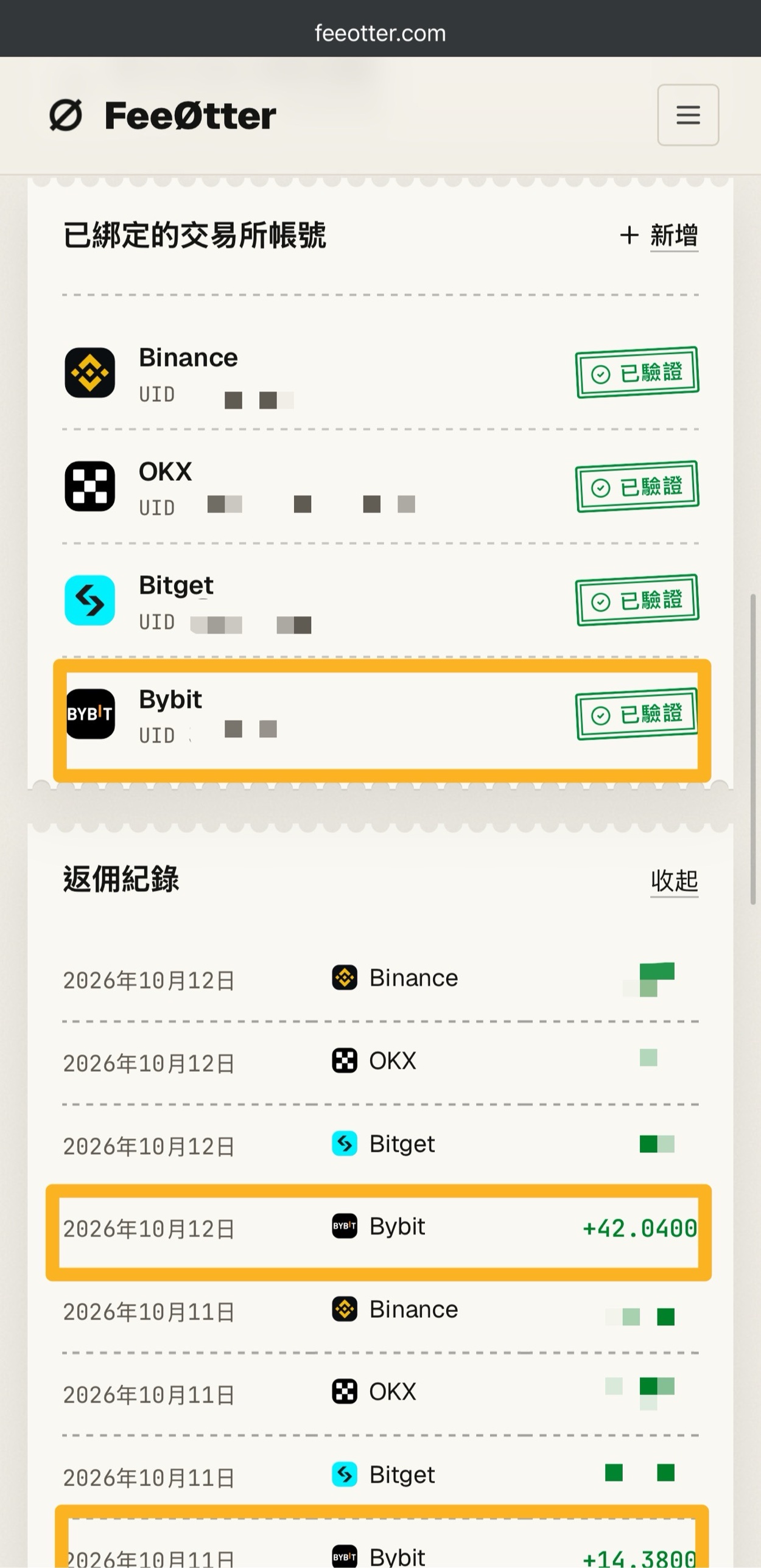
According to the Fee Otter rebate page, the extra rebate settles the previous day’s fees every day and is credited to your Fee Otter account; once you request a withdrawal, it’s paid in USDT over BEP20, currently with a minimum of 1 USDT per withdrawal. This money carries the risk that the third party changes its percentages or stops operating, and the percentage on Fee Otter’s page at the time is what counts. For the steps to sign up and link your UID, see Bybit rebate: get fees back with Fee Otter; fees after rebates for each exchange are listed in Actual fees after referral rebates. For the full rates, VIP tables and withdrawal fees, see Bybit fees and Gate fees; how futures costs are calculated is explained in How futures fees are calculated, and you can try your own numbers in the perpetual futures cost calculator.
How do Bybit and Gate futures rules differ?
For futures, fees aren’t the only thing to look at: leverage caps, funding fees and liquidation rules matter too. The table below uses figures read from the official APIs and help pages on 2026-10-21:
| Item | Bybit | Gate |
|---|---|---|
| Maximum BTC leverage | 150x (positions up to 300,000 USDT) | 200x (positions up to 500,000 USDT) |
| Crypto contracts with 100x or more | BTC, ETH 150x; SOL, XRP 100x | BTC, ETH 200x; SOL, XRP 100x |
| Most common leverage cap | 25x (190 of 521) | 50x (156 of 591) |
| BTC tier 1 maintenance margin rate | 0.33% | 0.3% |
| Funding settlement interval (crypto contracts) | 376 every 4 hours, 142 every 8 hours, 3 every 1 hour | 397 every 4 hours, 191 every 8 hours, 3 every 1 hour |
| Funding rate caps | BTC ±0.333%; 195 contracts ±2%, 151 ±2.5% | BTC ±0.3%; 556 contracts ±2% |
| When liquidated | No liquidation fee on perpetual and delivery contracts; if margin still falls short of maintenance margin, the position is closed at the bankruptcy price | Settled at the bankruptcy price; the insurance fund’s sources include the maintenance margin left over after liquidation |
Sources and dates: leverage, maintenance margin rates, funding intervals and caps come from the Bybit risk limit API, the Gate risk limit API and both exchanges’ contract list APIs, read on 2026-10-21; liquidation rules come from Bybit’s fee overview, Bybit’s liquidation process, Gate’s introduction to forced liquidation and Gate’s insurance fund explainer.
The gap between 200x and 150x only matters for BTC and ETH, and the maximum leverage only applies to the first position tier. What most people run into is the cap on small-cap contracts: on Bybit the most common cap is 25x, on Gate 50x. Funding fees are paid between longs and shorts; the platform doesn’t collect them, and they don’t earn a rebate. On both exchanges roughly 70% of crypto contracts settle every 4 hours, so the same 0.01% rate is paid 6 times a day; the caps are also wide on both, and a 10,000 USDT position that hits a ±2% cap pays 200 USDT in a single settlement. If you often hold small-cap futures overnight, check the funding rate and countdown on the trading page before settlement; for how it works, see What is the funding rate (Bybit’s introduction to funding rates, Gate’s funding rate explainer). Also, when you open a position on Gate, it reserves a 0.075% closing fee as margin (Gate’s initial margin explainer).
The higher the leverage, the closer the liquidation price is to your entry price, and if the price moves against you, the position may be liquidated and you lose your margin. You can estimate the liquidation price with the liquidation price calculator; for the difference between cross and isolated margin, see Cross vs isolated margin, and the steps to enable futures and set take-profit and stop-loss on each exchange are in the Bybit futures guide and the Gate futures guide.
How do Bybit and Gate referral rebate rules differ?
On Gate, the affiliate partner shares their commission with you and the exchange pays it straight to your account; Bybit has no such mechanism, so rebate sites earn commission through Bybit’s affiliate program and pass part of it on to you:
| Rule | Bybit (through Fee Otter) | Gate |
|---|---|---|
| Who pays the rebate | Paid by Fee Otter, credited to your Fee Otter account | Refunded by the exchange straight to your Gate spot account |
| Markets covered | Spot and futures, according to the Fee Otter rebate page | Spot, Alpha, futures and margin, excluding fiat trading |
| Calculation base | Affiliate commission is calculated on “trading fees − market maker rebates − bonuses / vouchers” | Trading fees; which amount is used once GT deduction is on is not stated officially |
| Duration | Affiliate commission is for life, but the relationship may end after 180 consecutive days without trading | No time limit while the referral relationship lasts |
| VIP limits | Total fee rebates for VIP accounts under an affiliate are capped at 50% | No rebate from VIP 11 and above |
| Payout timing | According to the Fee Otter rebate page: settled daily for the previous day, withdrawals paid in USDT over BEP20 | Refunded automatically after each trade is completed, 1 to 2 hours in special cases |
| Adding a referral code later | Main accounts with no referrer can add a partner’s affiliate code within 14 days of sign-up; it can’t be canceled or changed once added | No official way to add one found; the claim online that you “can bind within 7 days” refers to Gate Wallet (Web3), not exchange accounts |
| Changing referrer | No change request; for accounts registered after 2025-09-01 with under 1 USD in trading volume for 180 consecutive days, coming back to trade through a new partner’s link reassigns the account | No official way to change found; each user can only be invited through one invitation mode |
| Checking your binding | The account info page shows the bound affiliate code | Gate doesn’t describe an official way for invitees to check; you can see whether rebates are credited after you trade |
| What to watch when signing up | To get a rebate site’s rebate, sign up through its link; after 14 days it can’t be added | Invitations don’t carry across regional sites, so switching regional sites during sign-up breaks the link; if the referrer and invitee share an IP address, the referral is invalid |
Sources and dates: Bybit’s rules come from the Bybit affiliate program FAQ, Bybit’s guide to adding and checking an affiliate code (checked 2026-10-21) and section 7.7 of the Bybit affiliate terms, and the payout method comes from the Fee Otter rebate page (checked 2026-10-21); Gate’s rules come from the Gate referral rules, the Gate referral FAQ, the Gate announcement on invitee rebates and the Gate user agreement (updated 2026-07-22), checked on 2026-10-18, with the rule that VIP 11 and above earn no rebate reconfirmed on the Gate fee page on 2026-10-21.
If you’ve already signed up, Bybit leaves more room to fix things: within 14 days of sign-up you can add a partner’s affiliate code under “Join an Affiliate’s Community” on the account info page; after 14 days, the only route Bybit states officially is reassignment after 180 days of inactivity. Bybit also has a formal identity transfer feature; for details, see Changing your Bybit referral code. On Gate, everything is “settled the moment you sign up”: if you enter the wrong code or leave it blank, you have to live with it, so always check the referral code field before you tap sign up, and don’t switch regional sites during sign-up; see the Gate referral code rebind guide. To check who you’re bound to, see How to check whether you’ve bound a referral code; to weigh rebate cards, vouchers and rebates, see Fee vouchers vs referral rebates.
Do Bybit and Gate both require identity verification? What should users in Taiwan know?
Identity verification: both require verification before you can use them normally; the difference is whether an unverified account can still withdraw. Bybit states that every product and service requires at least Standard individual verification, and unverified accounts can’t deposit or trade but can still withdraw, up to 20,000 USDT a day and 100,000 USDT a month; after Standard verification the limit is 1,000,000 USDT a day, and each person can verify only one account (Bybit individual KYC FAQ, Bybit benefits by KYC level, checked 2026-10-21). Gate states that all users must complete identity verification, before both deposits and withdrawals (Gate identity verification FAQ), and its fee page lists a VIP 0 withdrawal limit of 3,000,000 USD every 24 hours. For the steps and the documents to prepare, see the Bybit identity verification guide and the Gate KYC guide.
TWD deposits and withdrawals: neither offers direct New Taiwan dollar (TWD) bank deposits. When we checked the Bybit P2P TWD market on 2026-10-13, there were 0 USDT buy ads and 0 sell ads; the Gate C2C TWD market showed “No ads available” on 2026-10-17. The route that actually works is the same for both: buy USDT with TWD on a local exchange in Taiwan (such as MAX or BitoPro), then transfer it to Bybit or Gate; to cash out, reverse the route back to your bank account in Taiwan. For fees on each network, see USDT withdrawal fees compared.
Regions and apps: Taiwan isn’t on Bybit’s list of service-restricted countries (updated 2026-10-16), nor among the restricted regions in section 2.5 of the Gate user agreement (updated 2026-07-22). Neither serves the US, Hong Kong, Singapore or Canada. The difference shows when you travel: Gate’s list is the longest among the 13 exchanges this site compares, adding Japan, Malaysia, South Korea, Vietnam, Indonesia, the Philippines, Thailand and the UK; Bybit’s list is short, but in Japan it keeps only Convert and withdrawals under a 2026-07-24 announcement, Malaysia’s Securities Commission ordered Bybit to disable its local website and app on 2024-12-27 (Securities Commission Malaysia), and Thailand’s SEC has blocked Bybit since 2025-06-28 (The Block). Not being listed in the terms doesn’t mean a service works there. When checked on 2026-10-21, both apps were available on the Taiwan App Store: the Bybit app (developer Bybit Fintech Limited) and the Gate app (developer GATE GLOBAL UAB). For which countries each exchange restricts, see Exchange restricted countries.
What are Bybit and Gate each good at?
Bybit‘s strengths are platform size and derivatives tools. Users hold about 2.7 times as much BTC on Bybit as on Gate; it offers options, TradFi contracts and contracts for difference (CFDs), charges no extra fee when a perpetual position is liquidated, and lets unverified accounts withdraw their money.
- Copy trading: Classic copy trading supports only USDT perpetuals; lead traders take 10% to 15% of net profit depending on their level, withheld daily and settled every Monday at 03:00 (UTC), and if the week ends at a loss, the withheld profit share is returned (Bybit copy trading profit sharing explained); copy trading can’t use the MNT discount.
- Trading bots: spot grid, futures grid, DCA, Martingale and combo strategies (Bybit trading bots).
- Options and TradFi: options at VIP 0 are Maker 0.02% and Taker 0.03%; USDT perpetuals include 277 stock, ETF, commodity and forex contracts (official API, 2026-10-21).
- Earn: on 2026-10-21, flexible USDT paid 6.99% a year on the first 100 USDT and 1.99% on the amount above that (Bybit Earn API); there are also Launchpool and the Bybit Card.
Gate‘s strength is its range of products. It lists 2,032 spot base coins, more than 5 times Bybit’s; it has 591 crypto USDT perpetual contracts, 70 more than Bybit, plus 443 contracts on stocks, indices, metals and the like. Lesser-known coins usually have lower trading volume, so you may want to check order book depth before placing an order.
- Trading bots: spot grid, futures grid, infinite grid, Martingale and DCA (Gate strategy bots).
- Copy trading: futures copy trading, with copy trading volume also counting toward your VIP level (Gate futures copy trading). Lead traders set their profit share within their level’s limit, and the cap for expert lead traders was raised to 30% on 2024-09-20 (Gate profit share announcement); profit share is calculated every 7 days and paid out daily at 01:45 (UTC) (Gate lead trader profit sharing rules).
- Earn and more: flexible USDT in Gate’s Simple Earn is matched lending, with an estimated annual rate of 2.31% from the official API on 2026-10-21 (Gate official API); there are also Launchpool, the Gate Web3 wallet and the Gate Card.
Earn rates float; for a comparison across exchanges, see USDT flexible savings rates compared, and for bots, see Exchange grid bots compared. Copy trading has fees too: copying a lead trader who opens and closes 40 times a month with 1,000 USDT at 5x leverage, all as Taker, costs 5,000 × 0.055% × 2 × 40 = 220 USDT on Bybit and 200 USDT on Gate. Neither exchange states officially whether copy trading fees earn referral rebates. For the full cost, see The cost of copy trading, and for how grids work, see What is grid trading.
How do Bybit and Gate compare on proof of reserves and security?
Both publish proof of reserves, and both let you use a Merkle tree to confirm your account was included:
- Bybit: published monthly and verified by the security firm Hacken. When checked on 2026-10-21, the latest was still round 40, a snapshot taken on 2026-09-23 at 03:00 (UTC): BTC 104%, ETH 103%, USDT 110%; users held 56,131 BTC and the platform 58,721 BTC (Bybit proof of reserves page, Hacken verification report).
- Gate: uses a Merkle tree plus zk-SNARKs and doesn’t state how often it updates. When we checked the Gate reserves page on 2026-10-21, the latest audit time was 2026-10-18 00:00 (UTC), with a total reserve ratio of 118%: BTC 121.60%, ETH 123.78%, USDT 111.68%; users held 21,156 BTC and Gate’s wallets 25,727 BTC. The previous one was 2026-08-19 (Gate reserves announcement).
Gate’s reserve ratios are higher and its snapshot more recent; Bybit is far larger, with users holding about 2.7 times as much BTC as on Gate. Proof of reserves can’t show where the surplus coins come from or whether there are matching liabilities, though. The major incidents on each side:
- Bybit hack on 2025-02-21: an ETH multisig cold wallet was tampered with during a transfer to a warm wallet, and 401,346 ETH was stolen. An FBI notice on 2025-02-26 attributed it to North Korea; the amount was about 1.5 billion USD (FBI notice). Bybit said client assets remained backed 1:1 and withdrawals were processed as usual, and within about 72 hours it replaced about 447,000 ETH through emergency loans, large deposits and purchases (The Block, CNBC report).
- Gate, January 2019, ETC 51% attack: the Ethereum Classic blockchain suffered a 51% attack, and Gate lost about 40,000 ETC, worth about 200,000 USD at the time, which it said the platform would cover (CoinDesk report, republished). This was an attack on the chain itself, not a hack of Gate’s wallets.
- Gate’s emergency futures system upgrade on 2025-04-23: because of heavy traffic, futures and copy trading were suspended, and Gate promised full compensation for user losses during the upgrade (excluding market factors) (The Block).
- Regulation in other regions: Japan’s Financial Services Agency has issued Bybit a warning for operating without registration, and in February 2025 it also asked Apple and Google to remove Bybit and other apps in Japan (The Defiant); the unregistered platforms named by the Philippine SEC in August 2025 include Bybit (Cointelegraph). Gate was on India’s list of show-cause notices to unregistered platforms on 2023-12-28 (The Statesman), and in 2024 it withdrew its Hong Kong license application and stopped trading in Hong Kong (Fintech News Hong Kong).
The two risks are different in nature: Bybit’s incident was a platform hack, covered by company loans and purchases, and withdrawals never stopped; Gate’s incident was a futures system outage, with compensation promised. As for protection, this site found no separate user protection fund at Bybit, though its futures have an insurance fund; Gate states officially that its futures insurance fund is not a guarantee, and I found no official figure from Gate for the current size of its platform-wide protection fund. Proof of reserves only reflects assets at the moment of the snapshot and isn’t deposit insurance; for coins you don’t trade for long periods, you could consider moving them to a wallet you control. For your account’s own protection settings, see Exchange account security settings. To compare the records of 13 exchanges side by side, see Exchange security records and Exchange proof of reserves compared; the full data on each exchange is in the Bybit review and the Gate review.
What to watch when switching from Bybit to Gate (or the other way)
We suggest switching in this order:
- Sign up for the new account first, entering the referral code on the sign-up page. When moving to Gate, there’s no chance to add one later, and don’t switch regional sites during sign-up; when moving to Bybit, if you want a rebate site’s rebate, sign up through its link, and add the affiliate code within 14 days at the latest.
- Complete identity verification on the new account; both exchanges require it before you can deposit.
- On the old account, close positions, cancel orders and redeem Earn products first, move the USDT you want to transfer back to the funding or spot account, then withdraw.
- On the receiving exchange’s deposit page, choose USDT and the network, and copy the deposit address for that specific network; on the sending exchange, choose the same network. The first time you send to a new address, send a small amount and confirm it arrives before sending a large one.
There are no internal transfers between the two exchanges, so USDT has to go through an on-chain withdrawal, and the fee is a fixed amount per withdrawal, charged by the sending exchange. The table below lists the 14 networks both exchanges show, in USDT, with each cell as “fee (minimum withdrawal)”:
| Network | Withdraw from Bybit to Gate | Withdraw from Gate to Bybit |
|---|---|---|
| Plasma | 0 (minimum 2) | 0.05 (minimum 1) |
| Aptos | 0.002 (no official minimum listed) | 0.04 (minimum 1) |
| Polygon | 0.07 (minimum 1) | 0.05 (minimum 1) |
| Arbitrum One | 0.1 (minimum 1) | 0.05 (minimum 1) |
| Avalanche C-Chain | 0.1 (minimum 10) | 0.05 (minimum 1) |
| Kaia | 0.1 (minimum 1) | 0.5 (minimum 1) |
| TON | 0.15 (minimum 1) | 0.3 (minimum 1) |
| BEP20 (BNB Smart Chain) | 0.15 (minimum 10) | 0.5 (minimum 1) |
| KAVA EVM | 0.3 (minimum 0.3) | 0.2 (minimum 1) |
| Celo | 0.5 (minimum 1) | 0.05 (minimum 1) |
| Solana | 0.5 (minimum 10) | 0.5 (minimum 1) |
| ERC20 | 0.8 (minimum 6) | 1 (minimum 1) |
| Optimism | 1 (minimum 1) | 0.05 (minimum 1) |
| TRC20 | 1.3 (minimum 2.6) | 1.5 (minimum 10) |
Bybit’s figures were read from the Bybit deposit and withdrawal status page on 2026-10-12; Gate’s fees come from the deposit and withdrawal data on the Gate fee page on 2026-10-21, and network availability and minimum withdrawals were read the same day from the Gate currency network API. When checked on 2026-10-21, Bybit’s page marked both USDT deposits and withdrawals as “Limited Service”, meaning some networks are restricted, so check which networks are open on the withdrawal page before transferring. Bybit labels Plasma and Arbitrum One as USDT0, while Gate’s network names don’t mention USDT0; a TON deposit address on Gate needs a Memo. Withdrawal fees change with on-chain conditions, so the amount shown on the withdrawal page before you confirm is what counts.
Sending from Bybit, the cheapest are Plasma (0) and Aptos (0.002); sending from Gate, the cheapest is Aptos (0.04), with six networks including Plasma, Polygon and Arbitrum One at 0.05. Aptos is cheap in both directions: sending 1,000 USDT from Bybit to Gate and back costs about 0.042 USDT in total, while both trips on TRC20 cost 2.8 USDT. Choose a network that matches on both sides; choosing the wrong one may lose your funds. If it happens, start with What to do if you deposit on the wrong network; for the full fees on each network across 13 exchanges, see USDT withdrawal fees compared. Referral rebates only refund trading fees, not withdrawal fees.
Bybit or Gate: which suits you?
- Beginners who mainly buy major coins on spot: choose Gate. Spot is 0.1% on both, and Gate’s referral rebate is refunded by the exchange straight to your spot account, with no need to open a third-party account; but you must enter the referral code when you sign up, because Gate doesn’t let you add one later.
- Futures traders who often use market orders (VIP 0): it depends on Gate’s rebate percentage. Bybit’s 0.055% with Fee Otter’s 40% back comes to 0.033%; if the Gate percentage in the “Referral code rebate” row of the comparison table is 34% or higher, Gate is cheaper, and if it’s below 34%, Bybit plus Fee Otter is cheaper.
- Traders of lesser-known coins or small-cap futures: choose Gate. It lists 2,032 spot coins, more than 5 times Bybit’s; Bybit’s 114 Innovation Zone contracts charge 0.11% Taker, against 0.05% at VIP 0 for Gate’s USDT perpetuals.
- Account assets of 10,000 to 100,000 USD: choose Gate. 10,000 USD in assets gets you VIP 3, and 40,000 USD gets you VIP 5 with futures Taker at 0.045%; Bybit needs 100,000 USD for VIP 1. Above 100,000 USD in assets, the two differ by only a few USDT a month.
- Those who care about platform size and will use the MNT discount: choose Bybit. Users hold about 2.7 times as much BTC on Bybit as on Gate, and perpetual futures carry no liquidation fee; with MNT on, futures Taker is 0.0495% and spot 0.075%, lower than Gate with GT on.
- Those who thought of a referral code only after signing up, or who travel often: choose Bybit. You can add a partner’s affiliate code within 14 days of sign-up, which Gate doesn’t allow; its restricted list is also shorter than Gate’s, with South Korea, Vietnam and Indonesia not on it. However, regulators in Thailand and the Philippines have blocked or named Bybit, and not being listed in the terms doesn’t mean a service works there.
Many traders open both: major-coin futures and options on Bybit, coins listed only on Gate traded on Gate, which also spreads the risk of a single platform running into trouble; transferring USDT between them over Aptos costs under 0.05 USDT for the round trip. You need to complete identity verification on each, enter Gate’s referral code at sign-up, and sort out Bybit’s rebate site within 14 days of sign-up at the latest.
How the data in this article was checked
Bybit’s rates, VIP thresholds, MNT discount, identity verification, late-binding rules and restricted regions; Gate’s spot rates, VIP thresholds, USDT withdrawal fees and reserves; and both exchanges’ coin counts, contract counts, maximum leverage, funding intervals and caps are all figures read from official pages and public APIs on 2026-10-21, and the Fee Otter percentage was checked the same day. Gate’s futures rates by level come from 2026-10-11 and its referral rules from 2026-10-18, checked against its official fee page and help center; Bybit’s USDT withdrawal fees were checked on 2026-10-12 and its P2P market on 2026-10-13, and Gate’s C2C on 2026-10-17. Earn rates are floating snapshots, and incidents were cross-checked against official announcements, government notices and news reports. Our methodology is described in How we compile rebate data, and referral link disclosures are in Referral and rebate disclosure.
Frequently asked questions
Which has lower fees, Bybit or Gate?
Without platform tokens, Gate is cheaper; with platform tokens on, Bybit is cheaper. At VIP 0, Bybit futures are Maker 0.02% and Taker 0.055%, and Gate is 0.02% / 0.05%; spot is 0.1% / 0.1% on both. With MNT on, Bybit futures Taker is 0.0495% and spot 0.075%, while Gate’s GT only brings spot down to 0.09%. With 200,000 USDT of futures plus 20,000 USDT of spot a month, all Taker, Bybit costs 130 USDT and Gate 120 USDT; with platform tokens on for both, it’s 114 against 118 USDT.
Can I use Bybit and Gate at the same time?
Yes. Bybit and Gate are different companies; just sign up and complete identity verification on each. The limits apply within each exchange: Bybit allows each person to verify only one account, and Gate’s user agreement prohibits using multiple accounts. Handle the referral codes separately: Gate’s can only be entered at sign-up, while Bybit lets you add a partner’s affiliate code within 14 days. To move USDT between them, use Aptos: 0.002 USDT from Bybit and 0.04 USDT from Gate.
Should users in Taiwan choose Bybit or Gate?
The conditions for using them in Taiwan are about the same, so it comes down to how you trade: Gate for lesser-known coins and a rebate refunded directly by the exchange, Bybit if you care about platform size, will use the MNT discount or travel often. Taiwan isn’t on either exchange’s restricted list, and both apps can be found on the Taiwan App Store; neither offers direct New Taiwan dollar (TWD) deposits, so with both you first buy USDT with TWD on a local exchange in Taiwan and then transfer it over.
Which is safer, Bybit or Gate?
Neither can be called absolutely safe. Bybit lost about 1.5 billion USD in ETH in a hack on 2025-02-21; withdrawals kept running and the gap was filled in about 72 hours. We found no major public incident of Gate’s platform wallets being hacked, but on 2025-04-23 an emergency futures system upgrade suspended trading, and Gate promised compensation. On reserves, Bybit’s 2026-09-23 snapshot shows BTC 104% and USDT 110%, and Gate’s 2026-10-18 snapshot BTC 121.60% and USDT 111.68%; users hold about 2.7 times as much BTC on Bybit as on Gate.
Which pays more in referral rebates?
Looking only at the exchanges themselves, Gate pays a rebate and Bybit doesn’t. Gate’s referral rebate is refunded by the exchange to your spot account after each trade is completed, with no time limit while the referral relationship lasts and no rebate from VIP 11 and above; Bybit’s referral code doesn’t refund fees to invitees, so you need a rebate site: for example, the Fee Otter rebate page lists 40% for Bybit (checked 2026-10-21), paid by Fee Otter. Besides the percentage, look at the rates: Bybit futures Taker comes to 0.033% after 40% back, and Gate’s rebate has to be 34% or higher to go lower.
The automatic exchange rebate on this site’s Gate referral code is currently 20%, on both spot and futures.
I’ve already signed up. Can I still add or change a referral code?
On Bybit you can add one within 14 days; on Gate you can’t. Bybit main accounts with no referrer can add a partner’s affiliate code on the account info page within 14 days of sign-up, and it can’t be canceled or changed once added; after 14 days, the only route left is reassignment after 180 days of inactivity, for accounts registered after 2025-09-01. We found no official way on Gate to add or change a referral code; the claim online that “you can bind Gate within 7 days” refers to Gate Wallet, not exchange accounts.
What is the maximum futures leverage on Bybit and Gate?
BTC and ETH go up to 200x on Gate and up to 150x on Bybit (official API, 2026-10-21). The maximum only applies to the first position tier: up to 300,000 USDT for BTC on Bybit and up to 500,000 USDT on Gate. For other crypto contracts, the most common cap is 25x on Bybit and 50x on Gate; the higher the leverage, the closer the liquidation price is to your entry price.
Which network should I use to send USDT from Bybit to Gate?
Aptos is the easiest choice: 0.002 USDT to send from Bybit (2026-10-12), and 0.04 USDT in the other direction from Gate (2026-10-21). Looking only at sending from Bybit, Plasma is 0, but the minimum withdrawal is 2 USDT; TRC20 costs 1.3 and 1.5 USDT on the two sides, so it’s best avoided. Before sending, confirm that the receiving exchange’s deposit page has the same network open.
To sign up directly, see Gate referral code for Gate; for Bybit, the rebate method is in Bybit rebate: get fees back with Fee Otter. Rate details are in Bybit fees and Gate fees; if you already have an account, the rebind rules are in Changing your Bybit referral code and the Gate referral code rebind guide. Actual fees after rebates at each exchange are listed in Actual fees after referral rebates, the exchanges with the lowest fees are in Low-fee exchanges compared, and how much you could save in a year is in How much referral rebates can save you; for other exchanges’ referral codes and rebates, see Crypto exchange referral codes. To compare other pairs, see OKX vs Bybit, Binance vs Bybit, Bybit vs Bitget, Bybit vs MEXC, OKX vs Gate, Binance vs Gate, Bitget vs Gate and MEXC vs Gate.